Pakistan shares close at record high after budget dispels concern over capital gains tax hike

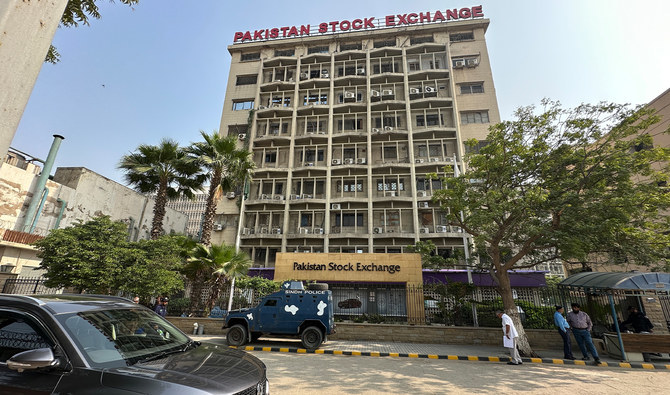
A car drives past the building of Pakistan Stock Exchange in Karachi, Pakistan on Novemeber 30, 2023. (AN photo/File)
Short Url
Updated 13 June 2024
Follow

Pakistan shares close at record high after budget dispels concern over capital gains tax hike

  • Benchmark share index closed up 4.9 percent at 76,338 points after presentation of budget, which looks to raise tax revenue of $47 billion
  • Budget aims to strengthen case for new IMF bailout deal, as Pakistan seeks estimated loan ranging from $6 billion to $8 billion

ISLAMABAD: Pakistan’s benchmark share index made its biggest single-day gain in nearly a year to close at a record high, a day after the government unveiled a budget that cheered investors by avoiding an anticipated increase in capital gains tax, despite an ambitious tax revenue target.

The benchmark share index closed up 4.9 percent at 76,338 points after the presentation of the budget, which looks to raise tax revenue of 13 trillion rupees ($47 billion) for the year starting July 1, up nearly 40 percent from the current year.

“The market was expecting an increase in capital gains tax and so investors had reduced exposure significantly,” said Adnan Sheikh, assistant vice president of Pak Kuwait Investment Co.

A record day was expected following the budget and Monday’s cut of 150 bps in the central bank’s policy rate, as “equities are the best option for the medium term,” said Sheikh.

Pakistan’s international sovereign bonds also rallied with longer-dated maturities seeing the largest gains. The 2036 bond added 1.4 cents — its biggest gain in more than two months — to be bid at just over 77 cents in the dollar, Tradeweb data showed. .

Following a post budget press conference on Thursday, Finance Minister Muhammad Aurangzeb told Reuters that Islamabad plans to raise up to $1 billion through international bonds in the 2025/26 fiscal year, adding that up to $300 million will be raised through Chinese markets.

Apart from the capital gains tax, analysts say the budget and other revenue measures were in line with expectations.

The budget aims to strengthen the case for a new bailout deal from the International Monetary Fund (IMF), as Pakistan seeks an estimated loan ranging from $6 billion to $8 billion, to avert default in an economy growing at the region’s slowest pace.

“We believe this budget will serve as prior action for a new IMF program,” Topline Securities said in a note.

Topline said that if parliament passes the budget in compliance with IMF measures, it expected a forward price to earnings ratio of 6.93 in three years time, for a historic high, from 3.4 now.

Defending the decision to boost tax revenue, Aurangzeb said the present tax-to-GDP ratio of a little under 10 percent was not sustainable.

Key objectives for the upcoming fiscal year include efforts to increase the ratio gradually to 13 percent in the next three years, Aurangzeb told a press conference after presenting the budget in parliament.


Islamabad offers skilled manpower to help Iraq in reconstruction, development efforts

Updated 10 sec ago
Follow

Islamabad offers skilled manpower to help Iraq in reconstruction, development efforts

  • The development comes during Pakistan President Asif Ali Zardari’s four-day visit to Iraq to strengthen bilateral cooperation
  • Zardari says current levels of bilateral trade do not reflect true potential of Pakistan-Iraq ties, highlights opportunities

ISLAMABAD: Pakistan has offered to provide skilled manpower to support Iraq’s reconstruction and development efforts, the Pakistani government said on Sunday, signaling Islamabad’s willingness to deepen cooperation with Baghdad in sectors including infrastructure, technical services and human resource development.

The development comes during Pakistan President Asif Ali Zardari’s four-day visit to Iraq to strengthen cooperation in trade, investment, religious tourism, energy and other sectors.

Zardari held a one-on-one meeting with his Iraqi counterpart, Dr. Abdul Latif Jamal Rashid, at Baghdad Palace, which was followed by delegation-level talks to review the state of bilateral relations.

“President Zardari reiterated Pakistan’s willingness to support Iraq’s reconstruction and development efforts through the provision of skilled and semi-skilled manpower under the existing Memorandum of Understanding on manpower transmission,” Pakistan’s Press Information Department (PID) said in a statement.

“He also highlighted Pakistan’s capacity in medical services, financial expertise and digital governance, and expressed readiness to share technical experience, including in secure data management, to support institutional capacity-building in Iraq.”

Iraq has been working to rebuild its economy and infrastructure after decades of conflict, including the 2003 US-led invasion and years of instability caused by sectarian violence and the fight against Daesh group. Although security conditions have improved in recent years, large parts of the country still face damaged roads, power plants, hospitals and housing, requiring large-scale reconstruction and public service delivery.

During Sunday’s meeting, Zardari noted that the current levels of bilateral trade do not reflect the true potential of Pakistan-Iraq economic, cultural and security relations, highlighting opportunities in agriculture, defense production, information technology, construction, pharmaceuticals and other sectors. He underscored the importance of business-to-business engagement and the establishment of direct banking channels to facilitate trade and commercial activity, according to the PID.

Zardari also requested improved facilitation for Pakistani pilgrims visiting Iraq and expressed hope for early finalization and implementation of a proposed Memorandum of Understanding on Zaireen (pilgrims) Management, aimed at ensuring orderly travel. He expressed his firm resolve to work with the Iraqi government to stop illegal entry and overstay of those Pakistanis who violate Iraqi law.

“Both Presidents expressed their resolve to fight extremism, terrorism and narco trade and enhance bilateral cooperation,” the PID said. “The two leaders reaffirmed their commitment to further deepening bilateral cooperation across political, economic and social domains.”

Pakistan and Iraq established diplomatic relations in 1947 and have traditionally maintained cordial ties, though commercial links remain modest. The volume of trade between both countries stood at $268 million in 2023.

Pakistan’s major exports to Iraq include machinery and mechanical appliances, pharmaceutical products, fish, cereals, essential oils and resinoids. Islamabad’s imports from Iraq include mineral fuels, mineral, organic chemicals, edible fruit and nuts.