VIENNA/PARIS: Iran is responding to last week’s UN nuclear watchdog board resolution against it by expanding its uranium-enrichment capacity at two underground sites, but the escalation is not as big as many had feared, diplomats said on Wednesday.
Iran bristles at such resolutions by the International Atomic Energy Agency’s 35-nation Board of Governors, and it reacted to the previous one 18 months earlier by enriching to up to 60 percent purity, close to weapons grade, at a second site and announcing a large expansion of its enrichment program.
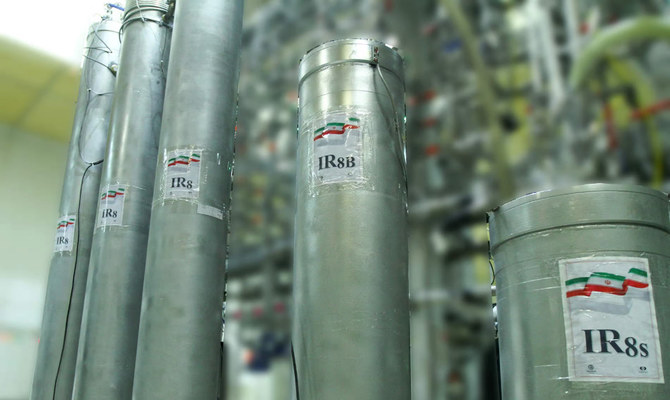
This time it plans to install more cascades, or clusters, of centrifuges, the machines that enrich uranium, at both its underground enrichment sites, five diplomats said. IAEA inspectors observing Iran’s progress plan to issue a report to member states on Thursday, three of the diplomats said.
“It’s not as much as I would expect,” one Vienna-based diplomat said, referring to the scale of Iran’s escalation.
“Why? I don’t know. Maybe they’re waiting for the new government,” they said, referring to the death in a helicopter crash last month of Iranian President Ebrahim Raisi and Foreign Minister Hossein Amirabdollahian, and the presidential election due to be held on June 28.
The IAEA Board passed a resolution a week ago calling on Iran to step up cooperation with the IAEA and reverse its recent barring of inspectors despite earlier US concerns Tehran would respond with atomic escalation. Only Russia and China opposed.
Diplomats did not go into specifics on the number or type of centrifuges being added or what level they would enrich to, though one diplomat said they would not be used to quickly expand Iran’s production of uranium enriched to up to 60 percent, close to the 90 percent of weapons grade.
The diplomats said they would wait to see what the IAEA said Iran had actually done but they were aware of Iran’s plans.
The move is “at the lower end of expectations and something we’re pretty sure they were going to do anyway,” one diplomat said, meaning it would have happened even without the resolution.
Iran did not fully follow through on its November 2022 announcement after the previous resolution. While it installed all the centrifuges it said it would at its underground enrichment plant at Natanz, 12 cascades of one advanced model, the IR-2m, are not yet in operation.
Iran is only enriching to up to 60 percent at an above-ground pilot plant at Natanz and its Fordow site, which is dug into a mountain. In November 2022 it started enriching to up to 60 percent at Fordow but it has yet to install all the additional cascades it said it would.

Iran expanding enrichment capacity after IAEA resolution, diplomats say
https://arab.news/8wzy5
Iran expanding enrichment capacity after IAEA resolution, diplomats say
- Iran is only enriching to up to 60 percent at an above-ground pilot plant at Natanz and its Fordow site, which is dug into a mountain
Lebanon PM publishes long-awaited banking law draft
- The law stipulates that each of the state, the central bank, commercial banks and depositors will share the losses accrued as a result of the financial crisis.
- Depositors with a limit of $100,000, over the course of four years
BEIRUT: Lebanese Prime Minister Nawaf Salam published on Friday a long-awaited banking draft bill, which distributes losses from the 2019 economic crisis between banks and the state.
The draft law is a key demand from the international community, which has conditioned economic aid to Lebanon on financial reforms.
In a televised speech, Salam said “this draft law constitutes a roadmap to getting out of the crisis” that still grips Lebanon.
The draft will be discussed by the Lebanese cabinet on Monday before being sent to parliament, where it could be blocked.
The law stipulates that each of the state, the central bank, commercial banks and depositors will share the losses accrued as a result of the financial crisis.
Depositors, who lost access to their funds after the crisis, will be able to retrieve their money, with a limit of $100,000, over the course of four years.
Salam said that 85 percent of depositors had less than $100,000 in their accounts.
The wealthiest depositors will see the remainder of their money compensated by asset-backed securities.
“I know that many of you are listening today with hearts full of anger, anger at a state that abandoned you,” Salam said.
“This bill may not be perfect... but it is a realistic and fair step toward restoring rights, halting the collapse.”
- ‘Banks are angry’ -
The International Monetary Fund, which closely monitored the drafting of the bill, had previously insisted on the need to “restore the viability of the banking sector consistent with international standards” and protect small depositors.
The Associations of Banks in Lebanon criticized the draft law on Monday, saying in a statement that it contains “serious shortcomings” and harms commercial banks.
“Banks are angry because the law opens the door to them sharing any part of the losses,” said Sami Zougheib, researcher at The Policy Initiative, a Beirut-based think tank.
He told AFP that banks would have preferred that the state bear full responsibility.
The text provides for the recapitalization of failing banks, while the government’s debt to the Central Bank will be converted into bonds.
Salam said that the bill aims to “revive the banking sector” which had collapsed, giving free rein to a parallel economy based on cash transactions, which facilitate money laundering and illicit trade.
According to government estimates, the losses resulting from the financial crisis amounted to about $70 billion, a figure that is expected to have increased over the six years that the crisis was left unaddressed.
Since assuming power, Salam and President Joseph Aoun have pledged to implement the necessary reforms and legislation.
In April, Lebanon’s parliament adopted a bank restructuring law, as the previous legislation was believed to have allowed a flight of capital at the outbreak of the 2019 crisis.
The new bill stipulates that politically exposed persons and major shareholders who transferred significant capital outside the country from 2019 onwards — while ordinary depositors were deprived of their savings — must return them within three months or face fines.
The draft law could still be blocked by parliament even if the cabinet approves it.
“Many lawmakers are directly exposed as large depositors or bank shareholders, politically allied with bank owners, and unwilling to pass a law that either angers banks or angers depositors,” Zougheib said.
Politicians and banking officials have repeatedly obstructed the reforms required by the international community for Lebanon to receive financial support.


