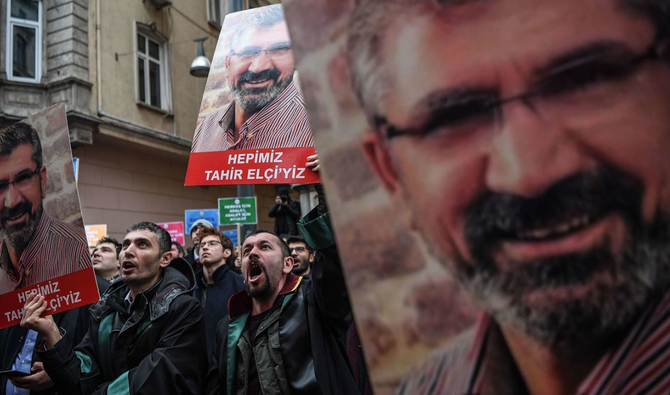
DIYARBAKIR, Turkiye: A Turkish court on Wednesday acquitted three police officers nine years after the killing of a prominent rights lawyer in the Kurdish majority city of Diyarbakir.
Tahir Elci, a prominent campaigner for Kurdish rights, was shot dead on a city street on November 28, 2015, during a gunfight between outlawed Kurdish militants and police.
Elci, who was head of the Diyarbakir bar association, was cut down as he appealed for calm in the aftermath of the killing of two police officers by the PKK in a nearby street.
The court ordered that three police officers, who appeared before the court by video link, be acquitted because of lack of evidence after a lengthy trial. They stood accused of “causing death by foreseeable negligence” and faced up to six years in prison.
Amnesty International blasted the verdict as a “huge blow” to Elci’s family and the wider human rights community in Türkiye.
“The failure of the authorities to hold those responsible for his killing to account is a thorn in the heart of his loved ones and a stain on the justice system in Turkiye,” Amnesty’s deputy regional director for Europe Dinushika Dissanayake said in a statement.
Lawyers for Elci’s family had denounced multiple failures in the investigation as well as the destruction of evidence and successive changes of prosecutor in charge of the case.
The long-awaited trial opened in 2020, five years after the killing, after rights advocates including Human Rights Watch had criticized “extreme delays” in the case.
Elci’s death came after the collapse of a ceasefire between the Turkish state and the Kurdistan Workers’ Party (PKK), which is blacklisted as a terrorist group by Ankara and its Western allies.
In 2019, investigators from the London-based research agency Forensic Architecture published an in-depth report into the shooting, suggesting that security forces could have killed him.


Court acquits Turkish police of killing human rights lawyer
https://arab.news/pj23m
Court acquits Turkish police of killing human rights lawyer

- Tahir Elci, a prominent campaigner for Kurdish rights, was shot dead on a city street on November 28, 2015, during a gunfight between outlawed Kurdish militants and police
- The court ordered that three police officers be acquitted because of lack of evidence after a lengthy trial


Iraq welcomes the appointment of Iran’s new supreme leader
- Armed faction Kataeb Hezbollah said it reflects a profound understanding “of the existential challenges confronting the nation”
BAGHDAD: Iraq’s Prime Minister Mohammed Shia Al-Sudani welcomed on Monday the appointment of Mojtaba Khamenei as Iran’s new supreme leader after his predecessor and father was killed in US and Israeli strikes.
“We express our confidence in the ability of the new leadership in the Islamic Republic of Iran to manage this critical stage,” and to further strengthen “the unity of the Iranian people” amid the current challenges, Sudani said in a statement.
He stressed that Iraq stands in solidarity with Iran and supports “all steps aimed at ending the conflict.”
Iran wields significant influence in Iraqi politics, and also backs armed groups whose power has grown both politically and financially.
Iraq has for decades been a proxy battleground between the US and Iran.
Pro-Tehran Iraqi groups were among the first to welcome the new supreme leader.
The powerful Badr organization said the new leadership represents a “blessed continuity of the path of the Islamic revolution.”
The Asaib Ahl Al-Haq faction said choosing Mojtaba Khamenei shows continuity and “reinforcement of the Islamic republic’s role as a central pillar in the axis of resistance.”
Armed faction Kataeb Hezbollah said it reflects a profound understanding “of the existential challenges confronting the nation.”
“The best successor to the best predecessor,” said Kataeb Hezbollah, which is part of the Islamic Resistance of Iraq — a pro-Iran alliance that has been claiming attacks on US bases since the start of the war in the Middle East.
Senior Iraqi politician and moderate cleric Ammar Al-Hakim wished the new supreme leader “success in following the path of his martyred father... in upholding the word of truth.”


