

Saudi Arabia inaugurates self-driving aerial taxi during Hajj

1 / 2
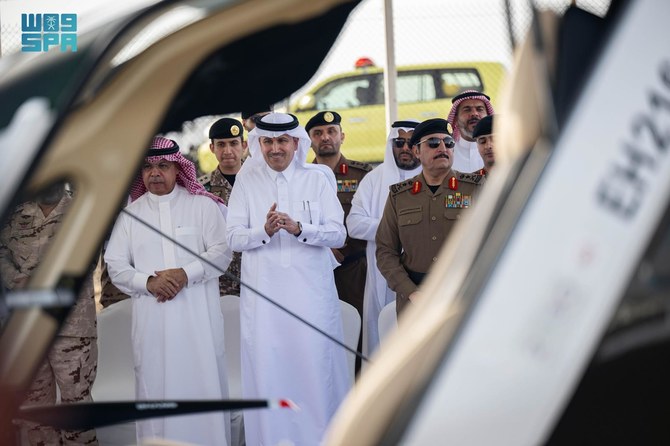
The flying taxi, launched in Saudi Arabia, is the world’s first to be licensed by a civil aviation authority. (SPA)
2 / 2
The flying taxi, launched in Saudi Arabia, is the world’s first to be licensed by a civil aviation authority. (SPA)
Short Url
Updated 12 June 2024
Follow

Saudi Arabia inaugurates self-driving aerial taxi during Hajj

  • The electric flying taxi will transport pilgrims across holy sites, facilitate the swift transfer of medical emergencies and supplies, as well as deliver goods

MAKKAH: Saudi Arabia has inaugurated a pioneering self-driving aerial taxi service for pilgrims during this year’s Hajj season.

The electric flying taxi will transport pilgrims across holy sites, facilitate the swift transfer of medical emergencies and supplies, as well as deliver goods, state news agency SPA reported.
Saleh bin Nasser Al-Jasser, Saudi Minister of Transport and Logistic Services, said the flying taxi is the world’s first to be licensed by a civil aviation authority.
On Wednesday, Al-Jasser witnessed the vertical takeoff of the autonomous vehicle during the launch event attended by Abdulaziz Al-Duailej, president of General Authority of Civil Aviation (GACA); Rumaih Al-Rumaih, Deputy Minister of Transport and Logistics Services, and several representatives of related entities.
The minister said the inauguration of the air taxi was part of the efforts to apply the latest future transport technologies and adopt innovative environment-friendly transport models that use artificial intelligence applications.
In line with the objectives of the National Transport and Logistics Strategy, the Kingdom aims to modernize the transport sector through the launch of air taxi technologies, electric cars and hydrogen trains.
Al-Jasser said the ministry is working to enhance smart mobility and develop legislation, laws, and systems that enable the employment of modern technologies.
It also seeks to provide experimental environments to facilitate the expansion of future transport technologies.
GACA’s Al-Duailej said the flying taxi was one of the most significant initiatives of the advanced air mobility roadmap, which aims to reduce passenger travel time within congested areas, especially during emergencies, facilitate the transportation of goods and medical supplies, and complete surveillance and inspection tasks in a speedy manner.
The aerial taxi is among 32 modern technologies applied to serve pilgrims during this year’s Hajj.


Foreign ministers chair Saudi-Omani coordination council meeting in Muscat

Updated 4 sec ago
Follow

Foreign ministers chair Saudi-Omani coordination council meeting in Muscat

MUSCAT: Saudi Foreign Minister Prince Faisal bin Farhan met with Oman’s Foreign MinisterSayyid Badr bin Hamad bin Hamoud Al-Busaidi on Monday.

They reviewed bilateral relations between their nations and ways to enhance and develop them across various fields. Additionally, they discussed regional and international developments.

The ministers co-chaired the third meeting of the Saudi-Omani Coordination Council in the Omani capital, Muscat, with the participation of the heads of the Council’s subsidiary committees and the two heads of the Council’s General Secretariat teams.

The meeting comes as an affirmation of the keenness of Saudi and Omani leaders to strengthen ties and advance them toward greater prosperity for both nations.

In his remarks during the meeting, Prince Faisal affirmed that gathering builds on the previous council meeting, held last year in AlUla, and on its positive and fruitful outcomes within the framework of the approved recommendations and initiatives. 

He stressed the importance of continuing the work of the council’s subsidiary committees to complete the necessary procedures to implement the remaining initiatives, and of the General Secretariat’s role in follow-up and in addressing any challenges that may hinder implementation.

He also underscored the importance of developing and enhancing trade relations, stimulating investment, and strengthening cooperation between the public and private sectors.

He also praised the ongoing work to establish and launch the Coordination Council’s electronic platform, which aims to connect all committee work and initiatives to facilitate follow-up on the Council’s progress. 

Al-Busaidi affirmed in his remarks the qualitative progress in relations between the two countries and the notable development witnessed across numerous sectors toward achieving economic integration and enhancing intra-trade and joint investments. 

The Omani foreign minister also highlighted deeper cooperation in the security and judicial fields, as well as the cultural and tourism sectors, noting the advanced and continuous political cooperation, consultation, and coordination on regional and international issues.