

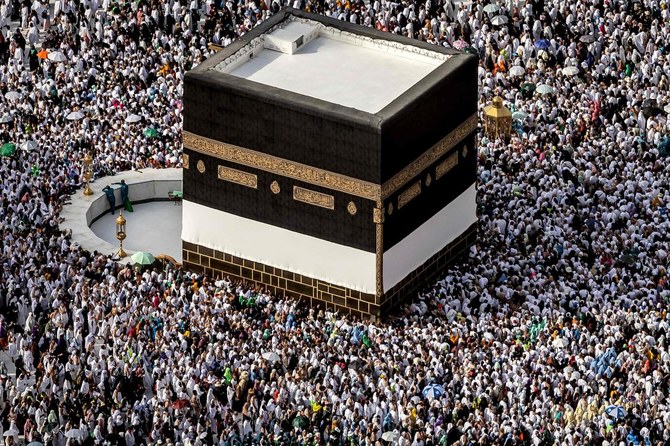

MAKKAH: Muslim pilgrims have been streaming into Saudi Arabia’s holy city of Makkah ahead of the start of the Hajj later this week, as the annual pilgrimage returns to its monumental scale.
Saudi officials say more than 1.5 million foreign pilgrims have arrived in the country by Tuesday, the vast majority by air, from across the world. More are expected, and hundreds of thousands of Saudis and others living in Saudi Arabia will also join them when the pilgrimage officially begins on Friday.
A breakdown of the arrival data revealed that 1,483,312 pilgrims arrived via air travel, while 59,273 pilgrims entered through land ports. Sea ports received a total of 4,710 pilgrims, state news agency SPA reported.
Saudi officials have said they expect the number of pilgrims this year to exceed 2023, when more than 1.8 million people performed Hajj, approaching pre-pandemic levels. In 2019, more than 2.4 million Muslims made the pilgrimage.
The pilgrims included 4,200 Palestinians from the occupied West Bank who arrived in Makkah earlier this month, according to the Palestinian Ministry of Awqaf and Religious Affairs. Palestinians in the Gaza Strip were not able to travel to Saudi Arabia for Hajj this year, because of the 8-month war between Israel and Hamas.
On Tuesday, pilgrims thronged the Grand Mosque in Makkah, performing a ritual circuit walking seven times around the Kaaba, the cube-shaped structure inside the mosque that is considered Islam’s holiest site. They wore ihrams, two unstitched sheets of white cloth that resemble a shroud.
Many were seen carrying umbrellas against the sun, in temperatures reaching 42 degrees Celsius (107 Fahrenheit) during the day on Tuesday.
“I was relieved when I arrived at the Al-Masjid Al-Haram and saw the Kaaba,” said Rabeia Al-Raghi, a Moroccan woman who came to Makkah for Hajj along with her husband and their daughter. “I am very happy.”
At night, the vast marble court around the Kaaba was packed with the faithful, walking nearly shoulder to shoulder and often jostling with barricades set up by security forces to direct the giant flows of people in and around the Grand Mosque.
Pilgrims do the circumambulation, known as “Tawaf” in Arabic, upon arriving in Makkah. The large crowds circling the Kaaba will last into the Hajj’s first day.
On Friday, pilgrims will move to the Mountain of Arafat for a daylong vigil, then to Muzdalifah, a rocky plain area a few miles away. In Muzdalifah, pilgrims collect pebbles to be used in the symbolic stoning of pillars representing the devil back in Mina.
One of the world’s largest religious gatherings, the Hajj is one of the Five Pillars of Islam. All Muslims are required to undertake it at least once in their lives if they are physically and financially able to do so.
Those in the Hajj view the pilgrimage as an opportunity to strengthen their faith, wipe out old sins and start new.


