Dozens arrested in new pro-Palestinian protests at University of California, Los Angeles

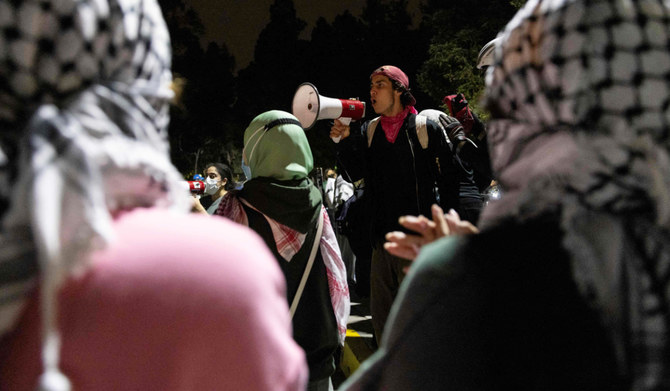
Pro-Palestinian protesters demonstrate facing law enforcement outside Dodd Hall in the University of California Los Angeles (UCLA) in Los Angeles, June 10, 2024. (AFP)
Short Url
Updated 12 June 2024
Follow

Dozens arrested in new pro-Palestinian protests at University of California, Los Angeles

  • Protest camps have sprung up on university campuses across the US and in Europe as students demand their universities stop doing business with Israel or companies that support its war efforts

LOS ANGELES: Police thwarted attempts by pro-Palestinian demonstrators to set up a new encampment at the University of California, Los Angeles, where officers cleared a previous camp this spring after it was attacked by counterprotesters.
Officers arrested 27 people late Monday during the demonstration, Rick Braziel, UCLA associate vice chancellor for campus safety, said in a statement.
The individuals were cited for willful disruption of university operations and one for interfering with an officer, according to UCLA police. They were issued 14-day orders to stay away from UCLA and then released.
Any student arrested will face disciplinary action, which could include being banned from campus and not being able to take finals or participate in commencement ceremonies, Braziel said.
The demonstrators repeatedly tried to set up tents, canopies and barriers as they moved to various locations, disrupting nearby final exams. The group also damaged a fountain, spray-painted brick walkways, tampered with fire safety equipment, damaged patio furniture, stripped wire from electrical fixtures and vandalized vehicles, police said.
During the demonstration, there were also attacks that led to six UCLA police being injured, as well as a security guard left bleeding from the head after being struck, according to Braziel.
“Simply put, these acts of non-peaceful protest are abhorrent and cannot continue,” Braziel said in the statement.
Protest camps have sprung up on university campuses across the US and in Europe as students demand their universities stop doing business with Israel or companies that support its war efforts. Organizers have sought to amplify calls to end Israel’s war against Hamas in Gaza, which they describe as a genocide against the Palestinians.
UCLA has been repeatedly roiled by protests and the university administration’s handling of the situation.
At one point, a pro-Palestinian encampment was attacked by counterprotesters, with no immediate response from police, and dozens were then arrested as the camp was cleared. The episode led to reassignment of the campus police chief and creation of a new campus safety office. A subsequent attempt to set up a new camp was also blocked.
Monday’s protest comes just days before University of California regents are scheduled to meet at UCLA and this coming weekend’s commencement ceremonies.


Trump tariff rollback offers relief for Indian farmers

Updated 16 November 2025
Follow

Trump tariff rollback offers relief for Indian farmers

  • Indian exporters had been hit harder than EU rivals among others
  • Coffee, spices and tea among exempt products

NEW DELHI: Indian agricultural exporters are among the winners from US President Donald Trump’s exemption of dozens of food items from his reciprocal tariffs regime, which some analysts say could help to revive lost demand.
Trump on Friday removed tariffs he had imposed on more than 200 food products, including beef, as consumer concerns mount over rising US grocery prices.
Unlike EU and Vietnamese suppliers facing 15–20 percent duties, Indian exporters of tea, coffee, spices and cashew nuts were hit harder after Trump doubled tariffs to as high as 50 percent on imports of certain Indian goods, including a punitive 25 percent levy from the end of August on India’s Russian oil purchases.
Ajay Sahai, director general of the Federation of Indian Export Organizations (FIEO), says that between $2.5 billion and $3 billion of exports will benefit from the tariff exemptions.
Positive signal for wider trade talks
“This order opens space for premium, speciality and value-added products,” he said. “Exporters who shift toward higher-value segments will be better protected from price pressures and can tap rising consumer demand.”
Officials involved in trade and farm export policy said the exemptions are also a positive signal for ongoing US–India trade talks and could ease export pressure triggered by this year’s tariff increases.
Exports of Indian goods to the US fell nearly 12 percent year on year in September to $5.43 billion after tariffs were raised. Indian farm exports, estimated to account for $5.7 billion of the country’s $87 billion exports to the US in 2024, were among those hit.
“The move benefits Indian farmers and exporters of tea, coffee, cashew and fruits and vegetables,” a senior official involved in Indian farm export policy said on condition of anonymity.
Ajay Srivastava, founder of the Global Trade Research Initiative lobby group, said India’s US-bound farm exports — focused on a few high-value spices and niche products — would register limited gains given its weak presence in key exempt items such as tomatoes, citrus fruits, melons, bananas and fruit juices.
“The tariff shift would marginally strengthen India’s position in spices and niche horticulture and help revive some lost US demand after the tariff hikes,” Srivastava added.
Latin American, African and ASEAN suppliers are likely to make larger gains, he said, adding that it was not immediately clear whether Indian exports will be exempt from 25 percent reciprocal tariffs or full 50 percent tariffs.
Exporters, however, fear that other factors will keep potential gains in check, pointing to high freight costs, strong competition from Vietnam and Indonesia and tougher US quality requirements.
“Tariff relief is important, but market recovery also depends on logistics and our ability to match prices,” one exporter said.