

Anger over weapons sales as UK government figures show more than 100 licenses issued for exports to Israel since Oct. 7 Hamas attack

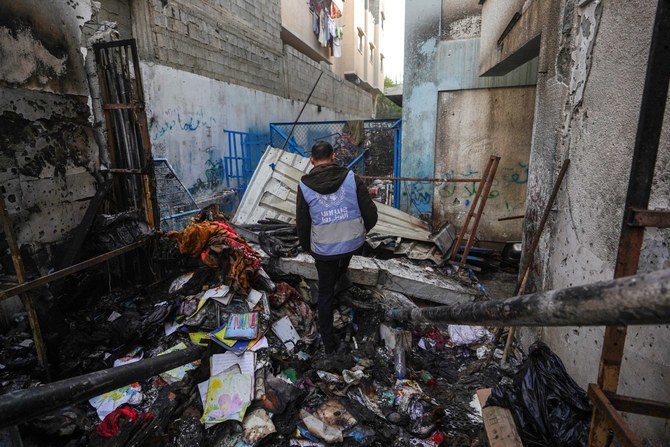
A UNRWA personnel checks a burnt area at a school housing displaced Palestinians that was hit during the ongoing conflict between Israel and the militant group Hamas, in Nuseirat in the central Gaza Strip on May 17, 2024. (AFP)
Short Url
Updated 11 June 2024
Follow

Anger over weapons sales as UK government figures show more than 100 licenses issued for exports to Israel since Oct. 7 Hamas attack

  • Data release follows calls by campaigners for greater transparency on arms exports
  • Critics accuse UK of ignoring its international legal obligations over military shipments

LONDON: The UK has approved more than 100 export licenses for the sale of weapons, military equipment, and other items to Israel since the Oct. 7 attack by Hamas militants that killed around 1,200 people, government figures show.

Just over a third of the licenses, 37 of the 108 issued, were described as military, while 63 were declared as non-military, but included telecommunication and software items for use by the Israel Defense Forces.

A further eight open licenses were granted, statistics released by the Department for Business and Trade show.

The data has been released after calls by politicians and campaigners for the British government to be transparent about arms exports to Israel amid what the department called “exceptional parliamentary interest.”

Almost 37,000 Palestinians have been killed and at least 83,530 injured in the Israeli military offensive in Gaza launched in retaliation for the Oct. 7 attack.

Emily Apple, of the Campaign against Arms Trade, slammed the figures for only showing the number of licenses, not the value or the detailed categories of what was exported — data that is normally contained in quarterly arms export licenses statistics, the Guardian reported.

“This data release was supposed to address the political and public interest in arms sales to Israel; the figures released do not do this as they do not give any details of the equipment exported or its value,” she said.

“If and when we have a new Labour government (after a July 4 general election), it is vital that they not only impose an arms embargo but also address the lack of transparency in our export licensing system,” she added.

Approved UK arms exports licenses to Israel were valued at £42 million ($53.4 million) in 2022, with the 2023 figure due to be released later this week.

Campaigners have pressed the British government to end its arms sales to Israel, claiming the exports break international humanitarian law.

Yasmine Ahmed, director at UK Human Rights Watch, said: “The right way to approach Israel’s commitment to comply with international humanitarian law is not by reference to Israel’s subjective interpretation of its compliance with IHL, but by an objective interpretation of what IHL actually requires.”

Her concerns were echoed by Sacha Deshmukh, CEO of Amnesty International UK, who said: “We’re supporting this important case because of the UK’s refusal to abide by its international legal obligations and suspend arms transfers to Israel.”

Earlier this month it was announced that British government ministers found no reason to end weapons exports to Israel after reviewing the latest three-month period of the Gaza war up to April.

“As required by the UK’s robust arms export control regime, the foreign secretary has now reviewed the most recent advice about the situation in Gaza and Israel’s conduct of their military campaign,” a statement from the UK Foreign Office said.

“The business secretary has therefore decided our position on export licenses remains unchanged. This is consistent with the advice ministers have received. As ever, we will keep the position under review.

“The UK operates a robust and thorough assessment of arms export license applications against the Strategic Export Licensing Criteria. These criteria include that we will not grant an export license if there is a clear risk that the items might be used to commit or facilitate a serious violation of international humanitarian law.”


‘A den of bandits’: Rwanda closes thousands of evangelical churches

Updated 22 December 2025
Follow

‘A den of bandits’: Rwanda closes thousands of evangelical churches

  • A 2018 law introduced new rules on health, safety, and financial disclosures, and requires all preachers to have theological training
  • Observers say the real reason for the closures comes down to control, noting that even those who complied with the law had been shut down 
  • President Kagame has described the church as a relic of the colonial period, a chapter of its history with which the country is still grappling


KIGALI: Grace Room Ministries once filled giant stadiums in Rwanda three times a week before the evangelical organization was shut down in May.
It is one of the 10,000 churches reportedly closed by the government for failing to comply with a 2018 law designed to regulate places of worship.
The law introduced new rules on health, safety, and financial disclosures, and requires all preachers to have theological training.
President Paul Kagame has been vocal in his criticisms of the evangelical churches that have sprouted across the small country in Africa’s Great Lakes region.
“If it were up to me I wouldn’t even reopen a single church,” Kagame told a news briefing last month.
“In all the development challenges we are dealing with, the wars... our country’s survival — what is the role of these churches? Are they also providing jobs? Many are just thieving... some churches are just a den of bandits,” he said.
The vast majority of Rwandans are Christian according to a 2024 census, with many now traveling long and costly distances to find places to pray.
Observers say the real reason for the closures comes down to control.
Kagame’s government is saying “there’s no rival in terms of influence,” Louis Gitinywa, a lawyer and political analyst based in Kigali, told AFP.
The ruling party “bristles when an organization or individual gains influence,” he said, a view also expressed to AFP by an anonymous government official.

‘Deceived’ 

The 2018 law requires churches to submit annual action plans stating how they align with “national values.” All donations must be channelled through registered accounts.
Pastor Sam Rugira, whose two church branches were shut down last year for failing to meet fire safety regulations, said the rules mostly affected new evangelical churches that have “mushroomed” in recent years.
But Kagame has described the church as a relic of the colonial period, a chapter of its history with which the country is still grappling.
“You have been deceived by the colonizers and you let yourself be deceived,” he said in November.
The closure of Grace Room Ministries came as a shock to many across the country.
Pastor Julienne Kabanda, had been drawing massive crowds to the shiny new BK Arena in Kigali when the church’s license was revoked.
The government had cited unauthorized evangelical activities and a failure to submit “annual activity and financial reports.”
AFP was unable to reach Kabanda for comment.

‘Open disdain, disgust’ 

A church leader in Kigali, speaking to AFP on condition of anonymity, said the president’s “open disdain and disgust” for churches “spells tough times ahead.”
“It is unfair that even those that fulfilled all requirements are still closed,” he added.
But some say the clampdown on places of worship is linked to the 1994 Rwandan genocide in which around 800,000 people, mostly ethnic Tutsis, were slaughtered.
Ismael Buchanan a political science lecturer at the National University of Rwanda, told AFP the church could sometimes act as “a conduit of recruitment” for the Democratic Forces for the Liberation of Rwanda (FDLR), the Hutu militia formed in exile in DR Congo by those who committed the genocide.
“I agree religion and faith have played a key role in healing Rwandans from the emotional and psychological wounds after the genocide, but it also makes no sense to have a church every two kilometers instead of hospitals and schools,” he said.
Pastor Rugira meanwhile suggested the government is “regulating what it doesn’t understand.”
It should instead work with churches to weed out “bad apples” and help them meet requirements, especially when it comes to the donations they rely on to survive, he said.