

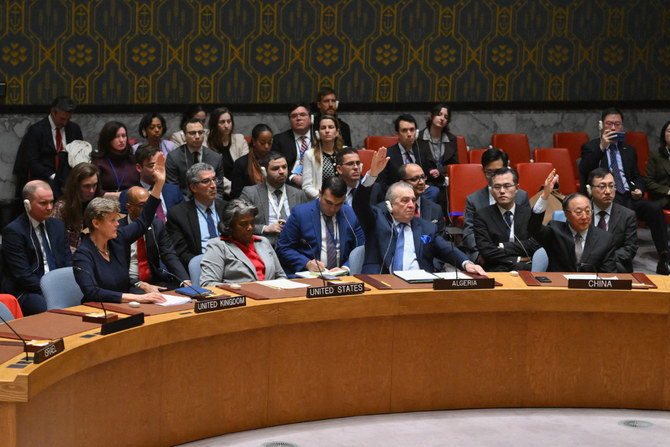
UN Security Council adopts Gaza resolution calling for immediate ceasefire and release of hostages

In this photo taken on March 25, 2024, US Ambassador Linda Thomas-Greenfield (2nd R) abstains during a resolution vote calling for an immediate ceasefire in Gaza. (Reuters)
Short Url
Updated 11 June 2024
Follow

UN Security Council adopts Gaza resolution calling for immediate ceasefire and release of hostages

  • Plan consists of three phases, culminating in permanent halt to hostilities and start of reconstruction
  • It was the 11th time council had voted on draft resolution relating to the war in Gaza, only three adopted

NEW YORK CITY: A US-led resolution endorsing a ceasefire plan aimed at ending the eight-month war in Gaza was adopted by the UN Security Council on Monday, with 14 of the 15 members voting in favor and Russia abstaining.

It was the 11th time the council had voted on a draft resolution relating to the war in Gaza. Only three have been adopted.

Resolution 2735, a copy of which was obtained by Arab News, welcomes a three-phase ceasefire proposal announced by US President Joe Biden on May 31, which Washington said Israeli authorities have accepted, and calls on Hamas to accept it as well. It urges both sides “to fully implement its terms without delay and without condition.”

After it was adopted, the US ambassador to the UN, Linda Thomas-Greenfield, said the council has sent “a clear message to Hamas: accept the ceasefire deal on the table.” If it does so, “the fighting would stop today,” she added.

Hamas can now see the international community is united behind a deal that will save lives, help Gazans “to rebuild and heal” and reunite Israeli hostages with their families, she said.

The deal will also lead to “a more secure Israel and unlock the possibility of more progress, including calm along Israel’s northern border with Lebanon,” Thomas-Greenfield continued.

“We cannot forget the Israelis displaced from their homes in northern Israel, under threat from Hezbollah. These attacks from terrorist groups backed by Iran must stop. They have to stop.”

She said Palestinians have endured “sheer hell in this war started by Hamas. There’s an opportunity to chart a different course; Hamas must take it.”

Phase one of the plan, as outlined by the resolution, requires “an immediate, full and complete ceasefire, with the release of hostages, including women, the elderly and the wounded, the return of the remains of some hostages who have been killed, (and) the exchange of Palestinian prisoners.”

It also calls for the “withdrawal of Israeli forces from the populated areas in Gaza, the return of Palestinian civilians to their homes and neighborhoods in all areas of Gaza, including in the north, as well as the safe and effective distribution of humanitarian assistance at scale throughout the Gaza Strip to all Palestinian civilians who need it, including housing units delivered by the international community.”

Phase two would include “a permanent end to hostilities, in exchange for the release of all other hostages still in Gaza, and a full withdrawal of Israeli forces from Gaza.” Phase 3 would begin “a major, multi-year reconstruction plan for Gaza and the return of the remains of any deceased hostages still in Gaza to their families.”

The proposal states that should negotiations between the two sides during phase one take longer than six weeks, the ceasefire will be maintained as long as the talks continue, and it “welcomes the readiness of the United States, Egypt and Qatar to work to ensure negotiations keep going until all the agreements are reached and phase two is able to begin.”

It rejects any potential attempts to impose “demographic or territorial change in the Gaza Strip, including any actions that reduce the territory of Gaza,” reiterates the commitment to a two state solution, and stresses the importance of “unifying the Gaza Strip with the West Bank under the Palestinian Authority.”

Slovenia’s deputy permanent representative to the UN, Ondina Blokar Drobic, told council members after the vote: “We have been saying this for months now: The suffering in Gaza must end.

“We have been constantly calling for the immediate release of hostages. However, military operations for the release of hostages, leaving hundreds of civilians killed and injured, like the one in the Nuseirat refugee camp on Saturday, cannot be the new normal. The principles of international humanitarian law and human rights law apply to hostage-rescue operations as well.”

Listing the many atrocities and horrors witnessed during the war, Drobic added: “The denial of aid to civilians, including women, children, persons with disabilities and older persons; humanitarian and UN personnel killed; UN premises targeted; hospitals besieged; children’s limbs amputated without anesthesia; women giving birth without appropriate assistance; mass graves; civilian areas in Gaza and in Israel targeted, attacked and destroyed — none of this should be taking place.

“Photos of children, some of them born during this war, dying because of malnutrition” will go down in history among the defining images of a conflict “this council should have prevented.”

She added: “It is for this reason we once again call for an immediate ceasefire. This is the first step toward achieving a comprehensive solution.”


How talks in Riyadh led to the end of harsh US sanctions on Syria

Updated 5 sec ago
Follow

How talks in Riyadh led to the end of harsh US sanctions on Syria

  • Congress’ repeal of the Caesar Act caps a Saudi-led diplomatic push to reintegrate a war-weary nation into the global economy
  • The end of tough US sanctions opens the door to foreign investment as Damascus reenters the world stage, analysts say

RIYADH: What began as a Saudi-led push to reengage Syria after the fall of Bashar Assad reached a pivotal moment on Dec. 17 when the US Congress voted to permanently repeal the Caesar Syria Civilian Protection Act of 2019.

The long-awaited step has removed a major obstacle to foreign investment and economic recovery in Syria, analysts say, further easing the nation’s global reintegration after years of international isolation.

“Saudi Arabia believed that bringing Syria back into the Arab fold was the right path forward,” Ghassan Ibrahim, a Syria expert and head of the London-based Global Arab Network, told Arab News.

“To achieve this, it required a strong and clear decision to support Syria. One of the main challenges was lifting sanctions and reconnecting Syria with the US, and Saudi Arabia played a major role in accomplishing that.”

Hani Nasira, a regional political analyst, said the decision stemmed from a meeting in Riyadh in May between Saudi Crown Prince Mohammed bin Salman, US President Donald Trump, and Syria’s interim President Ahmad Al-Sharaa.

“Following this decision, Syria will regain its vitality, and the train of development will return to the country,” Nasira told Arab News.

He said Saudi Arabia has emerged as “the foremost driving force and the most important incubator” of Syria’s return to the international community — a role underscored by Washington’s decision to end its strictest sanction.

Trump signaled that intent at the start of his three-day visit to Saudi Arabia on May 13. “After discussing the situation in Syria with the (Saudi) crown prince, I will be ordering the cessation of sanctions against Syria in order to give them a chance at greatness,” he said.

The following day in Riyadh, Trump met Al-Sharaa — who had led the rebel offensive that toppled Assad on Dec. 8, 2024 — marking the first high-level US-Syria meeting in a quarter of a century.

The meeting represented a dramatic turn for a country still adjusting to life after more than five decades of Assad family rule, and for an interim president who until recently had a $10 million bounty on his head.

“The meeting in Riyadh between the three leaders was carefully arranged and reflected a shared desire and need for cooperation between Syria and Saudi Arabia,” Ibrahim said.

“This cooperation laid the groundwork for a new type of coalition — one aimed at bringing greater stability and prosperity to the region.

“The Saudi, American and Syrian leaderships came together around a common vision; that stability is the pathway to prosperity. This vision aligns with Saudi Arabia’s Vision 2030, and all sides shared similar perspectives and objectives.”

Diplomatic momentum quickly followed. On May 23, US Secretary of State Marco Rubio signed a 180-day waiver of the Caesar Act’s secondary sanctions to facilitate humanitarian aid and early recovery efforts.

Nearly a month later, on June 30, Trump issued an executive order terminating the broader US sanctions program on Syria, effective July 1, and instructed the State Department to review whether additional Caesar-mandated sanctions should be suspended.

In November, following Al-Sharaa’s historic visit to the White House — the first Syrian leader to do so — the Caesar Act suspension was temporarily extended for another 180 days before Congress ultimately moved to repeal it.

“When Assad was in power, Syria’s only allies were Iran and Russia,” Ibrahim said. “After his removal, Syria was left with just one uncertain partner: Russia. That made reconnecting with the world essential.

“President Al-Sharaa chose Saudi Arabia as the first gateway to reestablish Syria’s ties with the international community. Saudi Arabia did not hesitate; it supported the new Syria and its new leadership.

“The relationship between the two countries had always existed, but it needed this push to be fully restored.”

First imposed in 2019 during Trump’s first term, the Caesar Act was a cornerstone of US pressure on the former Syrian regime.

Designed to deter foreign entities from doing business with Damascus, the law reportedly exacted a heavy toll on ordinary Syrians already suffering through a civil war that began in 2011.

Although the act formally expired in December last year under its five-year sunset clause, Congress renewed it through the 2025 National Defense Authorization Act, extending its reach into 2029 before reversing course months later.

Assad fled to Russia on Dec. 8, 2024, after Al-Sharaa’s Hayat Tahrir Al-Sham seized Damascus. In the months that followed, and amid appeals from Saudi Arabia and other regional powers, the Trump administration reassessed its Syria policy.

Beyond the symbolic importance of repealing the Caesar Act, Nasira said it will facilitate the release of Syrian assets held abroad, estimated at about $400 million, providing critical funding for economic reforms.

The World Bank estimates that reconstruction will cost between $140 billion and $345 billion, with a “best estimate” of $216 billion — nearly 10 times Syria’s 2024 gross domestic product of $21.4 billion.

In July, Damascus hosted its first Syrian-Saudi Investment Forum, producing more than 40 preliminary agreements worth about $6 billion across sectors including infrastructure, telecoms, tourism and health care.

That same month, Syria signed an $800 million agreement with Dubai Ports World to upgrade port infrastructure.

In August, it reached additional energy deals with Saudi Arabia, while a separate $7 billion energy project involving Turkish, Qatari and US firms promises to boost electricity supply.

Even so, sanctions relief alone, while “necessary,” is “far from sufficient,” said Vittorio Maresca di Serracapriola, lead sanctions expert at Karam Shaar Advisory

“For international capital to enter Syria at scale, deeper conditions must be met; meaningful banking sector reform, upgraded anti-money laundering and combating the financing of terrorism standards, and above all, political and security stability,” he said. 

Nevertheless, Ibrahim believes the repeal of the Caesar Act will allow Syria to “move to the next phase; reconstructing the country and ensuring there is no vacuum of authority or power.”

“It gives Syria a real opportunity,” he said. “The next step is strengthening the new leadership, deepening cooperation, attracting investment and restoring Syria as a normal member of the international community.”

Al-Sharaa echoed that message in his first post on X following the repeal, congratulating Syrians and thanking those who helped lift the sanctions.

“Through the will of the Syrians and the support of brothers and friends, a page of suffering has been turned, and a new phase of reconstruction has begun,” he said.

“Hand in hand, we move forward toward a future worthy of our people and our homeland.”