WASHINGTON: Badly needed aid has been delivered into Gaza from a newly repaired American-built pier, a US official said Saturday, following problems that had plagued the effort to bring supplies to Palestinians by sea.
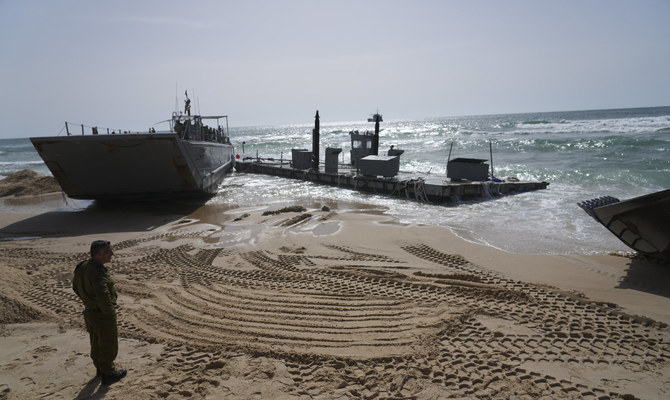
The pier constructed by the American military was only operational for about a week before it was blown apart in high winds and heavy seas on May 25. The damaged section was reconnected to the beach in Gaza on Friday after undergoing repairs at an Israeli port.
Crews delivered about 1.1 million pounds (492 metric tons) of humanitarian aid to Gaza via the pier on Saturday, the US official said. They spoke on condition of anonymity ahead of an official announcement of the delivery.
It came the same day that Israel mounted a heavy air and ground assault that rescued four hostages, who had been taken by Hamas during the Oct. 7 assault that launched the war in Gaza. At least 210 Palestinians, including children, were killed, a Gaza health official said.
It brings back online one way to get desperately needed food and other emergency supplies to Palestinians trapped by the eight-month-old Israel-Hamas war. Israeli restrictions on land crossings, and fighting, have greatly limited the flow of food and other vital supplies into the territory.
The damage to the pier was the latest stumbling block for the project and the persistent struggle to get food to starving Palestinians. Three US service members were injured, one critically, and four vessels were beached due to heavy seas.
Early efforts to get aid from the pier into the Gaza Strip were disrupted as crowds overran a convoy of trucks that aid agencies were using to transport the food, stripping the cargo from many of them before they could reach a UN warehouse. Officials responded by altering the travel routes, and aid began reaching those in need.
Vice Adm. Brad Cooper, deputy commander of US Central Command, told reporters on Friday that the lessons learned from that initial week of operations made him confident greater amounts of aid could be delivered now.
He said the goal was to get to 1 million pounds (500 tons or 450 metric tons) of food and other supplies moving through the pier into Gaza every two days. Before the causeway broke apart in the storm, more than 1,100 tons (1,000 metric tons) of aid were delivered, Pentagon officials said.
The US Agency for International Development is working with the UN World Food Program and their humanitarian partners working in Gaza to distribute food, high-nutrition emergency treatment for starving children, and other aid via the sea route.
Relief agencies have pressed Israel to reopen land routes that could bring in all the needed aid. Israel says it has allowed hundreds of trucks to enter through a southern checkpoint and pointed the finger at the UN for not distributing aid. The UN says it is often unable to retrieve the aid because of the security situation.
UN agencies have warned that over 1 million Palestinians in Gaza could experience the highest level of starvation by the middle of next month if hostilities continue.
President Joe Biden’s administration has said from the start that the pier wasn’t meant to be a total solution and that any amount of aid helps.
Biden, a Democrat, announced his plan for the US military to build a pier during his State of the Union address in early March, and the military said it would take about 60 days to get it installed and operational. It took a bit longer than planned, with the first trucks carrying aid for the Gaza Strip rolling down the pier on May 17.
The initial cost was estimated at $320 million, but the Pentagon said this past week that the price had dropped to $230 million, due to contributions from Britain and because the cost of contracting trucks and other equipment was less than expected.


![]()

Aid delivery to Gaza resumes through rebuilt pier
Short Url
https://arab.news/rw2bf
Aid delivery to Gaza resumes through rebuilt pier
- Israeli restrictions on land crossings, and fighting, have greatly limited the flow of food and other vital supplies into the territory


Latest updates



Recommended


© 2026 SAUDI RESEARCH & PUBLISHING COMPANY, All Rights Reserved And subject to Terms of Use Agreement.