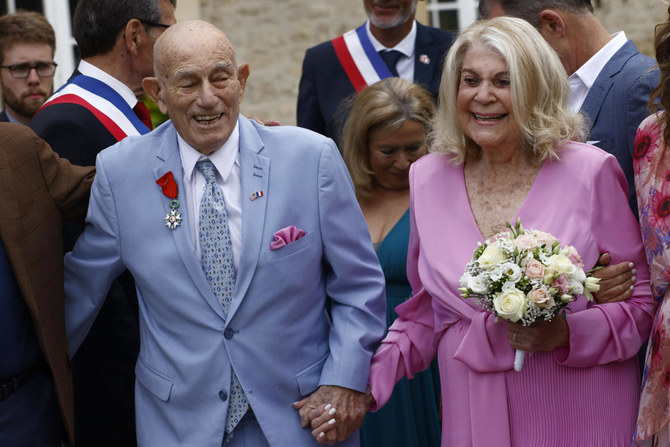
CARENTAN-LES-MARAIS, France: Together, the collective age of the bride and groom was nearly 200. But World War II veteran Harold Terens and his sweetheart Jeanne Swerlin proved that love is eternal as they tied the knot Saturday inland of the D-Day beaches in Normandy, France.
Their respective ages — he’s 100, she’s a youngster of just 96 — made their nuptials an almost double-century celebration.
Terens called it ″the best day of my life.″
On her way into the nuptials, the bubbly bride-to-be said, “It’s not just for young people, love, you know? We get butterflies. And we get a little action, also.″
The location was the elegant stone-worked town hall of Carentan, a key initial D-Day objective that saw ferocious fighting after the June 6, 1944, Allied landings that helped rid Europe of Adolf Hitler’s tyranny.
Like other towns and villages across the Normandy coast where nearly 160,000 Allied troops came ashore under fire on five code-named beaches, it’s an effervescent hub of remembrance and celebration on the 80th anniversary for the deeds and sacrifices of young men and women that day, festooned with flags and bunting and with veterans feted like rockstars.
As the swing of Glenn Miller and other period tunes rang out on the streets, well-wishers were already lined up a good hour before the wedding, behind barriers outside the town hall.
After both declaring “oui” to vows read by a deputy mayor, the couple waved to the adoring crowds outside, flutes of champagne in hand.
The crowd yelled “la mariee!” — the bride! — to Jeanne, who wore a long flowing dress of vibrant pink. Harold looked dapper in a light blue suit.
And they’re expected to get a very special wedding-night party: They’ve been invited to the state dinner at the Elysee Palace on Saturday night with President Emmanuel Macron and US President Joe Biden, the mayor said.
The wedding was symbolic, not binding in law. Mayor Jean-Pierre Lhonneur’s office said he wasn’t empowered to wed foreigners who weren’t residents of Carentan, and that the couple, who are both American, hadn’t requested legally binding vows. However, they could always complete those formalities back in Florida if they wished.
Lhonneur likes to say that Normandy is practically a 51st state of the USA, given its reverence and gratitude for veterans and the sacrifices of the tens of thousands of Allied soldiers who never made it home from the Battle of Normandy.
Dressed in a 1940s dress that belonged to her mother, Louise, and a red beret, 73-year-old Jane Ollier was among the early-bird spectators who waited for a glimpse of the happy couple.
“It’s so touching to get married at that age,” she said. ‘’If it can bring them happiness in the last years of their lives, that’s fantastic.”

A World War II veteran, 100, just married his bride, 96, near Normandy’s D-Day beaches
https://arab.news/y9br5
A World War II veteran, 100, just married his bride, 96, near Normandy’s D-Day beaches
- Terens called it ″the best day of my life”
- On her way into the nuptials, the bubbly bride-to-be said, “It’s not just for young people, love, you know? We get butterflies. And we get a little action, also″
Ilia Malinin hints at ‘inevitable crash’ amid Olympic pressure and online hate in social media post
- He says Olympic pressure and online hate have weighed on him. He described negative thoughts and past trauma flooding in during his skate
- He later congratulated the surprise champion, Mikhail Shaidorov of Kazakhstan
MILAN: Ilia Malinin posted a video on social media Monday juxtaposing images of his many triumphs with a black-and-white image of the US figure skater with his head buried in his hands, and a caption hinting at an “inevitable crash” amid the pressure of the Olympics while teasing that a “version of the story” is coming on Saturday.
That is when Malinin is expected to skate in the traditional exhibition gala to wrap up the Olympic figure skating program.
Malinin, who helped the US clinch the team gold medal early in the Winter Games, was the heavy favorite to add another gold in the individual event. But he fell twice and struggled throughout his free skate on Friday, ending up in eighth.
He acknowledged afterward that the pressure of the Olympics had worn him down, saying: “I didn’t really know how to handle it.”
Malinin alluded again to the weight he felt while competing in Milan in the caption to his social media video.
“On the world’s biggest stage, those who appear the strongest may still be fighting invisible battles on the inside,” wrote the 21-year-old Malinin. “Even your happiest memories can end up tainted by the noise. Vile online hatred attacks the mind and fear lures it into the darkness, no matter how hard you try to stay sane through the endless insurmountable pressure. It all builds up as these moments flash before your eyes, resulting in an inevitable crash.”
Malinin, who is expected to chase a third consecutive world title next month in Prague, had been unbeaten in 14 events over more than two years. Yet while Malinin always seemed to exude a preternatural calm that belied his age, the son of Olympic skaters Tatiana Malinina and Roman Skorniakov had admitted early in the Winter Games that he was feeling the pressure.
The first time came after an uneven short program in the team event, when he finished behind Yuma Kagiyama of Japan — the eventual individual silver medalist. Malinin referenced the strain of the Olympics again after the Americans had won the team gold medal.
But he seemed to be the loose, confident Malinin that his fans had come to know after winning the individual short program. He even playfully faked that he was about to do a risky backflip on the carpeted runway during his free skate introduction.
The program got off to a good start with a quad lutz, but the problems began when he bailed out of his quad axel. He ended up falling twice later in the program, and the resulting score was his worst since the US International Classic in September 2022.
Malinin was magnanimous afterward, hugging and congratulating surprise gold medalist Mikhail Shaidorov of Kazakhstan. He then answered a barrage of questions from reporters with poise and maturity that few would have had in such a situation.
“The nerves just went, so overwhelming,” he said, “and especially going into that starting pose, I just felt like all the traumatic moments of my life really just started flooding my head. So many negative thoughts that flooded into there and I could not handle it.”
“All I know is that it wasn’t my best skate,” Malinin added later, “and it was definitely something I wasn’t expecting. And it’s done, so I can’t go back and change it, even though I would love to.”


