UN will declare that both Israel and Hamas are violating children’s rights in armed conflict

1 / 2
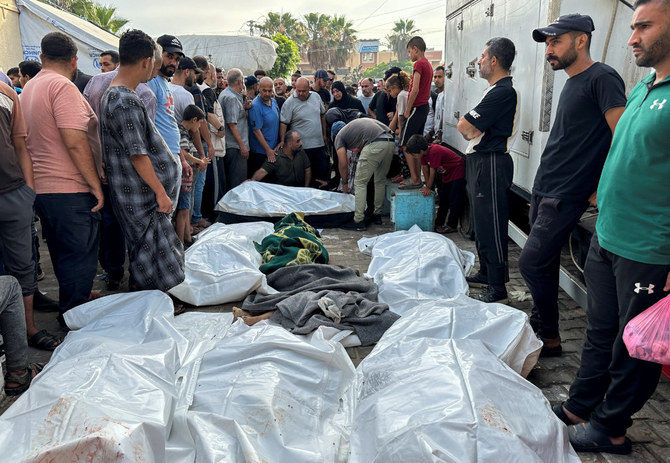
Mourners gather next to the bodies of Palestinians killed in Israeli strikes, during their funeral at Al-Aqsa hospital in Deir Al-Balah, in central Gaza Strip, on June 5, 2024. (REUTERS)
2 / 2
A man rides a scooter in Tel Aviv, past pictures of hostages kidnapped during the deadly October 7 attack by the Palestinian Islamist group Hamas. (REUTERS)
Short Url
Updated 08 June 2024
Follow

UN will declare that both Israel and Hamas are violating children’s rights in armed conflict

  • Israel’s inclusion to likely put more of a global spotlight on the country’s conduct of the war in Gaza
  • Adding Israel to the ‘list of shame’ an important step in the right direction: Palestinian UN envoy

UNITED NATIONS: The UN secretary-general will tell the Security Council next week that both Israel and Hamas are violating children’s rights and leaving them exposed to danger in their war to eliminate each other.

The secretary-general annually makes a global list of states and militias that are menacing children and threatening them. Parties on the list have ranged from the Kachin Independence Army in Myanmar to — last year — Russia during its war with Ukraine.
Now Israel is set to join them.
António Guterres sends the list to the Security Council and the council can then decide whether to take action. The United States is one of five veto-wielding permanent council members and has been reluctant to act against Israel, its longtime ally.
Another permanent member is Russia and when the United Nations put Russian forces on its blacklist last year for killing boys and girls and attacking schools and hospitals in Ukraine, the council took no action.
The inclusion of Israel this month will likely just put more of a global spotlight on the country’s conduct of the war in Gaza and increase already high tensions in its relationship with the global body.
The preface of last year’s UN report says it lists parties engaged in “the killing and maiming of children, rape and other forms of sexual violence perpetrated against children, attacks on schools, hospitals and protected persons.”
The head of Guterres’ office called Israel’s UN ambassador, Gilad Erdan, on Friday to inform him that Israel would be in the report when it is sent to the council next week, UN spokesman Stéphane Dujarric told reporters on Friday.
The militant Hamas and Palestinian Islamic Jihad groups also will be listed.
Israel reacted with outrage, sending news organizations a video of Erdan berating the head of Guterres’ office — who was supposedly on the other end of a phone call — and posting it on X.
“Hamas will continue even more to use schools and hospitals because this shameful decision of the secretary-general will only give Hamas hope to survive and extend the war and extend the suffering,” Erdan wrote in a statement. “Shame on him!”
The Palestinian UN ambassador said that adding Israel to the “‘list of shame,’ will not bring back tens of thousands of our children who were killed by Israel over decades.”
“But it is an important step in the right direction,” Riyad Mansour wrote in a statement.
Israeli Prime Minister Benjamin Netanyahu said “the UN put itself on the black list of history today” as the move heightened the long-running feud between Israel and the UN and even the routine mechanics of Israel’s dealings with the world body are now fraught with tensions.
The normally equanimous secretary-general’s spokesman broke from the good-natured tone of his noon briefing when asked to discuss the latest development.
“The call was a courtesy afforded to countries that are newly listed on the annex of the report,” Dujarric said. “The partial release of that recording on Twitter is shocking and unacceptable and frankly, something I’ve never seen in my 24 years serving this organization.”
Condemnation of the secretary-general’s decision appeared to bring together Israel’s increasingly fractious leadership — from the right-wing Netanyahu and Erdan to the popular centrist member of the War Cabinet, Benny Gantz.
Gantz cited Israel’s first prime minister, David Ben-Gurion, as saying “it matter not what say the goyim (non-Jews), what is important is what do the Jews.”
For month Israel has faced heavy international criticism over civilian casualties in Gaza and questions about whether it has done enough to prevent them in the eight-month-old war. Two recent airstrikes in Gaza killed dozens of civilians.
UN agencies warned Wednesday that over 1 million Palestinians in Gaza could experience the highest level of starvation by the middle of next month if hostilities continue.
The World Food Program and the Food and Agriculture Organization said in a joint report that hunger is worsening because of heavy restrictions on humanitarian access and the collapse of the local food system in the eight-month Israel-Hamas war.
The proportion of Palestinian women and children being killed in the Israel-Hamas war appears to have declined sharply, an Associated Press analysis of Gaza Health Ministry data has found, a trend that both coincides with Israel’s changing battlefield tactics and contradicts the ministry’s own public statements.
The trend is significant because the death rate for women and children is the best available proxy for civilian casualties in one of the 21st century’s most destructive conflicts. In October, when the war began, it was above 60 percent. For the month of April, it was below 40 percent.
Yet the shift went unnoticed for months by the UN and much of the media, and the Hamas-linked Health Ministry has made no effort to set the record straight.


US raid allegedly killed Syrian undercover agent instead of Daesh group official

Updated 05 December 2025
Follow

US raid allegedly killed Syrian undercover agent instead of Daesh group official

  • Neither US nor Syrian government officials have commented on the death, an indication that neither side wants the incident to derail improving ties
  • Weeks after the raid, interim President Ahmad Al-Sharaa visited Washington and announced Syria would join the global coalition against Daesh

DUMAYR, Syria: A raid by US forces and a local Syrian group aiming to capture an Daesh (IS) group official instead killed a man who had been working undercover gathering intelligence on the extremists, family members and Syrian officials have told The Associated Press.
The killing in October underscores the complex political and security landscape as the United States begins working with interim Syrian President Ahmad Al-Sharaa in the fight against remnants of IS.
According to relatives, Khaled Al-Masoud had been spying on IS for years on behalf of the insurgents led by Al-Sharaa and then for Al-Sharaa’s interim government, established after the fall of former President Bashar Assad a year ago. Al-Sharaa’s insurgents were mainly Islamists, some connected to Al-Qaeda, but enemies of IS who often clashed with it over the past decade.
Neither US nor Syrian government officials have commented on Al-Masoud’s death, an indication that neither side wants the incident to derail improving ties. Weeks after the Oct. 19 raid, Al-Sharaa visited Washington and announced Syria would join the global coalition against IS.
Still, Al-Masoud’s death could be “quite a setback” for efforts to combat IS, said Wassim Nasr, a senior research fellow with the Soufan Center, a New York-based think tank focused on security issues.
Al-Masoud had been infiltrating IS in the southern deserts of Syria known as the Badiya, one of the places where remnants of the extremist group have remained active, Nasr said.
The raid targeting him was a result of “the lack of coordination between the coalition and Damascus,” Nasr said.
In the latest sign of the increasing cooperation, the US Central Command said Sunday that American troops and forces from Syria’s Interior Ministry had located and destroyed 15 IS weapons caches in the south.
Confusion around the raid
The raid occurred in Dumayr, a town east of Damascus on the edge of the desert. At around 3 a.m., residents woke to the sound of heavy vehicles and planes.
Residents said US troops conducted the raid alongside the Syrian Free Army, a US-trained opposition faction that had fought against Assad. The SFA now officially reports to the Syrian Defense Ministry.
Al-Masoud’s cousin, Abdel Kareem Masoud, said he opened his door and saw Humvees with US flags on them.
“There was someone on top of one of them who spoke broken Arabic, who pointed a machine gun at us and a green laser light and told us to go back inside,” he said.
Khaled Al-Masoud’s mother, Sabah Al-Sheikh Al-Kilani, said the forces then surrounded her son’s house next door, where he was with his wife and five daughters, and banged on the door.
Al-Masoud told them that he was with General Security, a force under Syria’s Interior Ministry, but they broke down the door and shot him, Al-Kilani said.
They took him away, wounded, Al-Kilani said. Later, government security officials told the family he had been released but was in the hospital. The family was then called to pick up his body. It was unclear when he had died.
“How did he die? We don’t know,” his mother said. “I want the people who took him from his children to be held accountable.”
Faulty intelligence
Al-Masoud’s family believes he was targeted based on faulty intelligence provided by members of the Syrian Free Army.
Representatives of the SFA did not respond to requests for comment.
Al-Masoud had worked with Al-Sharaa’s insurgent group, Hayat Tahrir Al-Sham, in its northwestern enclave of Idlib before Assad’s fall, his cousin said. Then he returned to Dumayr and worked with the security services of Al-Sharaa’s government.
Two Syrian security officials and one political official, who spoke on condition of anonymity because they were not authorized to comment publicly, confirmed that Al-Masoud had been working with Syria’s interim government in a security role. Two of the officials said he had worked on combating IS.
Initial media reports on the raid said it had captured an IS official. But US Central Command, which typically issues statements when a US operation kills or captures a member of the extremist group in Syria, made no announcement.
A US defense official, when asked for more information about the raid and its target and whether it had been coordinated with Syria’s government, said, “We are aware of these reports but do not have any information to provide.” The official spoke on condition of anonymity in accordance with regulations.
Representatives of Syria’s defense and interior ministries, and of US envoy to Syria Tom Barrack, declined to comment.
Increased coordination could prevent mistakes
At its peak in 2015, IS controlled a swath of territory across Iraq and Syria half the size of the United Kingdom. It was notorious for its brutality against religious minorities as well as Muslims not adhering to the group’s extreme interpretation of Islam.
After years of fighting, the US-led coalition broke the group’s last hold on territory in late 2019. Since then, US troops in Syria have been working to ensure IS does not regain a foothold. The US estimates IS still has about 2,500 members in Syria and Iraq. US Central Command last month said the number of IS attacks there had fallen to 375 for the year so far, compared to 1,038 last year.
Fewer than 1,000 US troops are believed to be operating in Syria, carrying out airstrikes and conducting raids against IS cells. They work mainly alongside the Kurdish-led Syrian Democratic Forces in the northeast and the Syrian Free Army in the south.
Now the US has another partner: the security forces of the new Syrian government.
Airwars, a London-based conflict monitor, has reported 52 incidents in which civilians were harmed or killed in coalition operations in Syria since 2020.
The group classified Al-Masoud as a civilian.
Airwars director Emily Tripp said the group has seen “multiple instances of what the US call ‘mistakes,’” including a 2023 case in which the US military announced it had killed an Al-Qaeda leader in a drone strike. The target later turned out to be a civilian farmer.
It was unclear if the Oct. 19 raid went wrong due to faulty intelligence or if someone deliberately fed the coalition false information. Nasr said that in the past, feuding groups have sometimes used the coalition to settle scores.
“That’s the whole point of having a hotline with Damascus, in order to see who’s who on the ground,” he said.