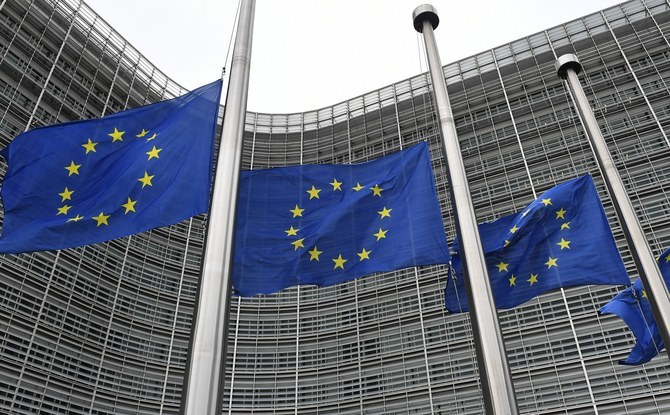
EU executive says Ukraine, Moldova ready to start EU accession talks

Ukraine and Moldova meet all the criteria needed to formally start negotiations on EU membership, the European Commission said on Friday, as Ukrainian Prime Minister Denys Shmyhal expressed hope that the talks could start later this month. AFP/File
Short Url
Updated 07 June 2024
Follow

EU executive says Ukraine, Moldova ready to start EU accession talks

  • Opening talks with the European Union would be a morale boost for Ukraine as the war with Russia enters its third year
  • The Commission assessment will now be discussed by experts in working groups

BRUSSELS/KYIV: Ukraine and Moldova meet all the criteria needed to formally start negotiations on EU membership, the European Commission said on Friday, as Ukrainian Prime Minister Denys Shmyhal expressed hope that the talks could start later this month.
“We confirm that on the Commission side we consider that all the steps have been met by the two countries,” Commission spokeswoman on enlargement Ana Pisonero said.
“The decision is now in the hands of the member states — it is for them to adopt the negotiating framework,” she said. “Once this step is done it is the prerogative of the EU Presidency to convene an intergovernmental conference to formally mark the start of the negotiations,” she added.
Opening talks with the European Union would be a morale boost for Ukraine as the war with Russia enters its third year and Moscow’s forces are advancing in the eastern Donetsk region and opening a new front in the northeastern Kharkiv region.
“Now we expect our European partners to take the next step — to start negotiations on European Union membership already this month,” Shmyhal said on the Telegram messaging app.
“Every day, the Ukrainian people fight for the right to be part of the European family in the war against the Russian aggressor.”
The Commission assessment will now be discussed by experts in working groups and then by ambassadors of EU governments next week. The 27 EU member states have to unanimously agree to start the negotiations, which take years to conclude, by adopting the so-called negotiating framework.

HUNGARY SCEPTICAL
Belgium, which holds the rotating EU presidency until the end of June, is making arrangements for intergovernmental conferences with Ukraine and Moldova to be held on June 25 in Luxembourg if there is unanimous backing.
But such backing is not guaranteed because Hungary, which maintains warm ties with Russia and has criticized Ukraine’s membership bid, has doubts about the Commission’s assessment that Ukraine is ready and wants to see some more items added to the negotiating frameworks, diplomats said.
Belgium and the Commission are keen to get agreement in June, before Hungary takes over the rotating presidency from July 1 for six months, because EU diplomats expect Budapest will put the whole process on ice until 2025.
Kyiv applied for EU membership in the weeks after Russia launched its full-scale invasion in February 2022 and it was granted candidate status four months later.
Despite the impact of the war, which has devastated the economy and forced millions to abandon their homes in frontline cities, towns and villages, the Ukrainian government has been implementing sweeping reforms recommended by the EU.
The changes have ranged from anti-corruption measures to regulations for public administration and food safety.


China’s top diplomat to visit Somalia on Africa tour

Updated 6 sec ago
Follow

China’s top diplomat to visit Somalia on Africa tour

  • Stop in Mogadishu provides diplomatic boost after Israel became the first country to formally recognize breakaway Somaliland
  • Tour focusses on Beijing's strategic trade ​access across eastern and southern Africa
BEIJING: China’s top diplomat began his annual New Year tour of Africa on Wednesday, focusing on strategic trade ​access across eastern and southern Africa as Beijing seeks to secure key shipping routes and resource supply lines.
Foreign Minister Wang Yi will travel to Ethiopia, Africa’s fastest-growing large economy; Somalia, a Horn of Africa state offering access to key global shipping lanes; Tanzania, a logistics hub linking minerals-rich central Africa to the Indian Ocean; and Lesotho, a small southern African economy squeezed by US trade measures. His trip this year runs until January 12.
Beijing aims to highlight countries it views as model partners of President Xi Jinping’s flagship “Belt and Road” infrastructure program and to expand export markets, particularly in young, increasingly ‌affluent economies such ‌as Ethiopia, where the IMF forecasts growth of 7.2 percent this year.
China, ‌the ⁠world’s ​largest bilateral ‌lender, faces growing competition from the European Union to finance African infrastructure, as countries hit by pandemic-era debt strains now seek investment over loans.
“The real litmus test for 2026 isn’t just the arrival of Chinese investment, but the ‘Africanization’ of that investment. As Wang Yi visits hubs like Ethiopia and Tanzania, the conversation must move beyond just building roads to building factories,” said Judith Mwai, policy analyst at Development Reimagined, an Africa-focussed consultancy.
“For African leaders, this tour is an opportunity to demand that China’s ‘small yet beautiful’ projects specifically target our industrial gaps, ⁠turning African raw materials into finished products on African soil, rather than just facilitating their exit,” she added.
On his start-of-year trip in 2025, ‌Wang visited Namibia, the Republic of Congo, Chad and Nigeria.
His visit ‍to Somalia will be the first by a Chinese foreign minister since the 1980s and is ‍expected to provide Mogadishu with a diplomatic boost after Israel became the first country to formally recognize the breakaway Republic of Somaliland, a northern region that declared itself independent in 1991.
Beijing, which reiterated its support for Somalia after the Israeli announcement in December, is keen to reinforce its influence around the Gulf of Aden, the entrance ​to the Red Sea and a vital corridor for Chinese trade transiting the Suez Canal to Europe.
Further south, Tanzania is central to Beijing’s plan to secure access to Africa’s ⁠vast copper deposits. Chinese firms are refurbishing the Tazara Railway that runs through the country into Zambia. Li Qiang made a landmark trip to Zambia in November, the first visit by a Chinese premier in 28 years.
The railway is widely seen as a counterweight to the US and European Union-backed Lobito Corridor, which connects Zambia to Atlantic ports via Angola and the Democratic Republic of the Congo.
By visiting the southern African kingdom of Lesotho, Wang aims to highlight Beijing’s push to position itself as a champion of free trade. Last year, China offered tariff-free market access to its $19 trillion economy for the world’s poorest nations, fulfilling a pledge by Chinese President Xi Jinping at the 2024 China-Africa Cooperation summit in Beijing.
Lesotho, one of the world’s poorest nations with a gross domestic product of just over $2 billion, ‌was among the countries hardest hit by US President Donald Trump’s sweeping tariffs last year, facing duties of up to 50 percent on its exports to the United States.