

Tensions rise in Lebanon and Israel amid escalation in use of incendiary bombs

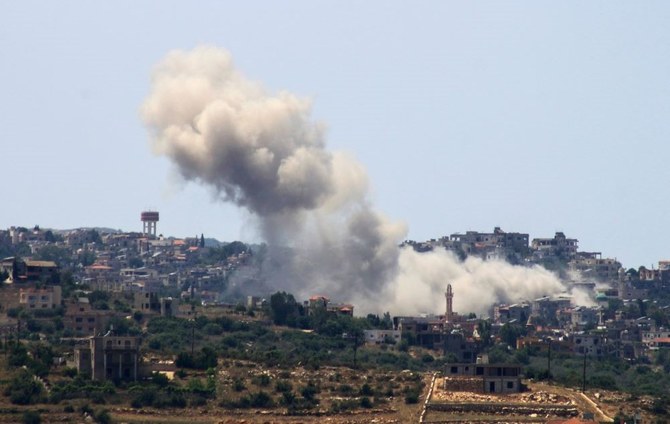
Smoke billows from the site of an Israeli airstrike on the southern Lebanese village of Aita Al-Shaab, near the border with Israel, June 4, 2024. (AFP)
Short Url
Updated 04 June 2024
Follow

Tensions rise in Lebanon and Israel amid escalation in use of incendiary bombs

  • Israeli officials threaten to burn all of Lebanon and return it to the Stone Age; Hezbollah ‘ready for all-out war’
  • Hezbollah has been engaged in a war of ‘distraction and support for Hamas’ for nearly eight months

BEIRUT: The Israeli army on Tuesday targeted parts of Lebanon along the border with incendiary white phosphorus bombs, as government officials threatened to “burn all of Lebanon” and “send it back to the Stone Age.”

Hezbollah has been engaged in a war of “distraction and support for Hamas” for nearly eight months, following the Oct. 7 attacks by Hamas on Israel. More than 450 people have been killed in the fighting between the Lebanese militant group and the Israeli army, including 328 members of Hezbollah.

The Israeli army reportedly used bombs containing white phosphorous, a controversial incendiary munition, to target forest areas on the outskirts of the towns of Naqoura, Jabal Labouneh, Alma Al-Shaab and Boustane, causing severe damage to crops and olive, pine and oak trees. Civil defense teams battled to extinguish the fires. An area between the towns of Markaba and Hula, near a Lebanese army site, was also hit with phosphorous shells, causing fires in the forest.

There is no outright ban on white phosphorous weapons under international law, but human rights campaigners say it is illegal to use them in populated areas.

According to security reports, the Israeli army also used diesel fuel to ignite fires in forests when it shelled areas on the outskirts of the towns of Naqoura and Jabal Labouneh close to the western sector of the Blue Line, the line of demarcation between Israel and Lebanon established in June 2000 by the UN.

Areas near the town of Deir Mimas and neighboring villages were reportedly hit by Israeli cluster shells with the aim of starting fires, and locations between the towns of Markaba and Hula were struck by phosphorus shells. Israeli artillery targeted the border town of Odaisseh, as well as the outskirts of the towns of Alma Al-Shaab, Tayr Harfa and Wadi Zebqin, and directed heavy artillery fire toward the outskirts of Aita Al-Shaab and Dhayra.

A resident of Kfar Sir, a village in the Nabatieh district, told Arab News: “The shelling on the town of Odaisseh was like an earthquake that shook Kfar Sir and the town of Harouf. We felt the house move. The types of shells and missiles used by the Israeli enemy are terrifying.”

Meanwhile, Hezbollah said it targeted several Israeli military sites, including “positions and bases of enemy officers and soldiers in the Maaleh Golani barracks in the occupied Syrian Golan” and “the Ramim barracks with artillery shells.”

Tensions continued to mount along the border on Tuesday as fires raged in northern Israel, including at Safed, which Israeli media sources said were caused by rockets launched from Lebanon. Yedioth Ahronoth newspaper reported that “volleys of dozens of rockets and drone launches toward the Galilee and the Golan Heights on Monday resulted in a significant number of fires.”

The Israeli military said its forces were helping efforts to extinguish fires in the north. Firefighter crews from the coastal and central regions were also called in to assist; 13 teams were said to be working in Kiryat Shmona, as well as 10 in Ami’ad and five in Naftali in the Upper Galilee.

The Israeli Broadcasting Authority reported that the country’s War Council convened, at the request of minister Benny Gantz’s Israel Resilience Party, to discuss the escalating conflict on the Lebanese front.

Opposition leader Yair Lapid posted a message on social media platform X about the fires, stating, “the north is burning, and with it, Israeli deterrence.”

Amid the rising tensions, Israeli officials issued stern warnings to Lebanon. National Security Minister Itamar Ben-Gvir described Hezbollah’s attacks and the resultant fires in the north of the country as “bankruptcy,” adding: “It is time for all of Lebanon to burn.”

Finance Minister Bezalel Smotrich vowed to “return Lebanon to the Stone Age” and said: “The situation in the north is deteriorating and the security zone should extend from Israel to southern Lebanon.”

In response to the Israeli threats, Hezbollah’s deputy leader, Sheikh Naim Qassem, said during a television interview with Al Jazeera on Tuesday: “If Israel wants to wage a full-scale war, we are ready.

“Any Israeli expansion of the war on Lebanon will be met with destruction, devastation, and displacement in Israel. We have used only a fraction of our capabilities, suited to the nature of the battle.”

He also denied there had been any “withdrawal of Radwan forces from the southern Lebanese border.”


Sudan’s prime minister takes his peace plan to the UN, but US urges humanitarian truce now

Updated 23 December 2025
Follow

Sudan’s prime minister takes his peace plan to the UN, but US urges humanitarian truce now

  • Sudan’s prime minister is proposing a wide-ranging peace initiative to end a nearly 1,000-day war with a rival paramilitary force
  • It seems unlikely the RSF would support the proposal, which would essentially give government forces a victory and take away their military power

UNITED NATIONS: Sudan’s prime minister on Monday proposed a wide-ranging peace initiative to end a nearly 1,000-day war with a rival paramilitary force, but the United States urged both sides to accept the Trump administration’s call for an immediate humanitarian truce.
Kamil Idris, who heads Sudan’s transitional civilian government, told the Security Council his plan calls for a ceasefire monitored by the United Nations, African Union and Arab League, and the withdrawal of paramilitary forces from all areas they occupy, their placement in supervised camps and their disarmament.
Sudan plunged into chaos in April 2023 when a power struggle between the military and the powerful paramilitary Rapid Support Forces exploded into open fighting, with widespread mass killings and rapes, and ethnically motivated violence. This has amounted to war crimes and crimes against humanity, according to the UN and international rights groups.
It seemed highly unlikely the RSF would support the prime minister’s proposal, which would essentially give government forces a victory and take away their military power.
In an indirect reference to the truce supported by the US and key mediators Saudi Arabia, Egypt and the United Arab Emirates, known as the Quad, Idris stressed to the UN Security Council that the government’s proposal is “homemade — not imposed on us.”
In early November, the Rapid Support Forces agreed to a humanitarian truce. At that time, a Sudanese military official told The Associated Press the army welcomed the Quad’s proposal but would only agree to a truce when the RSF completely withdraws from civilian areas and gives up their weapons — key provisions in the plan Idris put forward on Monday.
Idris said unless the paramilitary forces were confined to camps, a truce had “no chance for success.” He challenged the 15 members of the Security Council to back his proposal.
“This initiative can mark the moment when Sudan steps back from the edge and the international community — You! You! — stood on the right side of history,” the Sudanese prime minister said. He said the council should “be remembered not as a witness to collapse, but as a partner in recovery.”
US deputy ambassador Jeffrey Bartos, who spoke to the council before Idris, said the Trump administration has offered a humanitarian truce as a way forward and “We urge both belligerents to accept this plan without preconditions immediately.”
Bartos said the Trump administration strongly condemns the horrific violence across Darfur and the Kordofan region — and the atrocities committed by both the Sudanese Armed Forces and the Rapid Support Forces, who must be held accountable.
UAE Ambassador Mohamed Abushahab, a member of the Quad, said there is an immediate opportunity to implement the humanitarian truce and get aid to Sudanese civilians in desperate need.
“Lessons of history and present realities make it clear that unilateral efforts by either of the warring parties are not sustainable and will only prolong the war,” he warned.
Abushahab said a humanitarian truce must be followed by a permanent ceasefire “and a pathway toward civilian rule independent of the warring parties.”
UN Assistant Secretary-General for political affairs Khaled Khiari reflected escalating council concerns about the Sudan war, which has been fueled by the continuing supply of increasingly sophisticated weapons.
He criticized unnamed countries that refuse to stop supplying weapons, and both government and paramilitary forces for remaining unwilling to compromise or de-escalate.
“While they were able to stop fighting to preserve oil revenues, they have so far failed to do the same to protect their population,” Khiari said. “The backers of both sides must use their influence to help stop the slaughter, not to cause further devastation.”
The devastating war in Sudan has killed more than 40,000 people according to UN figures, but aid groups say the true number could be many times higher. The conflict has created the world’s largest humanitarian crisis, with over 14 million people displaced, disease outbreaks and famine spreading in parts of the country.