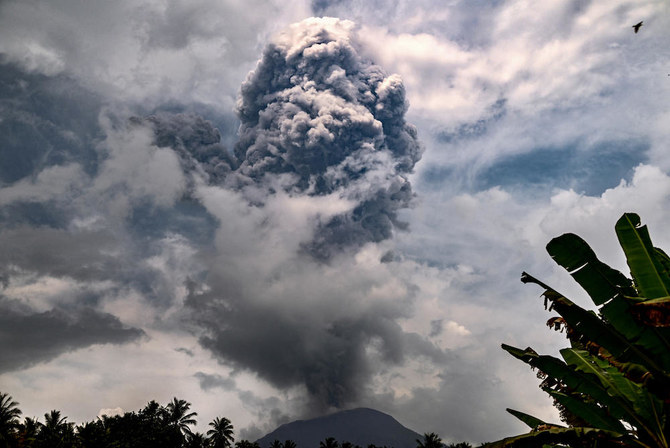
JAKARTA: Indonesia’s Mount Ibu volcano erupted on Tuesday, spewing thick columns of grey ash five kilometers into the sky, the volcanology agency said, but there were no immediate reports of evacuations.
The volcano on the eastern island of Halmahera erupted at 5:36 a.m. for about two minutes, said Heruningtyas Desi Purnamasari, an official of the PVMB agency, with all activities barred within seven kilometers (4.4 miles) of the crater.
“The volcano is recently active because there is an intense magma movement,” Heruningtyas said, adding that its alert status was at the highest level, where it has been since May 16.
Clouds of grey ash billowed into the sky from the crater in video images provided by the agency, PVMB, following a smaller eruption on Monday.
They are the latest in a series since May that spurred authorities to evacuate seven nearby villages, although Tuesday’s incident forced no new evacuation, the BNPB disaster agency said.
Indonesia straddles the so-called “Pacific Ring of Fire,” an area of high seismic activity where multiple tectonic plates meet.
Last month, the eruption of the Ruang volcano in North Sulawesi spewed incandescent lava, forcing the evacuation of more than 12,000 people.
More than 60 were killed after flash floods and cold lava flow from Mount Marapi, one of the most active volcanoes in the province of West Sumatra, inundated several nearby districts following torrential rain on May 11.

Indonesia’s Mt Ibu volcano erupts, spewing clouds of ash
https://arab.news/mgeef
Indonesia’s Mt Ibu volcano erupts, spewing clouds of ash
- The volcano on the eastern island of Halmahera erupted at 5:36 a.m. for about two minutes
- All activities are barred within seven kilometers of the crater
India accelerates free trade agreements against backdrop of US tariffs
- India signed a CEPA with Oman on Thursday and a CETA with the UK in July
- Delhi is also in advanced talks for trade pacts with the EU, New Zealand, Chile
NEW DELHI: India has accelerated discussions to finalize free trade agreements with several nations, as New Delhi seeks to offset the impact of steep US import tariffs and widen export destinations amid uncertainties in global trade.
India signed a Comprehensive Economic Partnership Agreement with Oman on Thursday, which allows India to export most of its goods without paying tariffs, covering 98 percent of the total value of India’s exports to the Gulf nation.
The deal comes less than five months after a multibillion-dollar trade agreement with the UK, which cut tariffs on goods from cars to alcohol, and as Indian trade negotiators are in advanced talks with New Zealand, the EU and Chile for similar partnerships.
They are part of India’s “ongoing efforts to expand its trade network and liberalize its trade,” said Anupam Manur, professor of economics at the Takshashila Institution.
“The renewed efforts to sign bilateral FTAs are partly an after-effect of New Delhi realizing the importance of diversifying trade partners, especially after India’s biggest export market, the US, levied tariff rates of up to 50 percent on India.”
Indian exporters have been hit hard by the hefty tariffs that went into effect in August.
Months of negotiations with Washington have not clarified when a trade deal to bring down the tariffs would be signed, while the levies have weighed on sectors such as textiles, auto components, metals and labor-intensive manufacturing.
The FTAs with other nations will “help partially in mitigating the effects of US tariffs,” Manur said.
In particular, Oman can “act as a gateway to other Gulf countries and even parts of Eastern Europe, Central Asia, and Africa,” and the free trade deal will most likely benefit “labor-intensive sectors in India,” he added.
The chances of concluding a deal with Washington “will prove to be difficult,” said Arun Kumar, a retired economics professor at the Jawaharlal Nehru University.
“With the US, the chances of coming to (an agreement) are a bit difficult, because they want to get our agriculture market open, which we cannot do. They want us to reduce trade with Russia. That’s also difficult for India to do,” he told Arab News.
US President Donald Trump has threatened sanctions over India’s historic ties with Moscow and its imports of Russian oil, which Washington says help fund Moscow’s ongoing war with Ukraine.
“President Trump is constantly creating new problems, like with H-1B visa and so on now. So some difficulty or the other is expected. That’s why India is trying to build relationships with other nations,” Kumar said, referring to increased vetting and delays under the Trump administration for foreign workers, who include a large number of Indian nationals.
“Substituting for the US market is going to be tough. So certainly, I think India should do what it can do in terms of promoting trade with other countries.”
India has free trade agreements with more than 10 countries, including comprehensive economic partnership agreements with South Korea, Japan, and the UAE.
It is in talks with the EU to conclude an FTA, amid new negotiations launched this year for trade agreements, including with New Zealand and Chile.
India’s approach to trade partnerships has been “totally transformed,” Commerce and Industry Minister Piyush Goyal said in a press briefing following the signing of the CEPA with Oman, which Indian officials aim to enter into force in three months.
“Now we don’t do FTAs with other developing nations; our focus is on the developed world, with whom we don’t compete,” he said. “We complement and therefore open up huge opportunities for our industry, for our manufactured goods, for our services.”