Hundreds of people evacuated as volcano spews clouds of ash in Indonesia

1 / 3
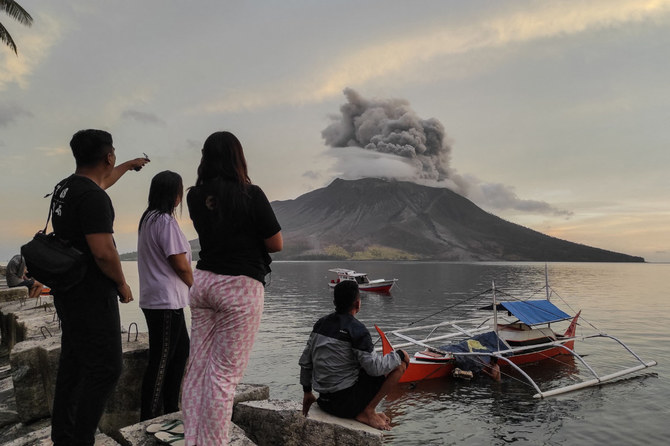
People watch from Tagulandang Island in Sitaro, North Sulawesi, as Mount Ruang volcano spews volcanic ash on April 19, 2024. (AFP)
2 / 3
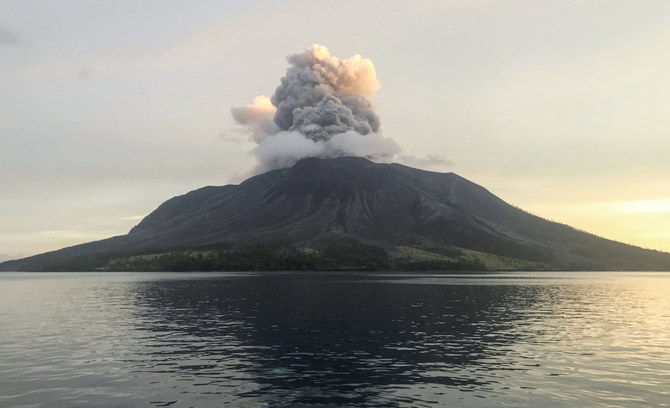
Mount Ruang volcano spews volcanic ash as seen from Tagulandang in Sitaro Islands Regency, North Sulawesi province, Indonesia, on April 19, 2024. (REUTERS)
3 / 3
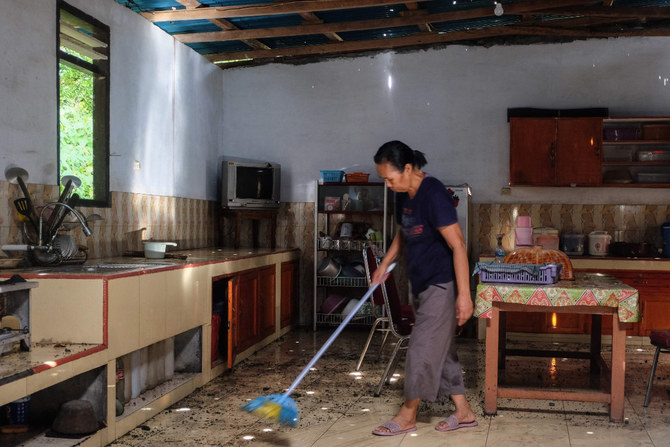
A woman sweeps the floor after volcanic material from the recent eruptions of Mount Ruang volcano fell through the roof of a building on Tagulandang island in Sitaro, North Sulawesi on April 19, 2024. (AFP)
Short Url
Updated 20 April 2024
Follow

Hundreds of people evacuated as volcano spews clouds of ash in Indonesia

  • Local authorities combed the villages surrounding the volcano and evacuated residents to safer areas by boat
  • Officials worry that part of the volcano could collapse into the sea and cause a tsunami, as happened in an eruption there in 1871

MANADO, Indonesia: More than 2,100 people living near an erupting volcano on Indonesia’s Sulawesi Island were evacuated Friday due to the dangers of spreading ash, falling rocks, hot volcanic clouds and the possibility of a tsunami.
Indonesia’s Center for Volcanology and Geological Hazard Mitigation recorded at least three eruptions since Friday afternoon, with the maximum height of the eruption column reaching 1,200 meters (3,900 feet).
An international airport in Manado city, less than 100 kilometers (60 miles) from the erupting Mount Ruang, is still temporarily closed as volcanic ash was spewed into the air.
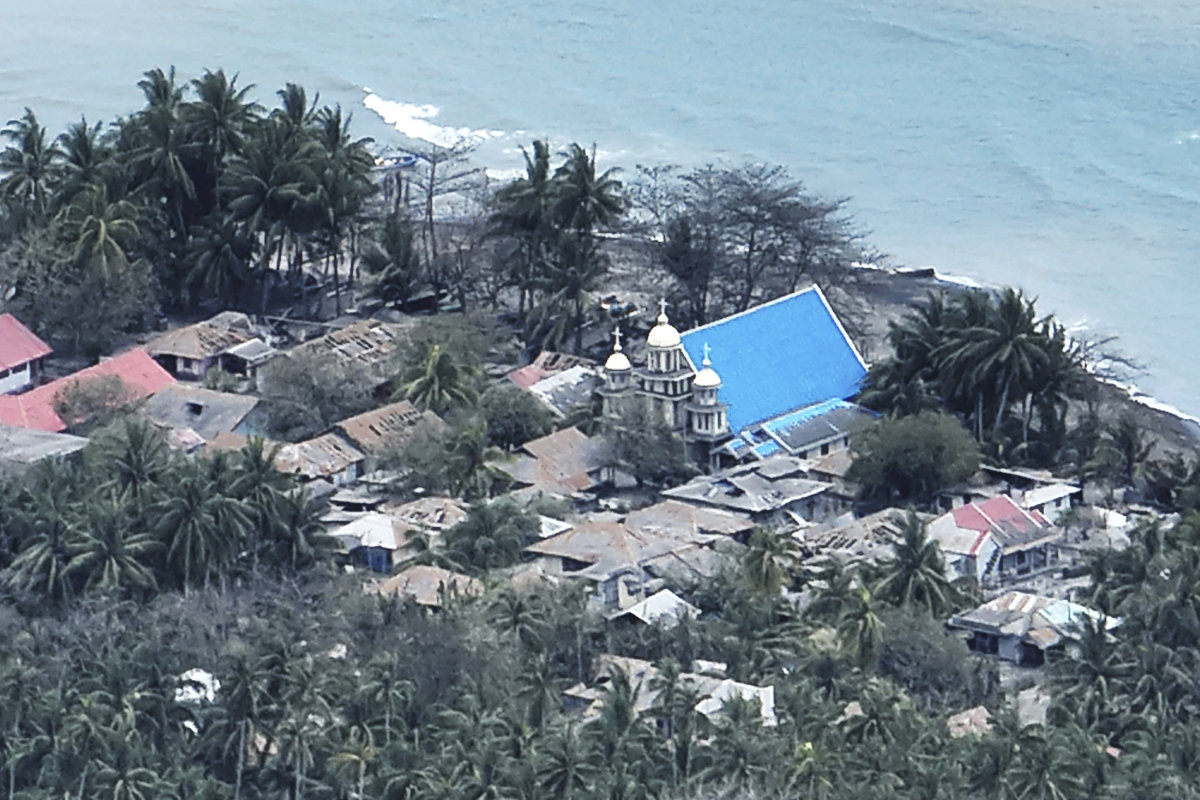


This photo provided by the Indonesian National Search and Rescue Agency shows a part of a village on Tagulandang island covered by ash from eruptions of Mount Ruang on April 19, 2024. (National Search and Rescue Agency via AP)

Satellite imagery from the Meteorology, Climatology and Geophysics Agency shows the ash has spread to the west, northwest, northeast and southeast, covering Manado and North Minahasa, according to a statement from Indonesia’s Transportation Ministry.
“We are still monitoring developments in the eruption of Mount Ruang and coordinating with relevant stakeholders … to anticipate the necessary actions to ensure flight safety, security and comfort,” said Ambar Suryoko, head of the regional airport authority.
More than 11,000 people were told to leave their homes that were located in the affected area. A joint team from the local authorities combed the villages surrounding the volcano and evacuated residents to safer areas by boat.
Officials worry that part of the volcano could collapse into the sea and cause a tsunami, as happened in an eruption there in 1871.
Houses, roads and other buildings were covered by gray volcanic ash, and many roofs were broken by debris spewed from the eruption.

Mount Ruang saw at least five large eruptions Wednesday, causing the Center for Volcanology and Geological Hazard Mitigation to issue its highest level of alert. People were ordered to stay at least 6 kilometers (3.7 miles) from the 725-meter (2,378-foot) mountain.
The observation from the agency on Friday said white smoke was rising from the main crater with medium to thick intensity.
East of the volcano, Tagulandang Island could be at risk if a collapse occurred. Its residents were among those being told to evacuate. Indonesia’s National Disaster Mitigation Agency said residents would be relocated to Manado, a journey of 6 hours by boat.
Indonesia, an archipelago of 270 million people, has 120 active volcanoes. It is prone to volcanic activity because it sits along the “Ring of Fire,” a horseshoe-shaped series of seismic fault lines around the Pacific Ocean.


‘A den of bandits’: Rwanda closes thousands of evangelical churches

Updated 22 December 2025
Follow

‘A den of bandits’: Rwanda closes thousands of evangelical churches

  • A 2018 law introduced new rules on health, safety, and financial disclosures, and requires all preachers to have theological training
  • Observers say the real reason for the closures comes down to control, noting that even those who complied with the law had been shut down 
  • President Kagame has described the church as a relic of the colonial period, a chapter of its history with which the country is still grappling


KIGALI: Grace Room Ministries once filled giant stadiums in Rwanda three times a week before the evangelical organization was shut down in May.
It is one of the 10,000 churches reportedly closed by the government for failing to comply with a 2018 law designed to regulate places of worship.
The law introduced new rules on health, safety, and financial disclosures, and requires all preachers to have theological training.
President Paul Kagame has been vocal in his criticisms of the evangelical churches that have sprouted across the small country in Africa’s Great Lakes region.
“If it were up to me I wouldn’t even reopen a single church,” Kagame told a news briefing last month.
“In all the development challenges we are dealing with, the wars... our country’s survival — what is the role of these churches? Are they also providing jobs? Many are just thieving... some churches are just a den of bandits,” he said.
The vast majority of Rwandans are Christian according to a 2024 census, with many now traveling long and costly distances to find places to pray.
Observers say the real reason for the closures comes down to control.
Kagame’s government is saying “there’s no rival in terms of influence,” Louis Gitinywa, a lawyer and political analyst based in Kigali, told AFP.
The ruling party “bristles when an organization or individual gains influence,” he said, a view also expressed to AFP by an anonymous government official.

‘Deceived’ 

The 2018 law requires churches to submit annual action plans stating how they align with “national values.” All donations must be channelled through registered accounts.
Pastor Sam Rugira, whose two church branches were shut down last year for failing to meet fire safety regulations, said the rules mostly affected new evangelical churches that have “mushroomed” in recent years.
But Kagame has described the church as a relic of the colonial period, a chapter of its history with which the country is still grappling.
“You have been deceived by the colonizers and you let yourself be deceived,” he said in November.
The closure of Grace Room Ministries came as a shock to many across the country.
Pastor Julienne Kabanda, had been drawing massive crowds to the shiny new BK Arena in Kigali when the church’s license was revoked.
The government had cited unauthorized evangelical activities and a failure to submit “annual activity and financial reports.”
AFP was unable to reach Kabanda for comment.

‘Open disdain, disgust’ 

A church leader in Kigali, speaking to AFP on condition of anonymity, said the president’s “open disdain and disgust” for churches “spells tough times ahead.”
“It is unfair that even those that fulfilled all requirements are still closed,” he added.
But some say the clampdown on places of worship is linked to the 1994 Rwandan genocide in which around 800,000 people, mostly ethnic Tutsis, were slaughtered.
Ismael Buchanan a political science lecturer at the National University of Rwanda, told AFP the church could sometimes act as “a conduit of recruitment” for the Democratic Forces for the Liberation of Rwanda (FDLR), the Hutu militia formed in exile in DR Congo by those who committed the genocide.
“I agree religion and faith have played a key role in healing Rwandans from the emotional and psychological wounds after the genocide, but it also makes no sense to have a church every two kilometers instead of hospitals and schools,” he said.
Pastor Rugira meanwhile suggested the government is “regulating what it doesn’t understand.”
It should instead work with churches to weed out “bad apples” and help them meet requirements, especially when it comes to the donations they rely on to survive, he said.