

A Ghana toddler sets a world record as the youngest male artist. His mom says he just loves colors

1 / 2
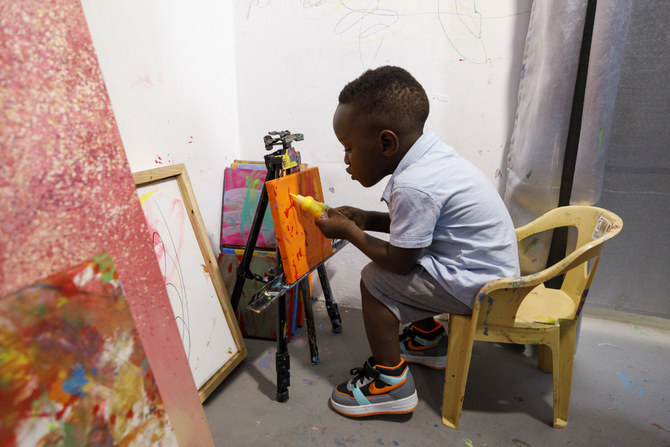
Ace-Liam Nana Sam Ankrah, who will turn two in July, paints amidst his own art work at his mother's art gallery in Accra, Ghana,on May 27, 2024. (AP Photo/Misper Apawu)
2 / 2
Ace-Liam Nana Sam Ankrah, who will turn two in July, paints at his mother’s art gallery in Accra, Ghana, on May 27, 2024. (AP Photo/Misper Apawu)
Short Url
Updated 03 June 2024
Follow

A Ghana toddler sets a world record as the youngest male artist. His mom says he just loves colors

ACCRA, Ghana: Meet Ace-Liam Ankrah, a Ghana toddler who has set the record as the world’s youngest male artist.
His mother, Chantelle Kukua Eghan, says it all started by accident when her son, who at the time was 6 months old, discovered her acrylic paints.
Eghan, an artist and founder of Arts and Cocktails Studio, a bar that that offers painting lessons in Ghana’s capital, Accra, said she was looking for a way to keep her boy busy while working on her own paintings.


Ace-Liam Nana Sam Ankrah, who will turn two in July, shows off his paint tubes at his mother’s art gallery in Accra, Ghana, on May 27, 2024. (AP Photo/Misper Apawu)

“I spread out a canvas on the floor and added paint to it, and then in the process of crawling he ended up spreading all the colors on the canvas,” she said.
And that’s how his first artwork, “The Crawl,” was born, Eghan, 25, told The Associated Press.
After that and with his mother’s prodding, Ace-Liam kept on painting.
Eghan decided to apply for the record last June. In November, Guinness World Records told her that to break a previous record, her son needed to exhibit and sell paintings.

She arranged for Ace-Liam’s first exhibition at the Museum of Science and Technology in Accra in January, where nine out of 10 of his pieces listed were sold. She declined to say for how much the paintings sold.
They were on their way.
Then, Guinness World Records confirmed the record in a statement and last week declared that “at the age of 1 year 152 days, little Ace-Liam Nana Sam Ankrah from Ghana is the world’s youngest male artist.”
Guinness World Records did not immediately respond to an Associated Press query about the previous youngest male artist record holder.
The overall record for the world’s youngest artist is currently held by India’s Arushi Bhatnagar. She had her first exhibition at the age of 11 months and sold her first painting for 5,000 Rupees ($60) in 2003.


Ace-Liam Nana Sam Ankrah plays on a table at his mother’s art gallery iat his mother’s art gallery in Accra, Ghana, on May 27, 2024. (AP Photo/Misper Apawu)

These days, Ace-Liam, who will be 2 years old in July, still loves painting and eagerly accompanies his mom to her studio, where a corner has been set off just for him. He sometimes paints in just five-minute sessions, returning to the same canvas over days of weeks, Eghan says.
On a recent day, he ran excitedly around the studio, with bursts of energy typical for boys his age. But he was also very focused and concentrated for almost an hour while painting — choosing green, yellow and blue for his latest work-in-progress and rubbing the oil colors into the canvas with his tiny fingers.
Eghan says becoming a world record holder has not changed their lives. She won’t sell “The Crawl” but plans on keeping it in the family.
She added that she hopes the media attention around her boy could encourage and inspire other parents to discover and nurture their children’s talents.
“He is painting and growing and playing in the whole process,” she says.


Creators spotlight graphic novels as powerful literacy tools at Dubai literature festival

Updated 22 January 2026
Follow

Creators spotlight graphic novels as powerful literacy tools at Dubai literature festival

DUBAI: Comic creators Jamie Smart, John Patrick Green and Mo Abedin joined the Emirates Airline Festival of Literature in Dubai this week to discuss the growing role of comics in classrooms and how graphic novels are reshaping children’s relationship with reading.

Smart is the author of the bestselling “Bunny vs. Monkey” series, Green is known for his popular “The InvestiGators” books about crime-solving alligators, and Abedin is the UAE-based creator of the sci-fi graphic novel “Solarblader."


A post shared by @jamiefumboo

A key point shared by all three speakers was that comics should be valued as a complete art form rather than a stepping stone to prose. Abedin described comics as “a very high art form,” explaining that the medium taught readers how to process complex ideas such as emotion, empathy and culture through visual storytelling. 

He added that comics allowed readers to slow down and engage on their own terms because “the reader is also able to control the pace of the narrative.”

For Smart, the power of comics lies in the emotional connection they create. He spoke about how the word “comics” immediately takes him back to childhood, recalling being “eight years old and going down the newsagent” and spending hours reading. That sense of joy, he said, is what many reluctant readers respond to. He noted that parents often tell him, “My child would not read a book, a single book … until they picked up a comic,” adding that comics inform readers even when they are simply entertaining. “They can just be an emotional, heartfelt story,” he said.

Green focused on how comics function as a visual language that readers learn over time. He described them as “almost a separate language,” noting that some adults struggle at first because they are unsure how to read a page — whether to follow images or text. But that flexibility is what gives comics their strength, allowing readers to choose how they experience a story and giving them more agency than prose or film.

The panel also discussed re-reading as a powerful part of the comics experience. Children often race through a book for the plot, then return to notice visual details, background jokes and character expressions, building deeper comprehension with each reading.

By the end of the session, all three agreed that comics should be studied and respected as their own form of literature — one that welcomes readers of all levels, builds confidence and makes reading feel like discovery rather than obligation.