BEIJING: China landed an uncrewed spacecraft on the far side of the moon on Sunday, overcoming a key hurdle in its landmark mission to retrieve the world’s first rock and soil samples from the dark lunar hemisphere.
The landing elevates China’s space power status in a global rush to the moon, where countries including the United States are hoping to exploit lunar minerals to sustain long-term astronaut missions and moon bases within the next decade.
The Chang’e-6 craft, equipped with an array of tools and its own launcher, touched down in a gigantic impact crater called the South Pole-Aitken Basin on the moon’s space-facing side at 6:23 a.m. Beijing time (2223 GMT), the China National Space Administration said.
The mission “involves many engineering innovations, high risks and great difficulty,” the agency said in a statement on its website. “The payloads carried by the Chang’e-6 lander will work as planned and carry out scientific exploration missions.”
The successful mission is China’s second on the far side of the moon, a region no other country has reached. The side of the moon perpetually facing away from the Earth is dotted with deep and dark craters, making communications and robotic landing operations more challenging.
Given these challenges, lunar and space experts involved in the Chang’e-6 mission described the landing phase as a moment where the chance of failure is the highest.
“Landing on the far side of the moon is very difficult because you don’t have line-of-sight communications, you’re relying on a lot of links in the chain to control what is going on, or you have to automate what is going on,” said Neil Melville-Kenney, a technical officer at the European Space Agency working with China on one of the Chang’e-6 payloads.
“Automation is very difficult especially at high latitudes because you have long shadows which can be very confusing for landers,” Melville added.
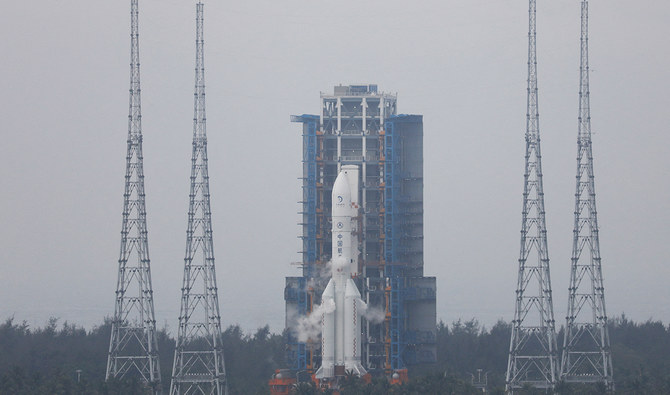
The Chang’e-6 probe launched on May 3 on China’s Long March 5 rocket from the Wenchang Satellite Launch Center on the southern island of Hainan, reaching the lunar vicinity roughly a week later before tightening its orbit in preparation for a landing.
Chang’e-6 marks the world’s third lunar landing this year: Japan’s SLIM lander touched down in January, followed the next month by a lander from US startup Intuitive Machines.
The other countries that have sent spacecraft to Earth’s nearest neighbor are the then-Soviet Union and India. The United States is the only country to have landed humans on the moon, starting in 1969.
SAMPLING THE MOON
Using a scoop and drill, the Chang’e-6 lander will aim to collect 2 kg (4.4 pounds) of lunar material over two days and bring it back to Earth.
The samples will be transferred to a rocket booster atop the lander, which will launch back into space, tag up with another spacecraft in lunar orbit and return, with a landing in China’s Inner Mongolia region expected around June 25.
If all goes as planned, the mission will provide China with a pristine record of the moon’s 4.5 billion-year history and yield new clues on the solar system’s formation. It will also allow for an unprecedented comparison between the dark, unexplored region with the moon’s better understood Earth-facing side.
A simulation lab for the Chang’e-6 probe will develop and verify sampling strategies and equipment control procedures, China’s official Xinhua news agency said. It will use a full-scale replica of the sampling area based on exploration results on the environment, rock distribution and lunar soil conditions around the landing site.
China’s lunar strategy includes its first astronaut landing around 2030 in a program that counts Russia as a partner. In 2020 China conducted its first lunar sample return mission with Chang’e-5, retrieving samples from the moon’s nearer side.
The US Artemis program envisions a crewed moon landing by late 2026 or later. NASA has partnered with space agencies including those of Canada, Europe and Japan, whose astronauts will join US crews on an Artemis mission.
Artemis relies heavily on private companies, including Elon Musk’s SpaceX, whose Starship rocket aims this decade to attempt the first astronaut landing since NASA’s final Apollo mission in 1972.
On Saturday Japanese billionaire Yusaku Maezawa canceled a private mission around the moon he had paid for, which was to have used SpaceX’s Starship, citing schedule uncertainties in the rocket’s development.
Boeing and NASA postponed the company’s first crewed launch of Starliner, a long-delayed capsule meant to become the second US space taxi to low-Earth orbit.


![]()

China lands on moon’s far side in historic sample-retrieval mission
Short Url
https://arab.news/b953n
China lands on moon’s far side in historic sample-retrieval mission
- Chang’e-6 craft touched down in gigantic crater on moon’s space-facing side
- The landing elevates China’s space power status in a global rush to the moon
Latest updates


© 2026 SAUDI RESEARCH & PUBLISHING COMPANY, All Rights Reserved And subject to Terms of Use Agreement.