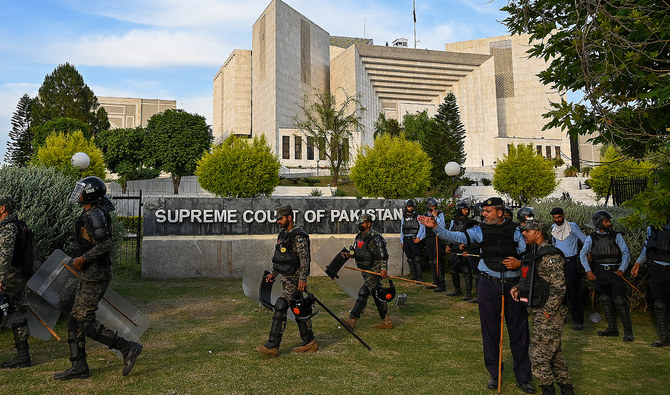
ISLAMABAD: Pakistan’s top court on Saturday explained why it decided not to live-stream the last two hearings of a case related to anti-graft law amendments when former Prime Minister Imran Khan joined the proceedings via video link from jail, saying it was to prevent the broadcast’s political misuse.
Khan, who was incarcerated last year in August on corruption charges, has since been convicted in several legal cases after prison trials. He has frequently claimed innocence in all the cases against him, calling them part of a strategy to keep him away from the country’s political arena.
Khan originally challenged the amendments made by Prime Minister Shehbaz Sharif’s previous administration in May 2022 to the National Accountability Bureau (NAB) Ordinance, which reduced several powers of the country’s anti-graft body. He requested to participate in the Supreme Court hearing over the matter last month after being largely kept out of the public eye by the authorities since his arrest in August.
The court granted him permission to join the proceedings via video link, although it opted not to live-stream the proceedings as it had done previously.
“When the head of a political party wants to be heard, who is not an Advocate of this Court, there is a real probability that these hearings may be used for political purposes and point scoring and in respect of matters which do not concern these appeals,” the court said in a written order issued in response to an appeal filed by the advocate-general of Khyber Pakhtunkhwa province to live-stream the proceedings.
The application called the court’s decision to live-stream some of the hearings and refusing to televise others a “discrimination.”
“This was a paramount consideration when we had dismissed the [advocate-general’s] application,” it continued. “And, our apprehension proved correct later in the day. When Mr. [Imran Khan] Niazi addressed this Court on (30 May 2024) he also mentioned other cases, the general elections held on 8 February 2023, a commission of inquiry and his incarceration; all these matters have nothing to do with the subject matter of these appeals.”
The Supreme Court said it could not have allowed this since it would have thwarted “proper administration of justice.”
It noted that discussions of unrelated matters could skew public perception and undermine the right to a fair hearing and trial for others involved in them.
“While a request to live broadcast or live-stream may be submitted, and may also be objected to, it is clarified that this, as matters presently stand, is in the exclusive domain of this Court,” it added.


![]()

Pakistan’s top court says live-streaming anti-graft law amendments case risked political misuse
Short Url
https://arab.news/9mrb2
Pakistan’s top court says live-streaming anti-graft law amendments case risked political misuse
- Supreme Court decided not to live-stream the proceedings after ex-PM Khan joined from jail via video link
- The top court says in a written order the decision to live-stream a hearing exclusively falls within its domain
Latest updates


© 2026 SAUDI RESEARCH & PUBLISHING COMPANY, All Rights Reserved And subject to Terms of Use Agreement.