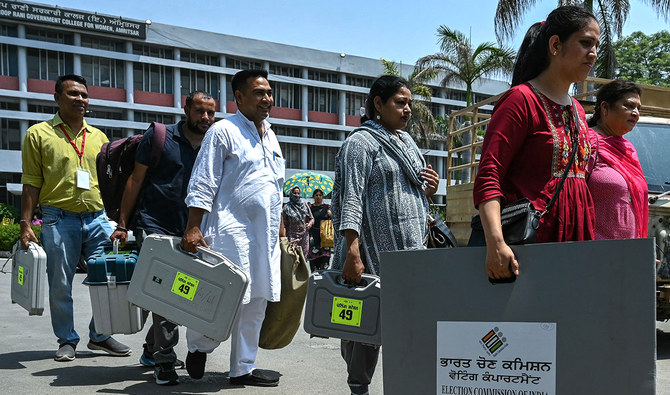
NEW DELHI: Indians began voting Saturday in the last round of a six-week-long national election that is a referendum on Hindu nationalist Prime Minister Narendra Modi’s decade in power.
The election is considered one of the most consequential in India’s history. If Modi wins, he’ll be only the second Indian leader to retain power for a third term after Jawaharlal Nehru, the country’s first prime minister.
The seventh round of voting in 57 constituencies across seven states and one union territory will complete polling for all 543 seats in the powerful lower house of parliament. Nearly 970 million voters — more than 10 percent of the world’s population — were eligible to elect a new parliament for five years. More than 8,300 candidates ran for the office.
Most polls show Modi and his Bharatiya Janata Party leading over the broad opposition alliance that’s challenging them, led by the Congress party. The votes will be counted Tuesday, with results expected by the end of the day.
Modi’s campaign, vying for a third-straight term, began on a platform of economic progress. He promised to uplift the poor and turn India into a developed nation by 2047. But it has turned increasingly shrill in recent weeks as he escalated polarizing rhetoric in back-to-back incendiary speeches that targeted the country’s Muslim minority, who make up 14 percent of India’s 1.4 billion people.
On Thursday, after finishing his election campaign, Modi went to meditate at a memorial site honoring a famous Hindu saint who is believed to have attained enlightenment there.
When the election kicked off in April, Modi and his BJP were widely expected to clinch another term.
Since first coming to power in 2014, Modi has enjoyed immense popularity. His supporters see him as a self-made, strong leader who has improved India’s standing in the world, and credit his pro-business policies with making the economy the world’s fifth-largest.
At the same time, his rule has seen brazen attacks and hate speech against minorities, particularly Muslims. India’s democracy, his critics say, is faltering and Modi has increasingly blurred the line between religion and state.
But as the campaign ground on, his party has faced stiff resistance from the opposition alliance and its main face, Rahul Gandhi of the Congress party. They have attacked Modi over his Hindu nationalist politics and are hoping to benefit from growing economic discontent.
Pre-poll surveys showed that voters were increasingly worried about unemployment, the rise in food prices and an overall sentiment that only a small portion of Indians have benefitted despite brisk economic growth under Modi, making the contest appear closer than initially anticipated.
In this election, Modi’s BJP — which controls much of India’s Hindi-speaking northern and central parts — sought to expand their influence by making inroads into the country’s eastern and southern states, where regional parties hold greater sway.
The BJP also banked on consolidating votes among the Hindu majority, who make up 80 percent of the population, after Modi opened a long-demanded Hindu temple on the site of a razed mosque in January. Many saw it as the unofficial start of his campaign, but analysts said the excitement over the temple may not be enough to yield votes.
Instead, Modi ramped up anti-Muslim rhetoric after voter turnout dipped slightly below 2019 figures in the first few rounds of the 2024 polls.
This was seen as a tactic to energize his core Hindu voter base. But analysts say it also reflected the lack of any big-ticket national issue to help Modi propel his BJP to electoral victory, as he has done previously.
In 2014, Modi’s status as a political outsider cracking down on deep-rooted corruption won over voters disillusioned with decades of dynastic politics. And in 2019, he swept the polls on a wave of nationalism after his government launched airstrikes into rival Pakistan in response to a suicide bombing in Kashmir that killed 40 Indian soldiers.
But things are different this time, analysts say, giving Modi’s political challengers a potential boost.
“The opposition somehow managed to derail his plan by setting the narrative to local issues, like unemployment and the economy. This election, people are voting keeping various issues in mind,” said Rasheed Kidwai, a political analyst.


![]()

Voting begins in the last round of India’s election, a referendum on Modi’s decade in power
Short Url
https://arab.news/naue6
Voting begins in the last round of India’s election, a referendum on Modi’s decade in power
- The seventh round of voting in 57 constituencies across seven states, one union territory will complete polling for all 543 seats in parliament
- If Modi wins, he’ll be only the second Indian leader to retain power for a third term after Jawaharlal Nehru, the country’s first prime minister
Latest updates


Recommended


© 2026 SAUDI RESEARCH & PUBLISHING COMPANY, All Rights Reserved And subject to Terms of Use Agreement.