

Pakistan battles forest fires amidst heat wave

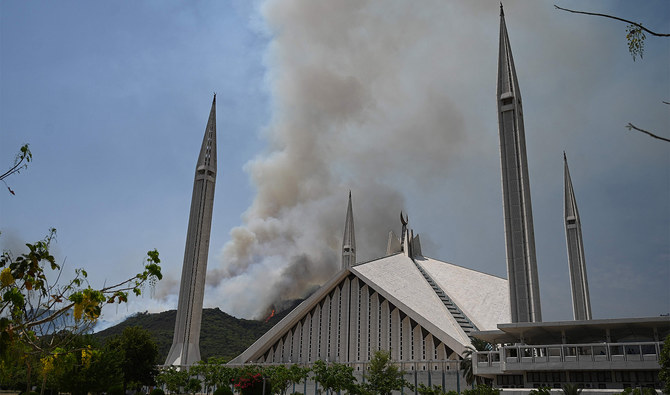
Smoke rises from a fire that erupted few days back in Margalla Hills forest near Faisal Mosque amid rising temperatures during a hot summer day in Islamabad on May 31, 2024. (AFP)
Short Url
Updated 31 May 2024
Follow

Pakistan battles forest fires amidst heat wave

  • Raging fire on Islamabad hills with temperatures hitting 41 degrees Celsius on Friday 
  • Officials yet to confirm if fires are related to the high temperatures or due to arson

ISLAMABAD: Authorities in Pakistan battled forest fires in multiple areas, including the capital Islamabad, on Friday as the country grappled with heat waves and dry weather.

Officials are yet to confirm if the fires are related to the high temperatures or due to arson.

Parts of Pakistan have seen temperatures as high as 52.2 degrees Celsius (126 F) over the last week with South Asia sweltering in a hotter summer this year — a trend scientists say has been worsened by human-driven climate change.

Plumes of smoke could be seen rising from a raging fire in the hills of Islamabad with temperatures hitting 41 degrees Celsius on Friday afternoon.

“It is difficult to get a fire brigade there; rescue officials are trying how to douse the fire,” a police official in Islamabad, Sohail Khan, told Reuters, adding that it was not certain if the fires were heat-related or cases of arson.

A spokesman for the Islamabad police said they were investigating the reasons for the fire and a special team had been formed for the probe by the city’s police chief.

A member of the Islamabad Wildlife Board, Waqar Zakaria, said the fire could be a case of “wilful arson,” adding that high temperatures have continued longer than usual and May has been drier than normal, leading to fires spreading faster because of dry vegetation.

An area in Punjab close to Islamabad, Kallar Kahar, also saw fire engulf 25 acres of grassland, the province’s disaster management (PDMA) said, adding that the flames, which had spread rapidly, had been contained.

“The Kalar Kahar forest fire might be a heat-related eruption,” PDMA spokesman Mazhar Hussain told Reuters.

Forest fires were also seen in Lower Dir, 250 km (155 miles) northwest of Islamabad, local resident Mohammad Jalil told Reuters by phone, adding that the flames had begun engulfing hundreds of trees four days ago and were yet to be controlled.

Pakistan is seen as by global organizations as one of the most vulnerable countries to extreme weather and climate change. In 2022, floods wreaked havoc in the country, killing over 1,700 people and displacing millions.

In India, at least 15 people died of suspected heat-stroke on Thursday with the region gripped by a debilitating heat wave expected to continue until Saturday.


Pakistan-origin fintech holds workforce pay workshop in Saudi Arabia

Updated 6 sec ago
Follow

Pakistan-origin fintech holds workforce pay workshop in Saudi Arabia

  • Riyadh event promotes earned wage access to support employee liquidity
  • Abhi Saudi says flexible pay models can boost retention and productivity

KARACHI: Pakistan-origin fintech Abhi Saudi hosted a workforce-focused workshop in Riyadh, the company said in a statement on Thursday, bringing together senior business leaders to discuss employee financial well-being and flexible pay solutions as Saudi Arabia advances reforms under Vision 2030.

Abhi, a financial technology firm founded in Pakistan and operating in the Gulf through Alraedah Digital Solutions, provides earned wage access (EWA) and small and medium enterprise (SME) financing solutions.

EWA allows employees to withdraw a portion of their already-earned salary before the official payday, helping them manage short-term liquidity needs without relying on traditional credit.

Abhi partners with thousands of firms across the region, offering payroll-linked financial services to employers and their staff.

“The event focused on modern workforce strategies and flexible pay solutions, highlighting how financial well-being initiatives such as Earned Wage Access (EWA) are supporting improved employee engagement, retention, and productivity while aligning with the objectives of Saudi Vision 2030,” the company said.

The “Wages Well-being Workshop” brought together professionals from sectors including telecommunications, banking, consulting and human resources to examine how changing workforce expectations are influencing compensation models and employer responsibilities amid the Kingdom’s broader economic transformation.

According to Abhi, discussions centered on the organizational impact of rigid salary structures, the link between financial stress and workplace performance and how flexible pay models could enhance financial stability without adding operational costs for employers.

Saudi Arabia’s Vision 2030 reform agenda seeks to diversify the economy, strengthen private-sector participation and modernize labor market practices, with financial inclusion and workforce productivity forming key pillars of the strategy.
