GENEVA: The number of people fleeing their homes because of war, violence and persecution has reached 114 million and is climbing because nations have failed to tackle the causes and combatants are refusing to comply with international law, the UN refugee chief said Thursday.
In a hard-hitting speech, Filippo Grandi criticized the UN Security Council, which is charged with maintaining international peace and security, for failing to use its voice to try to resolve conflicts from Gaza, Ukraine and Sudan to Congo, Myanmar and many other places.
He also accused unnamed countries of making “short-sighted foreign policy decisions, often founded on double standards, with lip service paid to compliance with the law, but little muscle flexed from the council to actually uphold it and — with it — peace and security.”
Grandi said non-compliance with international humanitarian law means that “parties to conflicts — increasingly everywhere, almost all of them — have stopped respecting the laws of war,” though some pretend to do so.
The result is more civilian deaths, sexual violence is used as a weapons of war, hospitals, schools and other civilian infrastructure are attacked and destroyed, and humanitarian workers become targets, he said.
Calling himself a frustrated humanitarian and looking directly at the 15 council members, Grandi said that instead of using its voice, “the council’s cacophony has meant that you have instead continued to preside over a broader cacophony of chaos around the world.”
The high commissioner for refugees told the council it’s too late for the tens of thousands who have been killed in Gaza, Ukraine, Sudan and other conflicts.
“But it is not too late to put your focus and energy on the crises and conflicts that remain unresolved, so that they are not allowed to fester and explode again,” Grandi said. “It is not too late to step up help for the millions who have been forcibly displaced to return home voluntarily, in safety and with dignity.”
It’s also not too late to save millions of people from the scourge of war, the refugee chief said.
But the Security Council is increasingly polarized, and its five veto-wielding permanent members are at odds, with the US, Britain and France often strongly opposed to the views of Russia and China.
On the Gaza war, the council has not called for a ceasefire because of opposition from the United States, Israel’s closest ally. And on Ukraine, the council has been ineffective as Russia, a key party to the conflict after Moscow invaded its smaller neighbor in February 2022, would veto almost any resolution.
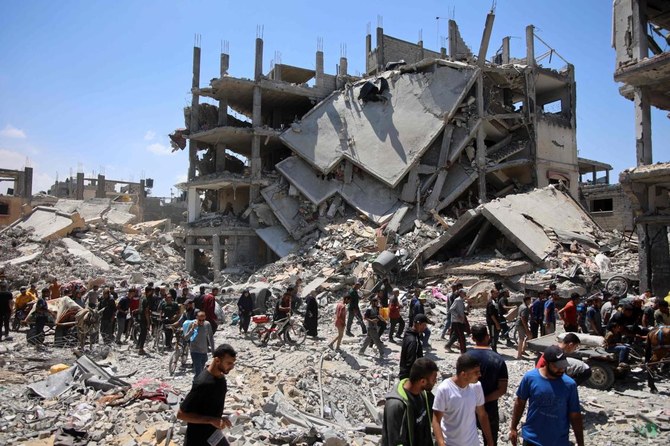
Grandi called what’s happened in Gaza since Hamas’ surprise attack on Oct. 7 and the “atrocious” recent events in the southern city of Rafah after an Israeli airstrike led to a deadly fire at a camp for displaced Palestinians an example of the “brutal conduct of hostilities meant not only to destroy but also to terrify civilians,” who increasingly more often have no choice but to flee.
He said Gaza is also “a tragic reminder of what happens when conflicts (and by extension a refugee crisis) are left unattended” for decades. He also pointed to Syria where after 13 years of conflict, 5.6 million Syrian refugees remain in neighboring countries including Lebanon and Jordan which also host Palestinian refugees.
Grandi said violations of international law, including forcing people to flee, are having a devastating effect on people around the world.
For example, in Myanmar, more than 1.5 million people have been displaced by fighting since October, bringing the total to over 3 million, “with many trying to seek refuge in neighboring countries,” he said.
In Ukraine, international humanitarian law is violated every day with Russian attacks on the country’s power networks, houses and other civilian infrastructure, he said.
And in Congo, Grandi said, “violence between men with guns is so common that no other place on Earth is as dangerous for women and children than the east of that country.”
“But how can members of the United Nations, how can `we the peoples’ pay so little attention and have so much inaction in a place where sex with a child can be bought for less than a cold drink?” the refugee chief asked.
“What a shameful stain on humanity!” Grandi said.


![]()

UN refugee chief says 114 million have fled homes because nations fail to tackle causes of conflict
Short Url
https://arab.news/wqdvh
UN refugee chief says 114 million have fled homes because nations fail to tackle causes of conflict
- UN refugee chief says the number of people fleeing their homes because of war, violence and persecution has reached 114 million


Latest updates


© 2026 SAUDI RESEARCH & PUBLISHING COMPANY, All Rights Reserved And subject to Terms of Use Agreement.