




LONDON: By applying for arrest warrants for senior Israeli ministers and Hamas commanders, Karim Khan, prosecutor at the International Criminal Court, has thrust the court itself into the spotlight, raising questions about the move’s likelihood of success and timing.
Calling it “totally absurd” and “a travesty of justice,” Israel’s Prime Minister Benjamin Netanyahu slammed Khan’s decision to seek arrest warrants against him and Defense Minister Yoav Gallant, together with several Hamas commanders, for war crimes.

A protester shows a sign bearing portraits of Israeli Prime Minister Benjamin Netanyahu transformed to Nazi Germany's leader Adolf Hitler during a demonstration called by French organization "France Palestine Solidarite" in Paris, on May 27, 2024. (AFP)
For his part, Gallant labeled the proposed warrants against him and his prime minister as “disgraceful,” claiming that it was motivated by a desire to reverse the foundation of the state of Israel.
Considering the scant likelihood in this case of an ICC arrest warrant being acted upon — a move Hassan Imran, a senior legal adviser at human rights organization Law for Palestine, told Arab News would be “precedent-making” — it raises the question: What is motivating Khan?

Exterior view of the International Criminal Court in The Hague, Netherlands, on April 30, 2024. (AP/File)
Julie Norman, a senior associate fellow at the London-based Royal United Services Institute, believes the proposed arrest warrants could be intended to nudge the warring parties toward a deal.
“Supporters of the move are hoping the charges will add pressure for both sides to end the conflict, for Hamas to release the hostages, and for Israel to increase access to humanitarian aid in Gaza,” said Norman.
Although some have said the ICC’s action would complicate any ceasefire negotiations, Mark Kersten, assistant professor of criminal justice and criminology at Canada’s University of the Fraser Valley, told a Middle Eastern news outlet that “complicated” did not necessarily equate to “worse” negotiations.
FASTFACTS
• The International Criminal Court is an intergovernmental organization and tribunal seat in The Hague, Netherlands.
• The ICC is distinct from the International Court of Justice, a UN organ that hears disputes between states.
• The ICC was established in 2002 in a follow-up of the multilateral Rome Statute.
“Take Colombia, where the ICC had a decade-long preliminary examination,” he said. “Accountability processes negotiated during the peace process there translated into meaningful justice for many of the wartime atrocities committed by the government and the rebels.
“Moreover, for the ICC to undermine negotiations, there must be a realistic prospect of a peace process. If such negotiations do not exist, the claim that pursuing accountability will ruin them is likely a red herring — an argument intended to shield the perpetrators of atrocities.”

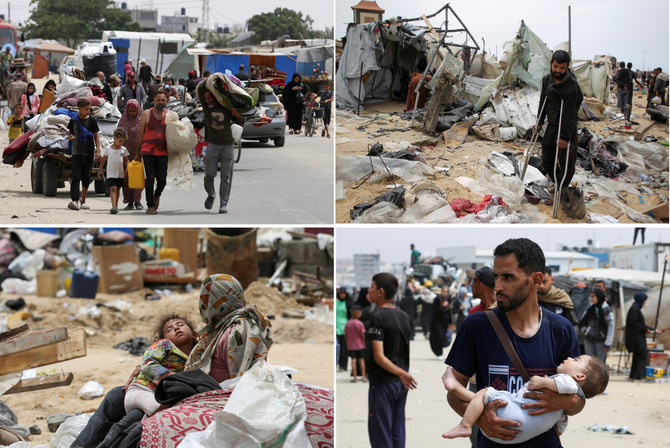
Palestinians gather at the site of an Israeli strike on a camp area housing internally displaced people in Rafah on May 27. (AFP)
Khan’s request has gone to the ICC’s pre-trial chamber, where it will now be down to the three sitting judges — Romania’s Iulia Motoc, Benin’s Reine Alapini-Gansou, and France’s Nicolas Guillou — to determine whether to take action or not.
After seven months of fact-finding, lawyers believe Khan’s case is strong: Netanyahu and Gallant have been accused of using starvation as a weapon of war, willfully causing suffering, willfully killing, intentionally attacking civilian populations, extermination and persecution.
Sergey Vasiliev, associate professor of law at the University of Amsterdam, told Turkiye’s Anadolu news agency that the ICC judges now have to decide whether there are reasonable grounds the accused committed the crimes and if an arrest, as opposed to a summons, is necessary.
“I expect the judges to grant the request. I assume the investigation has been conducted thoroughly over the past seven months, the evidence amply sufficient to meet the threshold and it to be a concise yet compelling legal narrative,” said Vasiliev.

Judges of the committee of the International Criminal Court Committee are assembled at the ICC headquarters in The Hague, Netherlands. (ICC file photo)
Justifying his position, Vasiliev said the standard for “reasonable grounds” was not as demanding as the more onerous “substantial grounds to believe,” adding that applications for arrest warrants were not “generally expected to provide elaborate analysis of the evidence.”
As to the timeline, some commentators expect the judges will make their decision in the near future.
“I think it is a matter of days until we know if the arrest warrants will be issued and then all 124 states that are members of the court are obligated to take action on them,” Gershon Baskin, Middle East director at the International Communities Organization, told Arab News.

Children enjoy the luxury of riding atop a vehicle as many other Palestinians travel on foot along with their belongings to flee Rafah on May 28, 2024 , due to an Israeli military operation on May 28, 2024. (REUTERS)
Given that the ICC neither carries out arrests nor tries people in absentia, the question then becomes one of enforcement. There has been little sign of Israel handing over its own people, with Gallant stressing “it is not a party and does not recognize its authority.”
Nor do Gallant and Netanyahu have to worry about the US turning them over to the ICC. Khan’s move has engendered a rare moment of concord across the aisle, with Republican Sen. Lindsey Graham pushing to censure the ICC.
Graham received a positive response from Secretary of State Antony Blinken after asking: “I want to take actions, not just words. Will you support a bipartisan effort to sanction the ICC — not only for the outrage against Israel but to protect, in the future, our own interests?”

US Senator Lindsey Graham (R-SC) gives a statement to the press during his visit in Tel Aviv, Israel, on May 29, 2024. (REUTERS)
Catching some off-guard, particularly given its vocal support for Israel and having echoed other European states in describing the ICC move as “deeply unhelpful,” Chancellor Olaf Scholz confirmed Germany would not defy an ICC arrest warrant were one to be issued.
On Monday, Israel’s Attorney General Gali Baharav-Miara said Israel’s legal system is actively investigating allegations of possible criminal misconduct during the war in Gaza and that Khan’s request for arrest warrants was therefore hasty and inappropriate.
“The states that established the court saw it as a tool for dealing with situations where there is ‘no law and no judge.’ That is not our situation,” Baharav-Miara told a conference of the Israel Bar Association.
Opinion
This section contains relevant reference points, placed in (Opinion field)
“It would have been more correct for the prosecutor to wait until the internal state procedures were completed before making a decision. It would have been right to give the state of Israel a fair opportunity in this regard.”
Julia Roknifard, an assistant professor at the University of Nottingham’s School of Politics, History, and International Relations, says that in all likelihood, the ICC will not see a case actioned given the lack of jurisdiction it has over Israel itself.
“Netanyahu liked to travel to the US, but I don’t think he is welcome there now, and I don’t think he is in the mood right now to travel at all, so I think it is very unlikely that we would see an arrest were a warrant issued,” Roknifard told Arab News.
Echoing Roknifard, Baskin said it was highly unlikely that Gallant and Netanyahu would travel to any country in which they had any concern of being arrested and handed over to the ICC, describing warrants as “kind of a moot point.”
Roknifard does not believe Khan is pursuing warrants for mere symbolic reasons. “I wouldn’t read into the ICC motion more than it is supposed to be — to charge individuals with the crimes they have (allegedly) committed,” she said

International Criminal Court Prosecutor Karim Khan. (AFP)
Instead, like Imran, Roknifard touts the importance of the case brought by South Africa to the International Court of Justice, which last week ordered Israel to cease its offensive in Rafah — an order that Israel has ignored.
Commenting on Khan’s proposed arrest warrants, Imran said he saw it as less about a particular case and more about the future, or lack thereof, of the ICC.
“European states, I think, now have to make a choice between the institutions they have been supporting financially and their calls for a rules-based order modeled around international law and their support for Israel,” Imran told Arab News.
“We have seen many of them criticize the court in the wake of Khan’s announcement, and now we see some stating they will respect the decision, but it’s hard to tell what they will do were Netanyahu to actually travel to their territory with an arrest warrant out for him.
“Some will try and beat around the bush. But if they did not apply the decision, they would be essentially disowning this international institution and basically disintegrating the ICC and, if they do, that means they will have to change their policy goals.”


