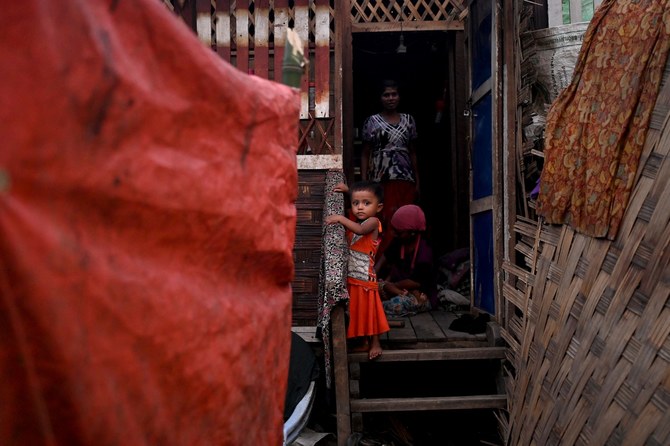

DHAKA: The World Bank approved on Wednesday $700 million to help address the protracted humanitarian crisis facing Rohingya refugees in Bangladesh as international aid drops.
Bangladesh hosts more than 1.2 million Rohingya Muslims who over decades escaped death and persecution in neighboring Myanmar, especially during a military crackdown in 2017.
Most of them live in Cox’s Bazar district, a coastal region in eastern Bangladesh, which with their arrival became the world’s largest refugee settlement.
Humanitarian conditions in the camps have been deteriorating over the years and Bangladeshi authorities have warned they were reaching crisis levels as global aid for the oppressed stateless minority has sharply declined.
The World Bank funding is “to provide basic services and build disaster and social resilience for both the host communities and displaced Rohingya population.”
The financing will be partly a loan, Hasan Sarwar, additional secretary at the Bangladeshi Ministry of Disaster Management and Relief, told Arab News.
“Around half of the amount, which is approved for the well-being of the Rohingyas, will come here as a grant, and the rest of the amount which is for the host community people will be received as a loan,” he said.
He added: “This grant from the World Bank will be helpful for building and repairing infrastructure like roads, drainage systems, solar electricity systems, etc., inside the Rohingya camps. Besides, this fund will be spent on skill development and livelihood projects.
“The majority of the grants will be spent through the UN system for the Rohingyas’ well-being.”
Although Bangladesh is not a signatory to the 1951 UN Refugee Convention, its government supports the Rohingya by providing not only land, but also water, electricity, a huge law-enforcement presence, as well as medical and administrative officials.
Sarwar said the government has spent around $2 billion since the beginning of the crisis on maintaining the infrastructure and managing the community of over 1 million people.
He said part of the World Bank funding could be spent on law enforcement, as security in the camps has been deteriorating amid the continuing civil war in Myanmar, which prevents a UN-backed repatriation process from taking off.
“Repatriation of the Rohingya to Myanmar is the only sustainable solution to this crisis,” Sarwar said. “It has been stalled for months due to the unrestful situation inside Myanmar. We are in touch with the Myanmar military authorities, but the repatriation is almost impossible for now.”