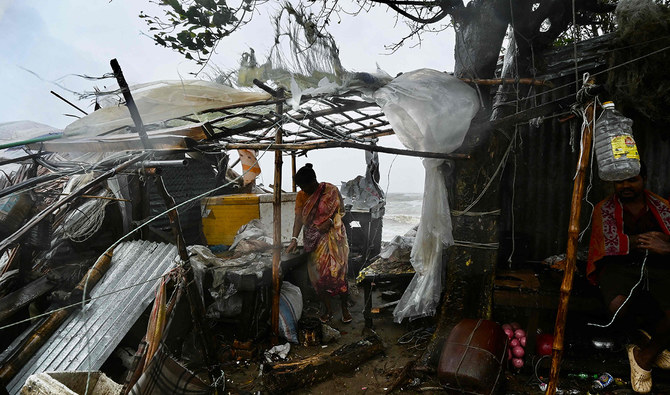

PATUAKHALI: Residents of low-lying areas of Bangladesh and India surveyed the damage Monday as a cyclone that lashed the coast weakened into a heavy storm after killing at least 10 people and destroying thousands of homes.
Fierce gales and crashing waves battered the coast as Cyclone Remal made landfall on Sunday night.
By Monday afternoon it had eased, but winds and rain still hammered residents as they picked through the wreckage of their houses.
Villages had been swamped by storm surges, tin roofs had been ripped off, trees uprooted and powerlines cut, an AFP reporter in the affected area said.
“Heavy rains unleashed by the cyclone are going on, and the wind speed is also high,” said Showkat Ali, government administrator of Barisal district, where seven people died.
“They mostly died after they were crushed under fallen houses or collapsed walls,” he told AFP.
Three others died in neighboring districts, including by drowning.
Cyclones have killed hundreds of thousands of people in Bangladesh in recent decades, but the number of superstorms hitting its densely populated coast has increased sharply, from one a year to as many as three, due to the impact of climate change.
In Khulan district, two people died, government administrator Helal Mahmud told AFP.
“The cyclone has damaged more than 123,000 homes in the division, and among them some 31,000 homes were completely damaged,” he said.
At its peak, Remal’s wind speeds hit 111 kilometers (69 miles) per hour, said Muhammad Abul Kalam Mallik, senior weather forecaster at the state-run Bangladesh Meteorological Department.
While scientists say climate change is fueling more storms, better forecasting and more effective evacuation planning have dramatically reduced the death toll.
Around a million people in Bangladesh and neighboring India took shelter, fleeing inland for concrete storm shelters away from the dangerous waves.
Most of Bangladesh’s coastal areas are just a meter or two (three to six feet) above sea level, making them vulnerable to high storm surges.
Sumita Mondal, 36, who hunkered down overnight away from India’s coast, said she had fled with only what she could carry.
“My three-year-old son is crying for food,” she told AFP by telephone.
Kamrul Hasan, secretary of Bangladesh’s disaster management ministry, said “embankments in several places have been breached or submerged, inundating some coastal areas.”
In India’s West Bengal, the “cyclone has blown off the roofs of hundreds of houses” and “uprooted thousands of mangrove trees and electricity poles,” senior state government minister Bankim Chandra Hazra told AFP.
“Storm surges and rising sea levels have breached a number of embankments,” Hazra added. “Some island villages are flooded.”
At least 800,000 Bangladeshis fled and more than 150,000 people in India moved inland from the vast Sundarbans mangrove forest, where the Ganges, Brahmaputra and Meghna rivers meet the sea.
Mallik, the Bangladeshi weather expert, said the expansive mangrove forests helped dissipate the worst of the storm.
“Like in the past, the Sundarbans acted as a natural shield to the cyclone,” he said.
But Abu Naser Mohsin Hossain, Bangladesh’s senior forest official for the Sundarbans, said the storm surge had swamped crucial freshwater areas with salt water.
“We are worried,” said Hossain. “These ponds were the source of fresh water for the entire wildlife in the mangroves — including the endangered Bengal tigers.”