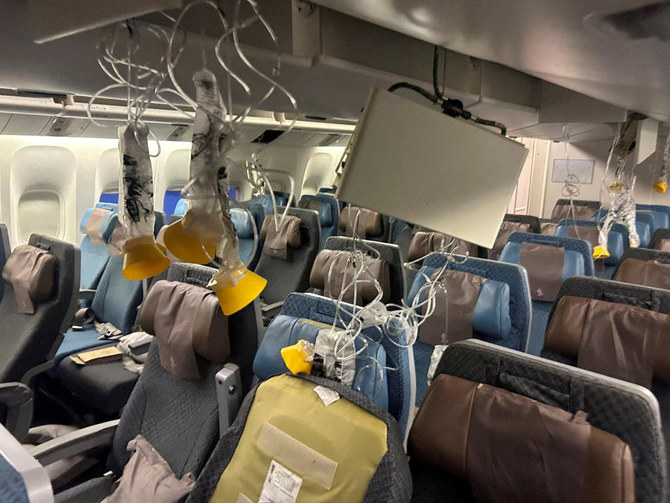
SINGAPORE: Preliminary findings of an investigation into a Singapore Airlines flight hit by severe turbulence last week showed a rapid change in gravitational force and a 54 meter altitude drop caused injuries, Singapore’s transport ministry said on Wednesday.
One passenger died of a suspected heart attack and dozens were injured after Singapore Airline Flight SQ321, flying from London to Singapore, encountered what the airline described as sudden, extreme turbulence while flying over Myanmar. The ministry said the investigation was ongoing.
The SQ321 London-Singapore flight on a Boeing 777-300ER plane carrying 211 passengers and 18 crew diverted to Bangkok for an emergency landing after the plane was buffeted by turbulence that flung passengers and crew around the cabin, slamming some into the ceiling.
“The aircraft experienced a rapid change in G (gravitational force) ... This likely resulted in the occupants who were not belted up to become airborne,” the ministry said in a statement, citing a report by the Transport Safety Investigation Bureau of Singapore.
“The vertical acceleration changed from negative 1.5G to positive 1.5G within 4 seconds. This likely resulted in the occupants who were airborne to fall back down.
“The rapid changes in G over the 4.6 seconds duration resulted in an altitude drop of 178 ft (54 m), from 37,362 ft to 37,184 ft. This sequence of events likely caused the injuries to the crew and passengers,” it said.
The report also said a pilot was heard calling out that the fasten seat belt sign had been switched on.

Singapore Airlines flight investigation finds sharp altitude drop caused injuries
https://arab.news/728wr
Singapore Airlines flight investigation finds sharp altitude drop caused injuries
- One passenger died of a suspected heart attack and dozens were injured after Flight SQ321 encountered extreme turbulence
Fourth Palestine Action activist ends hunger strike in UK prison
- Amy Gardiner-Gibson began eating again after 49 days of protest
- Govt rejects claims it ignored prison safety protocols
LONDON: A fourth Palestine Action activist imprisoned in the UK has ended her hunger strike.
Amy Gardiner-Gibson, who also uses the name Amu Gib, began eating again after 49 days of fasting, the campaign group Prisoners for Palestine said.
Qesser Zuhrah, another activist, ended her hunger strike last week after 48 days but said she might resume it next year, Sky News reported.
Four Palestine Action activists have now ended their hunger strikes while in prison, while four others are continuing to fast.
All of them are in prison on remand, awaiting trial for a series of high-profile alleged break-ins and criminal damage.
Palestine Action was proscribed as a terrorist organization and banned earlier this year.
On Tuesday, Swedish climate activist Greta Thunberg was arrested in central London at a rally in support of the hunger strikers.
The protesters are demanding that weapons factories in Britain with ties to Israel be shut down, as well as the removal of Palestine Action’s proscription.
They are also calling for immediate bail to be given to imprisoned pro-Palestine activists and an end to the alleged mistreatment of prisoners in custody.
Seven imprisoned members of Palestine Action have been transferred to hospital over the course of the hunger strike campaign. Doctors have highlighted concerns about the long-term impact of fasting on the activists.
Lawyers representing the group on Monday initiated legal action against the government over its alleged failure to follow prison safety regulations.
The government, however, has rejected this accusation, Sky News reported.
A Ministry of Justice spokesperson said: “Ministers do not intervene in individual cases. Where individuals are on remand, doing so would risk prejudicing ongoing legal proceedings and undermine the independence of the justice system.
“Concerns about welfare and process can be raised through established legal and administrative channels, including prison governors and ultimately the prison and probation ombudsman.
“Healthcare decisions are taken independently by qualified NHS professionals and appropriate care and oversight frameworks remain in place.”
The activists still on hunger strike include Heba Muraisi and Teuta Hoxha. Hoxha has been on remand for 13 months and her family told Sky News they feared she would die in prison.
Another of the activists, Kamran Ahmad, is believed to have been on hunger strike for 45 days and hospitalized three times.
Lewie Chiaramello, who has Type 1 diabetes, is on day 31 of his strike and taking part by fasting every other day.