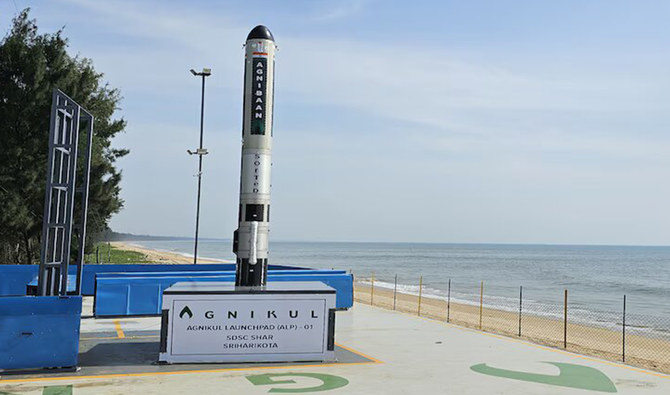
BENGALURU: India’s Agnikul Cosmos called off a test flight of its first rocket on Tuesday seconds before it was due to launch — the fourth such cancelation in the last three months.
Launches of India’s second privately built rocket, and first using a combination of gas and liquid fuel, had been aborted three times before because of technical issues, including one flight that was canceled about 90 seconds before lift-off.
The launch, scheduled for 5:45 a.m. IST (0015 GMT) on Tuesday, was first delayed less than six minutes before lift-off “due to a technical glitch in the countdown activities,” and officials set a new lift-off time of 9:25 a.m.
Only five seconds before lift-off, however, the launch was put on “temporary hold to check igniter performance,” then was called off altogether.
The mission was expected to last two minutes and test the new “semi-cryogenic” engine and 3D-printed parts. If successful, it would have represented a technological step for India, whose Indian Space Research Organization (ISRO) has not yet successfully flown a semi-cryogenic engine, which uses a mix of liquid and gas for propellant.
Agnikul Cosmos’ Agnibaan rocket is a customisable, 2-stage launch vehicle that can take up to 300 kg (about 660 lb) of payload to orbits about 700 km in altitude (435 miles), the company said. SpaceX’s Falcon Heavy can put up to 63,500 kgs to low Earth orbit.
India’s first privately developed rocket, from the company Skyroot, was flown from ISRO’s launch site in 2022.
Founded in 2017, Agnikul — whose name is derived from the Hindi and Sanskrit word for fire — runs the country’s first private launchpad and mission control center, while ISRO operates all other launchpads.

India’s space startup calls off maiden rocket launch for fourth time
https://arab.news/5b4w7
India’s space startup calls off maiden rocket launch for fourth time
- Launches of India’s second privately built rocket had been aborted three times before because of technical issues
- Cosmos’ Agnibaan is customisable, 2-stage launch vehicle that can take up to 300 kg of payload to orbits 700 km in altitude
Military remains loyal after Maduro ouster, Venezuelan exiles say
- The military, and even Maduro’s own son, have pledged loyalty to new interim leader Delcy Rodriguez, Maduro’s former vice president and close confidant
COLOMBIA: Real change has not come to Venezuela despite Nicolas Maduro’s ouster as president and the armed forces remain loyal to the regime: that was the blunt assessment Monday of former security operatives living in exile.
Last weekend, from the Colombian-Venezuelan border, Williams Cancino watched the spectacular US snatch-and-grab of his ex-boss and president.
He hoped it could be the beginning of freedom for Venezuela, after a quarter century of repression, economic depression and one-party rule.
But if things are to really change, first “a new high command is needed” in the country’s powerful security services, he told AFP on Monday.
“The top brass are totally loyal to the regime,” said Cancino, who until his defection in 2019 was an officer in Venezuela’s police and the Special Action Forces, which are often used to crack down on dissent.
Through flawed elections and mass protests, they helped Maduro’s government to survive.
When contacted by AFP, several Venezuelan former soldiers and police officers — branded as traitors by their government — shared the view that many of the same people still control Venezuela, despite a dramatic change at the top.
Much power appears to remain in the hands of Interior Minister Diosdado Cabello and Defense Minister Vladimir Padrino — both wanted by US authorities.
The military, and even Maduro’s own son, have pledged loyalty to new interim leader Delcy Rodriguez, Maduro’s former vice president and close confidant.
“Currently, the armed forces’ leadership is nothing more than an appendage of a dictatorial regime,” said one former colonel who spoke to AFP on condition of anonymity.
With Maduro out of the country, he believes “the high command” should “step aside.”
Cleberth Delgado, a former detective, is also skeptical about a transition in Venezuela while commanders loyal to Rodriguez remain in their posts.
In constant contact with former comrades, many ex-officers say they are preparing to return to Venezuela, with the goal of taking over roles from the current military leadership.
“We are waiting for the right moment to support the new government,” one that is elected at the polls, Delgado said. But so far, there is little sign that it will happen.
Even US Secretary of State Marco Rubio, who has spent his political career campaigning for democracy in Cuba and elsewhere in Latin America, said elections were not the priority in Venezuela.
US President Donald Trump has outright dismissed the idea that Nobel Peace Prize laureate and opposition figurehead Maria Corina Machado could lead the country.
While some former officers still speak of change by force, Cancino hopes his former comrades will do the right thing.
“We don’t want conflict, and much less a civil war. We don’t want to face off against brothers.”