PORT MORESBY: It is “very unlikely” more survivors of Papua New Guinea’s deadly landslide will be found, a UN agency warned Tuesday, as thousands at risk from further slips were ordered to evacuate.
Some 2,000 people are feared buried by a massive landslide that entombed a remote highland community in the early hours of May 24.
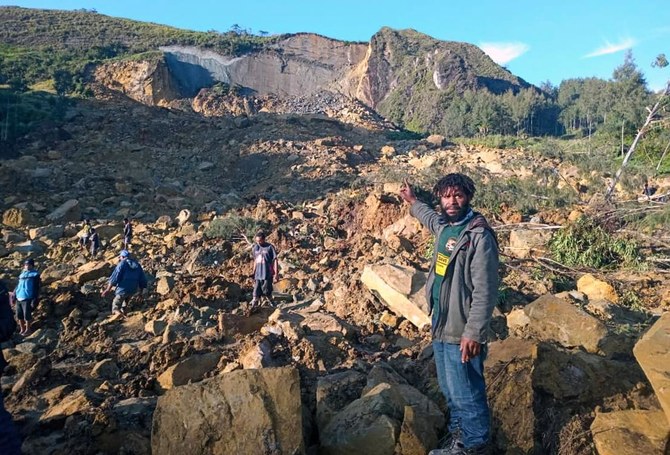
Since then, locals have been picking through a hellscape of meters-deep churned-up earth, uprooted trees and car-sized boulders in the search for loved ones — often using little more than their hands, shovels and digging sticks.
But hopes are dimming that anyone is alive underneath the mountain of rubble.
“It is not a rescue mission, it is a recovery mission,” UNICEF Papua New Guinea’s Niels Kraaier said. “It is very unlikely they will have survived.”
Full-scale rescue and relief efforts have been severely hampered by the remote location, the only road link being severed, heavy rainfall and nearby tribal violence.
The Papua New Guinea Defense Forces have struggled to access the site with heavy earth-moving equipment.
Early on Tuesday, Enga provincial administrator Sandis Tsaka warned the disaster could worsen further, as clumps of limestone, dirt and rock continue to shear off the side of Mount Mungalo.
Tsaka said authorities were now trying to coordinate the evacuation of almost 7,900 more people.
“The tragedy is still active,” he said. “Every hour you can hear rock breaking — it is like a bomb or gunshot and the rocks keep falling down.”
Aid officials said many residents were refusing to leave at-risk areas because they were holding out hope of finding loved ones.
Satellite images show the enormous scale of the disaster.
A vast smear of yellow and grey debris can be seen cutting through once verdant bushland and severing the region’s only road.
“This was an area heavily populated with homes, businesses, churches and schools, it has been completely wiped out. It is the surface of the moon — it is just rocks,” said Tsaka.
“People are digging with their hands and fingers,” he said, expressing anguish at the unde-resourced government’s inability to meet the enormity of the disaster.
“I am not equipped to deal with this tragedy,” Tsaka admitted.
Overwhelmed Papua New Guinea authorities held an online emergency meeting with United Nations agencies and international allies Tuesday, hoping to kickstart the relief effort.
Papua New Guinea’s national disaster center has told the United Nations that the initial “landslide buried more than 2,000 people alive.”
According to a letter obtained by AFP, the slide also “caused major destruction to buildings, food gardens and caused major impact on the economic lifeline of the country.”
The scale of the catastrophe required “immediate and collaborative actions from all players,” it added, including the army, and national and provincial responders.
Australia has announced millions of dollars worth of aid, including emergency relief supplies such as shelters, hygiene kits and support for women and children.
China’s President Xi Jinping and his US counterpart Joe Biden — more accustomed to scrapping for influence in the strategically located country — both offered assistance.
More than 1,000 people have already been displaced by the catastrophe, aid agencies have estimated.
UN Development Programme official Nicholas Booth said up to 30,000 people could have been cut off by the disaster across several villages.
These communities had enough supplies for the coming weeks, but opening up that road remained essential, he said.
“This landslide has blocked the road westward, so not only are there challenges in accessing the village itself, but it does mean the communities beyond that are also cut off.”
Locals said the landslip may have been triggered by recent heavy rains.
Papua New Guinea has one of the wettest climates in the world, and research has found shifting rainfall patterns linked to climate change could exacerbate the risk of landslides.
The estimated death toll has climbed significantly since the disaster struck, as officials reassess the size of the population.
Many people fleeing tribal violence have moved into the area in the past few years.
The area is located about 600 kilometers from Port Moresby.


![]()

‘Unlikely’ to be more survivors from Papua New Guinea landslide
Short Url
https://arab.news/bfm7d
‘Unlikely’ to be more survivors from Papua New Guinea landslide
- Some 2,000 people are feared buried by a massive landslide that entombed a remote highland community
- Full-scale rescue and relief efforts have been severely hampered by the remote location


Latest updates


© 2026 SAUDI RESEARCH & PUBLISHING COMPANY, All Rights Reserved And subject to Terms of Use Agreement.