
LONDON: On July 11 last year, 68-year-old Nora Ghaith and her husband Mustafa Sub Laban lost their battle to hold on to their home in Jerusalem’s Old City — in which Ghaith was born — when Israeli police broke down their door and forcibly evicted the elderly couple.
The eviction of the last remaining Palestinians in an apartment building now filled with settlers was carried out under a controversial law. This legislation enables Jews to claim properties that supposedly belonged to their families before they were evicted in 1948, and were subsequently occupied by Palestinian refugees.

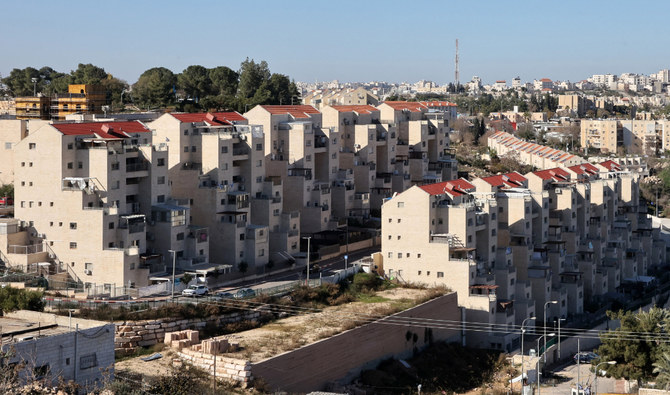
Since Oct. 7, plans for no fewer than eight new settlements in East Jerusalem have been fast-tracked. (AFP)
The Legal and Administrative Matters Law was passed in 1970 after Israel annexed East Jerusalem. The same law does not, however, permit the far larger number of Palestinians whose families were evicted from West Jerusalem in 1948 to reclaim the properties they lost.
In fact, the Absentee Property Law, passed in 1950 and amended in 1973, prevents Palestinians from reclaiming lost properties.
Both laws are doubly unjust, critics say, because Jews who left East Jerusalem in 1948 were later given Palestinian properties in West Jerusalem as compensation, and in being allowed to “reclaim” properties in East Jerusalem are being doubly compensated.

Israeli troops patrol the Palestinian refugee camp of Al-Fara, in the occupied West Bank. (AFP)
Last year, the “deeply shocking and heart-breaking” eviction of the Ghaith-Sub Laban family and many other Palestinian families in East Jerusalem was condemned by UN experts as “part of Israel’s apartheid machinery at work, designed to consolidate Jewish ownership of Jerusalem and racially dominate the city’s population.”
The human rights special rapporteurs said such evictions were “a gross violation of international humanitarian law and a war crime,” and evidence of “intention to annex and colonize the occupied territory in violation of international law.”

Between Oct. 7 last year and March 10, some 98 Palestinian homes were demolished, research reveals. (AFP)
Less than a year on, however, two Israeli human rights nongovernmental organizations said that while the global community’s attention has been focused on the death and destruction unfolding in Gaza, there has been “a major acceleration in the promotion and fast-tracking of new settlement plans in East Jerusalem and a dramatic spike in the rate of demolitions of Palestinian homes.”
The Israeli government “is clearly exploiting the war to create more facts on the ground to predetermine the final status of Jerusalem and thwart all prospects for a negotiated political agreement, while forcibly displacing Palestinians from their homes and the city,” Amy Cohen, director of international relations at Ir Amim, told Arab News.

Ir Amim, or City of Nations, is an Israeli NGO working “to render Jerusalem a more equitable and sustainable city for the Israelis and Palestinians who share it and to help secure a negotiated resolution on the city.”
Research, carried out jointly with Bimkom-Planners for Planning Rights, reveals that between Oct. 7 last year and March 10, some 98 Palestinian homes were demolished — an almost two-fold monthly increase compared with the period preceding the war.
At the same time, there has been “a major uptick” in efforts to create illegal settlements in East Jerusalem either within or alongside Palestinian neighborhoods.
These plans provide for more than 12,000 housing units. With an average 6.5 births per woman among ultra-Orthodox Jewish families recorded in the period 2019 to 2021, this means tens of thousands of additional settlers will be moving into East Jerusalem.

From 2008 to May 12 this year, 1,498 Palestinians were killed in the West Bank and East Jerusalem. (AFP)
According to the most recent census, approximately 361,700 (61 percent) of East Jerusalem’s population are Palestinian Arabs. The remaining 234,000 (40 percent) are Jewish — all of whom are regarded by the international community as illegal settlers in the territory, which has been occupied by Israel since the Six Day War in 1967.
The growing number of illegal settlements is especially concerning in light of the statistics for violent assaults in the West Bank. According to the UN Office for the Coordination of Humanitarian Affairs, from 2008 to May 12 this year, 1,498 Palestinians were killed in the West Bank and East Jerusalem — 10 times as many as the 149 Israeli deaths reported.
There is an even greater disparity in the number of injuries on both sides — 95,383 Palestinians and 2,373 Israelis.
The Israeli authorities “are certainly exploiting the circumstances right now, taking advantage of the fact that the international community is obviously overwhelmed with the horrific, catastrophic conditions in Gaza and all of its implications,” said Cohen.

The growing number of illegal settlements is especially concerning in light of the statistics for violent assaults in the West Bank. (AFP)
“So, while the attention is diverted there — and the Israeli government is complicit in this — the activists in the settler movement are really taking advantage of the circumstances to create more ‘facts on the ground.’”
These “facts” are motivated by the Israeli government’s policy “to ensure that Jerusalem remains what they often call the ‘united, eternal capital of Jerusalem,’ and to preserve the essence of the city being a Jewish capital.
“That means not only do they have to secure control over as much space as possible, but also over the demographic balance of the population — the demographic majority must be in favor of Jewish Israelis, which is being achieved by targeting the Palestinian population.”
She added: “These policies and these measures essentially put a cap on the Palestinian demographic, which serves as a form of — and it’s horrific to even say this — but a form of displacement and population control, to ensure that there will be a Jewish demographic majority in the city.
INNUMBERS
98 Palestinian homes demolished in Oct. 7-March 10 period in East Jerusalem.
12,000 Housing units planned in illegal settlements in East Jerusalem.
“And this has been playing out in the form of demolitions.”
Since Oct. 7, plans for no fewer than eight new settlements in East Jerusalem have been fast-tracked.
The fear, said Cohen, was that the situation was approaching a tipping point beyond which the implementation of a two-state solution would become impossible.
“If the international community were to come together today with representatives of Israel and the Palestinian Authority and begin to sit down and draw some sort of road map, it would look very, very different than it did 20 years ago, during Camp David or even before that during the Oslo Accords,” she said.

The Israeli government ‘is clearly exploiting the war to create more facts on the ground to predetermine the final status of Jerusalem,’ said Amy Cohen.
“Obviously, any road map would have to be adapted to the reality of today. You cannot reverse most of what has happened up until now in Jerusalem. But you can certainly prevent what Israel is trying to do right now.
“And so first and foremost is the need to really address the here and now, to halt the major developments on the ground for settlements and to halt the mechanisms of displacement, such as demolitions and evictions.”
Opinion
This section contains relevant reference points, placed in (Opinion field)
She added: “If the international community is really serious about a two-state solution, it needs to act now to hold Israel accountable to international law and the parameters of a two-state solution, and so far we haven’t seen that.”
Since the outbreak of the war there has been renewed discussion about the need to jump-start a new peace process, to renew dialogue toward an agreed-upon negotiated resolution.

The Absentee Property Law, passed in 1950 and amended in 1973, prevents Palestinians from reclaiming lost properties. (AFP)
“But with that, we have to bring back the centrality of Jerusalem in the debate, because without Jerusalem there is really no two-state solution.
“And as we all know, without a two-state solution, we will not be able to achieve peace and security for all of us, Israelis and Palestinians, living between the river and the sea.”


keywords