

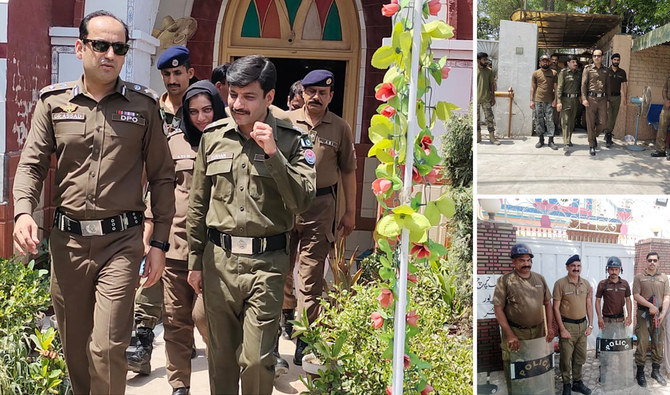
Police in Pakistan’s Sargodha finalize ‘hyper security’ arrangements for churches following mob attack 

The combination of photos shows police in Pakistan’s easter Sargodha district supervises security arrangements at churches following a mob attack against the Christian community on May 26, 2024. (Photo courtesy: @sargodhapolice/X)
Short Url
Updated 27 May 2024
Follow

Police in Pakistan’s Sargodha finalize ‘hyper security’ arrangements for churches following mob attack 

  • Angry mob attacked Christians in Pakistan’s eastern Sargodha district over blasphemy allegations 
  • Over 1,000 police officers and youths performing duties at key churches in Sargodha district, say police

ISLAMABAD: Police in Pakistan’s eastern Sargodha district said recently it has finalized “hyper security” arrangements at churches following last week’s mob attack against the Christian community that left one person critically injured. 

Violence erupted in Sargodha city on Saturday when a furious mob targeted members of the Christian community after some people accused their Christian neighbor of desecrating the Holy Qur’an. The house and a small shoemaking factory owned and operated by the man were burned down in the ensuing rampage, which was followed by police action that led to clashes with angry protesters.

The incident came within a year after another attack on the Christian community in August 2023, when a mob in Jaranwala city burned churches and targeted several houses in a similar incident involving blasphemy allegations.

“Sargodha police have completed arrangements for the hyper security of churches across the district,” Sargodha Police wrote on social media platform X. It added that over 1,000 police officers and youths were performing duties at important churches in the district. 

Saturday’s attack was condemned by rights activists and Pakistan’s leading human rights body, the Human Rights Commission of Pakistan (HRCP). Pakistani Christian rights activists protested against the attack on Saturday in Karachi, raising alarm over the safety of minorities in the South Asian country. 

“As a 27-year-old Pakistani Christian who has never been abroad since the day I was born to the moment I’m standing here, I and every Christian who calls themselves Pakistani live under fear, under pressure and under the constant threat of being, God forbid, accused of committing blasphemy,” Luke Victor, a rights activist and one of the organizers of the Karachi demonstration, said. 

Blasphemy is an incendiary charge in deeply conservative, Muslim-majority Pakistan, where even unproven allegations of insulting Islam have provoked deadly vigilantism.

Christians, who make up around two percent of Pakistan’s population, occupy one of the lowest rungs in society and are frequently targeted with spurious blasphemy allegations.
Politicians have also been assassinated, lawyers murdered and students lynched over such accusations.


JazzCash signs deal with Binance in UAE to explore regulated crypto adoption in Pakistan

Updated 12 sec ago
Follow

JazzCash signs deal with Binance in UAE to explore regulated crypto adoption in Pakistan

  • MoU focuses on awareness and development of compliant virtual-asset solutions in Pakistan
  • Pakistan introducing licensing regime for crypto firms as it formalizes digital-asset oversight

ISLAMABAD: Pakistani financial-technology platform JazzCash has signed a memorandum of understanding with global cryptocurrency exchange Binance in the United Arab Emirates to explore cooperation on virtual-asset use and education in Pakistan, the company said on Wednesday.

The agreement sets a framework for discussions on awareness campaigns and future digital-asset products that would comply with Pakistan’s emerging crypto regulations. The move signals growing engagement between global blockchain companies and Pakistani fintechs as authorities shift toward formal licensing of the sector.

Pakistan has spent the past year drafting rules to regulate the fast-expanding market for digital coins and tokens, requiring virtual-asset service providers to obtain government approval. Officials say the transition is aimed at curbing money-laundering and terror financing risks, boosting transparency and encouraging responsible innovation.

“JazzCash has always championed technologies that expand financial access while promoting secure and inclusive participation in the digital economy," JazzCash Chief Executive Officer Murtaza Ali said. 

“By entering into this exploratory MoU with Binance, we are advancing our efforts to understand how global digital-asset trends can support Pakistan’s evolving regulatory landscape. We aim to engage responsibly, support regulatory progress, and advance opportunities that build trust, transparency and innovation for our customers.”

The MoU does not establish a commercial partnership, but marks one of the most high-profile engagements between Pakistan’s fintech sector and a global crypto exchange as the country moves toward regulated digital-asset adoption.

Binance welcomed the cooperation, framing it as part of Pakistan’s shift toward regulated digital-asset activity.

"With regulatory frameworks like [Pakistan Virtual Assets Regulatory Authority] PVARA paving the way, this collaboration represents a significant step toward expanding financial inclusion and empowering more people to access the benefits of blockchain technology in a secure and compliant environment," Binance Chief Marketing Officer Rachel Conlan said.

Earlier this month, Binance executives met Pakistani finance officials to discuss digital-payments reform, blockchain-skills training and the potential for Web3-linked jobs. Pakistan also set up the Pakistan Crypto Council and formed PVARA this year to license and supervise crypto-asset service providers.