

Philippines boosts halal certification to cater to more Muslim tourists 

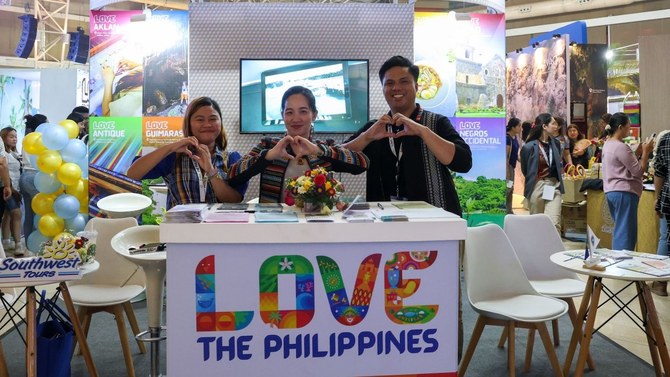
Exhibitors pose with a love sign at the Mindanao Tourism Expo in Cagayan de Oro, Philippines. (File/Philippines’ Department of Tourism)
Short Url
Updated 26 May 2024
Follow

Philippines boosts halal certification to cater to more Muslim tourists 

  • Tourism is key sector for the Southeast Asian country, comprising 13 percent of GDP
  • Philippines wants to double its halal-certified products and services by 2028

MANILA: The Philippines is working to cater more to Muslim tourists, officials have said, with efforts underway to increase halal accreditation of hotels and restaurants in the country. 

Tourism is a key sector for the archipelago known for its white sandy beaches, diving spots and diverse culture, having contributed nearly 13 percent, or about $44 billion, to the Philippines’ gross domestic product in 2019. 

The Department of Tourism has lately been trying to attract more Muslim tourists from around the world, particularly by ensuring halal certification in restaurants.  

“All the regions (in the Philippines) are working … to be Muslim-friendly … Throughout the country, we are doing the same … We continue to encourage our restaurant-owners to be Muslim-friendly and eventually put up their own halal kitchen,” DOT Undersecretary Myra Paz Abubakar told Arab News over the weekend. 

The predominantly Catholic Philippines — where Muslims constitute about 10 percent of the nearly 120 million population — has also been working to develop its overall domestic halal industry by 2028, with plans to double the number of its halal-certified products and services. 

Earlier this month, the tourism department led a delegation to the Arabian Travel Market in Dubai, where they promoted the country’s best tourism to the international market at a time when tourist arrivals have been increasing from the Middle East. 

The Philippines welcomed more than 2 million international travelers since the beginning of the year, according to official data, including a 10 percent increase in visitors arriving from Gulf countries, especially Saudi Arabia and the UAE, which has been among the Philippine government’s key emerging-market targets.

But the Southeast Asian country is also eager to attract international Muslim visitors beyond the Gulf, Abubakar said. 

“DOT is not only targeting the Middle East market but our neighboring countries as well such as Brunei, Indonesia and Malaysia,” she said, citing Muslim-majority countries in the region. 

The Philippines was recognized with the Emerging Muslim-friendly Destination of the Year award last year at the Halal in Travel Global Summit held in Singapore. 

Since then, the Muslim market has been a priority for the country’s tourism sector.  

“We’re preparing to certify Muslim-friendly hotels and restaurants … We’re trying to be ready especially with the food because we know that the food, the halal certification, is very important,” DOT regional director Marie Elaine Unchuan told Arab News. 

The Philippines, which has Southeast Asia’s third-largest Muslim population, is preparing itself to be as halal-friendly as possible, as during international tourism fairs Philippine officials often get asked about the country’s readiness to host Muslim travelers, she said.  

“That was one of the questions … Do we have halal-certified restaurants, and do we have Muslim-friendly hotels? So, we’re really working on it. We’d rather be very prepared so that we can market more.” 


Uganda army denies seizing opposition leader as vote result looms

Updated 58 min 6 sec ago
Follow

Uganda army denies seizing opposition leader as vote result looms

  • Election day was marred by significant technical problems after biometric machines
  • There were also reports of violence against the opposition in other parts of the country

KAMPALA: Uganda’s army denied claims on Saturday that opposition leader Bobi Wine had been abducted from his home, as counting continued in an election marred by reports of at least 10 deaths amid an Internet blackout.
President Yoweri Museveni, 81, looked set to be declared winner and extend his 40-year rule later on Saturday, with a commanding lead against Wine, a former singer turned politician.
Wine said Friday that he was under house arrest, and his party later wrote on X that he had been “forcibly taken” by an army helicopter from his compound.
The army denied that claim.
“The rumors of his so-called arrest are baseless and unfounded,” army spokesman Chris Magezi told AFP.
“They are designed to incite his supporters into acts of violence,” he added.
AFP journalists said the situation was calm outside Wine’s residence early Saturday, but they were unable to contact members of the party due to continued communications interruptions.
A nearby stall-owner, 29-year-old Prince Jerard, said he heard a drone and helicopter at the home the previous night, with a heavy security presence.
“Many people have left (the area),” he said. “We have a lot of fear.”
With more than 80 percent of votes counted on Friday, Museveni was leading on 73.7 percent to Wine’s 22.7, the Electoral Commission said.
Final results were due around 1300 GMT on Saturday.
Wine, 43, whose real name is Robert Kyagulanyi, has emerged as the main challenger to Museveni in recent years, styling himself the “ghetto president” after the slum areas where he grew up in the capital, Kampala.
He has accused the government of “massive ballot stuffing” and attacking several of his party officials under cover of the Internet blackout, which was imposed ahead of Thursday’s polls and remained in place on Saturday.
His claims could not be independently verified, but the United Nations rights office said last week that the elections were taking place in an environment marked by “widespread repression and intimidation” against the opposition.

- Reports of violence -

Analysts have long viewed the election as a formality.
Museveni, a former guerrilla fighter who seized power in 1986, has total control over the state and security apparatus, and has ruthlessly crushed any challenger during his rule.
Election day was marred by significant technical problems after biometric machines — used to confirm voters’ identities — malfunctioned and ballot papers were undelivered for several hours in many areas.
There were reports of violence against the opposition in other parts of the country.
Muwanga Kivumbi, member of parliament for Wine’s party in the Butambala area of central Uganda, told AFP’s Nairobi office by phone that security forces had killed 10 of his campaign agents after storming his home.
