
MAKKAH: The global halal industry is poised for rapid expansion, with Saudi Arabia expected to play a vital role in developing Shariah-compliant products, said a senior minister.
Speaking at the inaugural edition of the Makkah Halal Forum, the Kingdom’s Minister of Commerce Majid bin Abdullah Al-Qasabi noted the significance of witnessing both local and international participation alongside the signing of six agreements on the sidelines of the event.
Held at the Makkah Chamber of Exhibitions and Events Center, the three-day forum included panel discussions that took place the day before.
Al-Qasabi said: “The halal industry stands as one of the most rapidly expanding sectors globally. Presently, the food market is valued at approximately $2.5 trillion, and is expected to reach $5.8 trillion in 2033.”
The global halal product industry is poised for an unprecedented transformation, as highlighted by Abdullah Saleh Kamel, president of the Islamic Chamber of Commerce and Development, during the same event.
He noted that Crown Prince Mohammed bin Salman has elevated the status of halal products to a focal point of global interest through the establishment of Halal Products Development Co. by the Public Investment Fund.
“This is the first instance where we learn of a sovereign wealth fund establishing a specialized firm for the development of halal products. In fact, we take pride that this company is a strategic partner for the forum," said Kamel.
The initiative aims to advance the global halal industry and develop a vital and flexible system for halal products in Saudi Arabia.
Fawaz bin Talal Al-Harbi, chairman of HPDC, underscored the rising global interest in halal products and services, with anticipated consumer spending reaching $5 trillion in the coming years.
He added that research indicates the Kingdom is among the leading importers of halal industries and products.
“Furthermore, Saudi Arabia is also the largest exporting nation of halal products to non-Muslim countries, generating great opportunities in the halal industry in the Kingdom,” said Al-Harbi, providing an example of the establishment of HPDC.
Al-Harbi emphasized that the forum aims to empower the promising halal sector by engaging the private sector, regulators, and legislative authorities to leverage the numerous opportunities in this field.
The objective is to unlock promising horizons for young people, foster the exchange of views, share expertise and experiences, and introduce the latest practices for the sector's development.
Amid varying reports on the global scale of the halal market, Yousuf Khalawi, secretary-general of the Islamic Chamber of Commerce and Development, indicated that the market for halal food and beverages is estimated to range between $2.2 to $2.8 trillion, experiencing an average growth rate of around 15 percent.
In an interview with Arab News, Khalawi expressed his belief that the statistics released by consulting firms are not accurate.
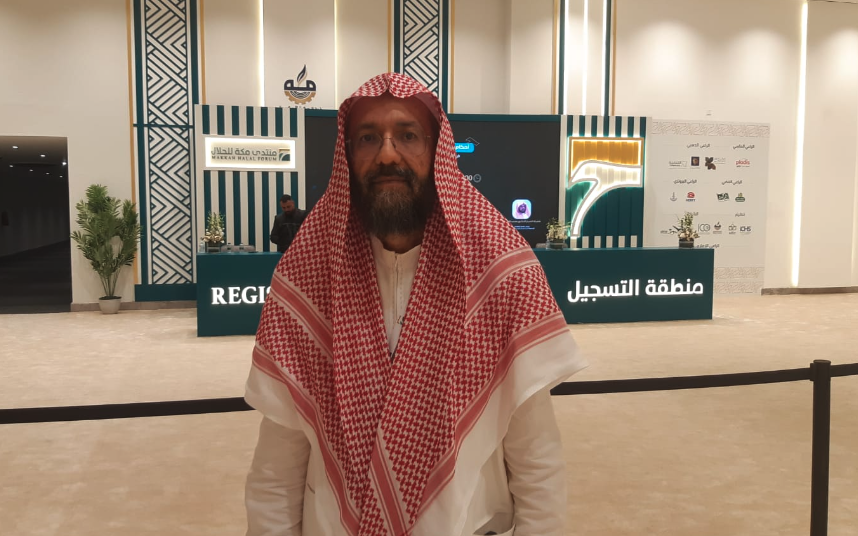
Yousuf Khalawi, secretary-general of the Islamic Chamber of Commerce and Development.
“I can give you just an example (to illustrate) why. The whole production of Saudi Arabia is considered halal, but it is not classified as Islam-compliant food simply because most of Saudi products are not stamped with ‘Halal’ or have certifications showing they are halal,” he explained.
He added that everyone knows that all Saudi products are halal, saying: “Major Muslim countries’ productions, like Saudi Arabia, Turkiye, Indonesia, Malaysia, are halal, even if it is (not) printed on the product.”
Halal certification
The secretary-general emphasized the significance of halal products carrying a certified tag, a designation that would be granted based on specific criteria to ensure Shariah compliance.
“If you want to get anything certified, this means you need standards. So, till now most Muslim countries do not have an official standardization. So, anyone can create a halal certificate and give it to any production company,” he told Arab News.
With well-established countries like Saudi Arabia, he added, products lacking Shariah-compliant certification are not allowed.
“This will upgrade the standard of standardization around the world. So, we are very happy with countries that have detailed specifications for halal such as the UAE, Turkiye, Malaysia, Comoros and more. This will improve the whole halal (industry) and will make it a professional industry,” Khalawi said.
He strongly believes that as more countries prioritize this issue, the halal industry will continue to improve as “huge developments (are) still needed in the halal (world) to be a professional industry.”
Six deals signed
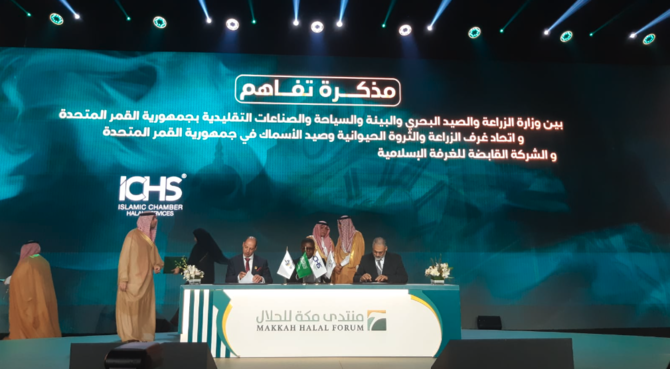
The forum witnessed the signing of six deals aimed at enhancing collaboration among the involved parties, marking the inauguration of a new phase for the halal industry and laying the foundation for future accomplishments in this sector.
The agreements comprised a memorandum of understanding between the HPDC. and Sinad Holding Co. Another MoU was inked between HPDC and the Islamic Chamber of Commerce and Development.
A third agreement between Manafae and the Federation of Pakistan Chambers of Commerce and Industry was signed, and the fourth deal was between Manafae and the Federation of Saudi Chambers.
Additionally, an agreement was reached between the Islamic Chamber Halal Services Co. and the Indonesian Chamber of Commerce and Industry.
The sixth MOU was signed between the Ministry of Agriculture, Fisheries, and Environment of Comoros and the Holding Co. of the Islamic Chamber of Commerce and Development.
Kamel of the Islamic Chamber of Commerce and Development underscored the profound spiritual significance of Makkah for Muslims worldwide. Additionally, he highlighted the city’s role as the forum venue, emphasizing its purpose for the collective well-being of the Muslim community.
Kamel, who also serves as the chairman of the board of directors of the Makkah Chamber of Commerce, pointed out that the forum is one of the activities stemming from the Manafea Agreement.
The tripartite agreement between the Chamber of Commerce of Makkah, the Chamber of Commerce of Madinah, and the Islamic Chamber of Commerce, Industry, and Agriculture is designed to transform the two cities into hubs for business events and an investment center, ultimately benefiting Muslims globally.