Army captain, soldier killed in gunbattle with militants in northwest Pakistan

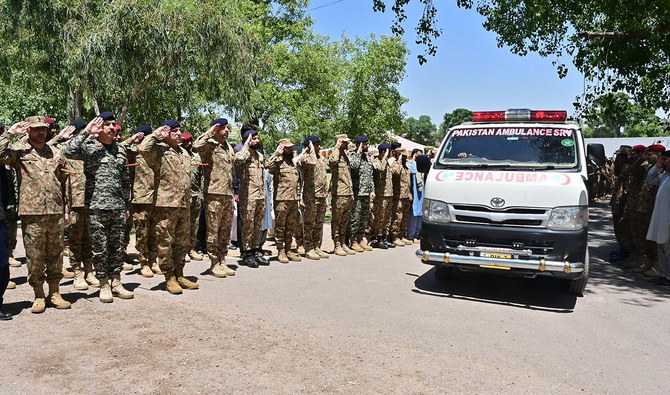
In this handout photo, taken and released by Pakistan's Inter-Service Public Relations (ISPR), military personnel attend funeral prayers for two army officials who were killed in a shootout with militants in Peshawar District on May 26, 2024. (Photo courtesy: ISPR)
Short Url
Updated 26 May 2024
Follow

Army captain, soldier killed in gunbattle with militants in northwest Pakistan

  • Five militants killed, three injured during shootout in Peshawar district, says army’s media wing 
  • Pakistan has seen surge in attacks since Nov. 2022 when its truce broke down with Pakistani Taliban

ISLAMABAD: A Pakistan Army captain, soldier and five militants were killed in a shootout with militants in the northwestern Peshawar District on Sunday, the army’s media wing said in a statement.
The gunbattle took place when security forces conducted an intelligence-based operation in Hassan Khel area in Peshawar District on the reported presence of “terrorists,” the Inter-Services Public Relations (ISPR), the army’s media wing, said. 
It said five “terrorists” were killed while three others were injured during the exchange of fire. 
“However, during an intense exchange of fire, leading his troops from the front, Captain Hussain Jahangir (age: 25 years, resident of Rahim Yar Khan District) along with another brave son of soil, Havildar Shafiq Ullah (age: 36 years, resident of District Karak), having fought gallantly, made the ultimate sacrifice and embraced Shahadat,” the ISPR said. 
The army said a sanitization operation was being carried out to eliminate any militants found in the area. 
“Security forces of Pakistan are determined to eliminate the menace of terrorism and such sacrifices of our brave soldiers further strengthen our resolve,” the army said.
 Prime Minister Shahbaz Sharif paid tribute to the security forces for killing five militants in a successful operation in Peshawar’s Hassan Khel area.
“The soldiers of the security forces carried out a successful operation against the terrorists by putting their lives at stake,” Sharif said in a statement. “[We] will rest only after completely eradicating the menace of terrorism.”
The entire nation was proud of its brave forces and paid a tribute to the martyrs, he added.
Pakistan’s security forces have suffered a surge in attacks from the Pakistani Taliban or the Tehreek-e-Taliban Pakistan (TTP) in the country’s western regions bordering Afghanistan ever since a fragile truce between the state and the banned outfit broke down in November 2022. 
The TTP, which seeks to impose its strict version of Islam in the South Asian country, has carried out some of the deadliest attacks against Pakistani civilians and security forces since 2007 before the army conducted multiple operations to drive them out of the tribal areas. 
Repeated attacks from the TTP against Pakistan’s security forces have soured relations between Islamabad and Kabul. Pakistan has accused the Taliban of providing shelter to TTP militants to attack Pakistan. Kabul has denied the allegations and insisted it does not allow any group to launch attacks on other countries from its soil.


Pakistan plans Benghazi consulate, lending legitimacy to Libya’s eastern authorities

Updated 6 sec ago
Follow

Pakistan plans Benghazi consulate, lending legitimacy to Libya’s eastern authorities

  • Libya descended into turmoil after a 2011 NATO-backed uprising toppled Muammar Qaddafi and has been divided into eastern, western authorities
  • The UN-recognized government in Tripoli controls the west, while the Libyan National Army forces based in ‌Benghazi hold ‌the east and the south

KARACHI: Pakistan is in talks to open a consulate ​in the eastern Libyan city of Benghazi, three sources with knowledge of the matter said, a move that could give a diplomatic boost to eastern authorities in their rivalry with Libya’s west.

Libya descended into turmoil after a 2011 NATO-backed uprising toppled Muammar Qaddafi and has been divided into eastern and western authorities since a 2014 civil war. The UN-recognized government in Tripoli controls the west, while

Libyan National Army leader Field Marshal Khalifa Haftar’s forces based in ‌Benghazi hold ‌the east and south, including major oilfields.

Islamabad would be ‌joining ⁠a ​small ‌group of countries with a diplomatic presence in Benghazi. Haftar discussed the move with officials during an ongoing visit to Pakistan, the sources said.

Haftar met Pakistan’s army chief on Monday to discuss “professional cooperation,” the Pakistani military said. He was due to sit down with Prime Minister Shehbaz Sharif on Tuesday, the sources said, declining to be identified because they were not authorized to speak to the media.

Pakistan’s prime ⁠minister’s office and foreign ministry did not respond to requests for comment.

The LNA’s official media page ‌said Haftar and his son Saddam met senior Pakistani ‍army officials “within the framework of strengthening bilateral ‍relations and opening up broader horizons for coordination in areas of common ‍interest.” It did not give further details and Reuters could not immediately reach eastern Libyan authorities for comment.

Pakistan’s air force said in a statement that Saddam Khalifa Haftar met Air Chief Zaheer Ahmed Baber Sidhu to discuss expanding defense cooperation, including joint training, ​with Islamabad reaffirming its support for the “capability development” of the Libyan air force. Pakistan’s army chief Field Marshal Asim Munir visited Benghazi in December, ⁠where he signed a multibillion-dollar defense deal with the LNA, previously reported by Reuters.

All three sources said the decision to open a consulate in Benghazi was linked to the $4 billion defense deal, one of Pakistan’s largest-ever arms sales.

Libya has been under a UN arms embargo since 2011, although UN experts have said it is ineffective. Pakistani officials involved in the December deal said it did not violate UN restrictions. Haftar has historically been an ally of the UAE, which supported him with air power and viewed him as a bulwark against extremists, while Pakistan — the only nuclear-armed Muslim-majority nation — signed a wide-ranging mutual defense pact with Saudi Arabia ‌late last year.