

Pakistan welcomes Ireland, Spain, and Norway’s recognition of a Palestinian state

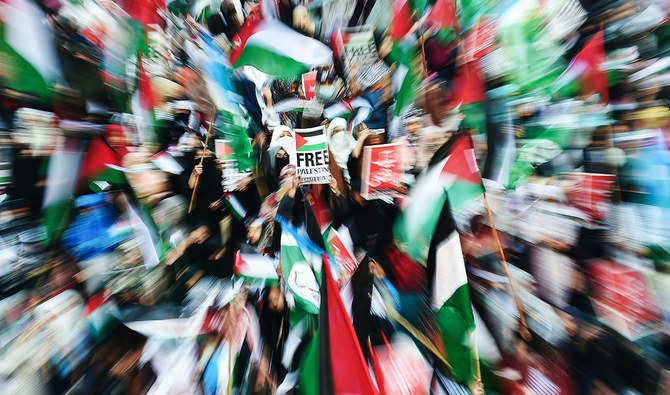
Supporters of Jamaat e Islami (JI) display placards and Palestine’s flags during a pro-Palestinian march in Karachi on January 14, 2024. (AFP)
Short Url
Updated 24 May 2024
Follow

Pakistan welcomes Ireland, Spain, and Norway’s recognition of a Palestinian state

  • Ireland, Spain and Norway have said will formally recognize Palestinian state from May 28
  • This followed recognitions by Barbados, Jamaica, Trinidad and Tobago and the Bahamas

ISLAMABAD: Pakistan on Friday called on the United Nations Security Council (UNSC) to grant Palestine full membership of the world body and welcomed Ireland, Spain and Norway’s announcement they would recognize a Palestinian state on May 28.
The prime ministers of the three countries made the announcement on Wednesday, following recent recognitions by Barbados, Jamaica, Trinidad and Tobago and the Bahamas. The additions have brought the total number of countries recognizing the Palestinian state to nearly 150.
Speaking at a weekly press briefing, Mumtaz Zahra Baloch, a spokesperson for the Pakistani foreign office, said her country welcomed the recent announcements on recognition for Palestine as a state.
“The State of Palestine is now recognized by an overwhelming majority of UN member states,” she told reporters in Islamabad. “Time has therefore come to accord full membership to the State of Palestine at the United Nations and other international organizations as called for by the UN General Assembly in its recent resolution.”
Baloch reiterated Pakistan’s call to the UN Security Council to “move positively in that direction.”
Pakistan does not recognize the state of Israel and calls for an independent Palestinian state based on “internationally agreed parameters” and the pre-1967 borders with Al-Quds Al-Sharif as its capital.
In recent months, the South Asian country has repeatedly raised the issue of Israel’s war on Gaza, launched last October, at the United Nations through its permanent representative, Ambassador Munir Akram.
“These recent announcements serve as another milestone in the decades-long quest of the people of Palestine for their right to self-determination,” she said.
“The Gaza genocide and the entire humanitarian situation there have underlined the urgency of moving toward the establishment of an independent and sovereign Palestinian state with Al-Quds Al-Sharif as its capital.”
The statement came as the top UN court was due to rule on a plea to halt the offensive in Gaza over accusations of a “genocide,” amid continuing Israeli military offensive.
Israel launched its war on Gaza after Hamas’s unprecedented attacks on October 7 that resulted in the deaths of more than 1,170 people, mostly civilians. Militants also took 252 hostages, 121 of whom remain in Gaza.
Israel’s retaliatory offensive has since killed at least 35,800 people in Gaza, mostly women and children, according to the Palestinian health ministry.
UAE INVESTMENT

Baloch also spoke about the United Arab Emirates (UAE) on Thursday committing $10 billion to invest in promising economic sectors as Pakistan pushes for foreign investment in a bid to shore up its $350 billion economy, which has struggled with high inflation and low growth as it navigates a tough reforms mandated by the International Monetary Fund (IMF).
“Prime Minister Muhammad Shehbaz Sharif paid an official visit to the United Arab of Emirates] yesterday [Thursday] at the invitation of the President of the UAE His Highness Sheikh Mohamed bin Zayed Al Nahyan,” Baloch told reporters.
“The prime minister held a bilateral meeting with the president and held meetings with UAE investors and entrepreneurs.”
She said the two leaders underscored the importance of “galvanizing cooperation and strategic partnership,” particularly in the fields of information and communication technologies, artificial intelligence, renewable energy and tourism. 
“They reaffirmed their commitment to ensure meaningful implementation of investment cooperation agreements in the area of energy, port operation projects, wastewater treatment, food security, logistics, minerals, banking and financial services, signed in November 2023,” Baloch added.
“His Highness Sheikh Mohamed bin Zayed Al Nahyan assured UAE’s support in all circumstances and made commitment of investing $10 billion dollars in multiple sectors in Pakistan.”


World Bank approves $400 million to expand water, sanitation services in Pakistan’s Punjab

Updated 4 sec ago
Follow

World Bank approves $400 million to expand water, sanitation services in Pakistan’s Punjab

  • Project aims to improve access for 4.5 million people and curb waterborne diseases
  • Program to prioritize women’s participation and climate-resilient urban infrastructure

ISLAMABAD: The World Bank this week approved $400 million for a new project to expand access to safe water, sanitation and hygiene services for around 4.5 million people in Pakistan’s most populous Punjab province, aiming to curb waterborne diseases and reduce long-term public health costs.

The project, known as the Punjab Inclusive Cities Program (PICP), is the second phase of the World Bank-supported Pakistan Urban Water, Sanitation and Hygiene Services Multiphase Programmatic Approach. It will focus on rehabilitating water supply networks, sewerage systems and wastewater treatment plants, while expanding stormwater drainage infrastructure across 16 secondary cities in Punjab.

Punjab faces persistent challenges in providing safe drinking water and adequate sanitation, with many urban households relying on contaminated sources. Weak infrastructure and limited hygiene services contribute to high rates of waterborne diseases such as diarrhea, typhoid and hepatitis, which disproportionately affect children and low-income communities.

“Reducing child stunting is essential for Pakistan’s future. Through the Punjab Inclusive Cities Program, we are investing in safe water, sanitation, and hygiene services to break the cycle of malnutrition and disease that holds back so many children from reaching their full potential,” the World Bank quoted its Country Director for Pakistan, Bolormaa Amgaabazar, as saying in a statement.

“In collaboration with the Punjab Government, the program represents a significant step forward in improving urban infrastructure and strengthening local institutions, thereby laying the foundation for healthier communities and a more prosperous Pakistan.”

Child stunting, a form of chronic malnutrition that leaves children too short for their age, is often linked to repeated infections, poor sanitation and unsafe drinking water, and remains a major public health concern in Pakistan.

Beyond water and sanitation, the project will also support solid waste management systems to improve sanitary waste disposal, extending services to an additional two million people in Punjab’s urban areas. The program will strengthen the capacity of local governments, including efforts to improve revenue generation and long-term service sustainability.

“The program complements infrastructure investments with capacity building and revenue generation, helping to ensure that service delivery is well sustained,” the statement quoted Amena Raja, Senior Urban Specialist at the World Bank, as saying.

“It will also help Punjab’s cities better withstand floods and droughts, ensuring urban development is both environmentally responsible and resilient to climate change.”

The program includes a gender-focused component, prioritizing the hiring of women in decision-making roles, establishing gender-compliant service desks and supporting skills development. It also aims to mobilize private capital to support water and sanitation services in Punjab’s secondary cities.

Pakistan has been a member of the World Bank since 1950 and has received more than $48 billion in assistance since. The Bank’s current portfolio in the country comprises 54 projects with total commitments of $15.7 billion, while its private-sector arm, the International Finance Corporation, has invested about $13 billion since 1956.

Earlier this year, Pakistan and the World Bank signed a first-of-its-kind agreement for a plan to focus $20 billion in lending to the cash-strapped nation over the coming decade on development issues like the impact of climate change as well as boosting private-sector growth.