

BEIRUT: Lebanese school children on a bus had a narrow escape when a drone strike killed a Hezbollah member in the car ahead, blowing out the windscreen of their vehicle and wounding three pupils.
Mohammed Nasser Farran, also a physics teacher at a public school in Nabatieh, was killed in the Israeli strike that targeted his car early on Thursday.
Three students were injured in the attack, which left the car in flames.
The strike was the first targeting a school teacher since the beginning of the confrontation between Hezbollah and the Israeli army.
Farran, 35, who is originally from Nabatieh and a resident of Kfarsir, was on his way to the Hassan Kamel Al-Sabbah public high school in Nabatieh at 7:15 a.m. to supervise quarterly exams.
An Israeli drone directly targeted his Toyota car on the Nabatieh road, killing him instantly.
Hezbollah mourned Farran’s death and said that he was a member of the group.
The bus was carrying middle school students as young as 14 to the Choukine public school when the drone struck.
Bus driver Ahmad Sbeity said that the drone launched a rocket toward the car, and the subsequent explosion shattered the bus windscreen.
Students screamed while the driver tried to calm the situation.
“Three of them were injured, with blood running from different parts of their bodies, while others had panic attacks and were screaming continuously. Divine providence saved these students from inevitable death,” Sbeity said.
The driver contacted the ambulance and Lebanese Red Cross, which took the injured to the hospital. He also asked another bus driver to return the other students to their homes.
“What happened is a brutal criminal act. This enemy does not differentiate between a student and a civilian, and between a school and a hospital.”
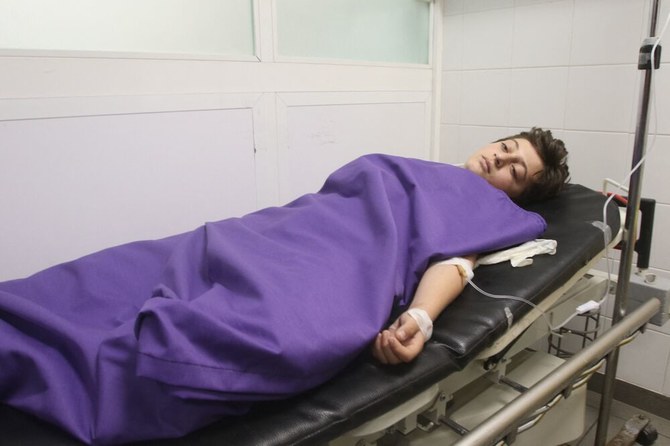
Following the attack, 11-year-old Mohammed Ali Nasser, one of the three injured students, was seen sitting on the sidewalk, his clothes stained with blood.
Nasser was taken to hospital, and later said that he and his classmates heard an explosion and saw the car burst into flames.
Students immediately placed their backpacks on their heads in fear of another raid, he said.
Nasser said that he would return to school after treatment and was not afraid of Israel.
Two other students, Ali Reda Moussa Ayyash, 13, and Qassem Mohammed Jaffal, 12, were also injured, while more than 10 others were treated for panic and stress.
Abbas Shmeisani, principal of Hassan Kamel Al-Sabbah Public High School in Nabatieh, mourned the death of the physics teacher.
Farran was an “active educator characterized by ethics, generosity, politeness, and dedication. Such is our fate with this criminal and terrorist enemy,” he said.
Nisreen Choueib, principal of Choukine Public School, condemned the targeting of school students.
“Our students sleep to the shaking of the walls from the sounds of raids, wake up to the sound of gunfire, and go to their schools where education is resilience and victory,” Choueib said.
Caretaker Agriculture Minister Abbas Hajj Hassan said: “History will record that this enemy has become adept at targeting children.”
Hezbollah targeted Israel’s military sites with rockets in response to the strike, including the recently established headquarters of the 91st Division at the Ayelet base, and the headquarters of the Sahel Battalion of the 769th Brigade at the Beit Hillel base.
Sirens sounded in the Upper Galilee in the settlements of Ayelet Hashachar, Rehaniya, Avivim, Alma, and Yir’on.
The Israeli army said the air defense forces “intercepted and destroyed 30 rockets launched from Lebanon toward the Upper Galilee.”
Hezbollah said it targeted Israeli surveillance equipment at Metula and Al-Raheb.
Israeli media reported that fires broke out between Kiryat Shmona and Beit Hillel after five rockets fell, while the Kiryat Shmona area lost power after a rocket attack.
The Israeli army continued its assaults on the border area, with the outskirts of the town of Aitaroun hit by intermittent shelling from Israeli positions.
A combat drone carrying a missile raided an agricultural orchard in the Hamoul area on the outskirts of the town of Naqoura.