

India on ‘red alert’ over severe heatwave

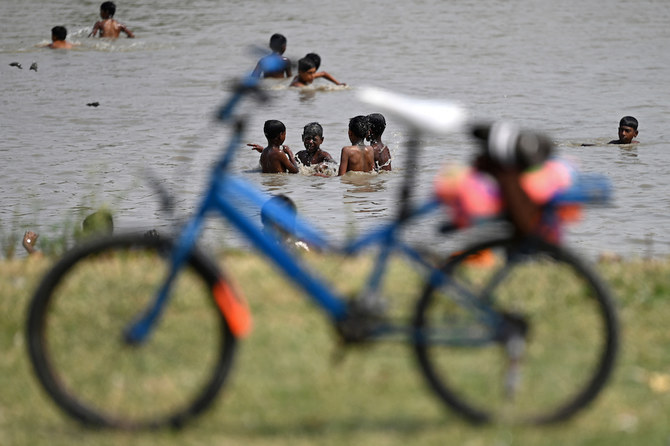
Heatwaves, most likely fueled by climate change, have been reaching dangerous levels across India and other Asian countries since April. Boys cool themselves in a pond on a hot summer day in New Delhi on May 5, 2024. (AFP)
Short Url
Updated 10 June 2024
Follow

India on ‘red alert’ over severe heatwave

  • Heatwaves reached dangerous levels in India, Asian countries since April
  • High mercury expected to impact livestock, land transport, power supply

NEW DELHI: Delhi and other parts of northern India were on the meteorological department’s highest alert over severe heatwaves on Wednesday, with temperatures in some regions expected to soar over 47 degrees Celsius.

The India Meteorological Department forecasts heatwave conditions to persist until the end of the week and issued a severe weather warning, known as the “red alert,” in the Indian capital region and the states of Punjab, Haryana, Rajasthan, Chandigarh and Uttar Pradesh.

Delhi officials ordered schools to shut on Tuesday as parts of the city recorded temperatures above 47 degrees Celsius. Though summer temperatures often peak during May in India, IMD director-general Dr. Mrutyunjay Mohapatra said the warning was necessary for the general public.

“Any heatwave conditions must be taken seriously because it can cause mortality or morbidity if care is not taken,” Mohapatra told Arab News on Wednesday.

The IMD has warned of the “very high likelihood of developing heat illness and heatstroke in all ages” due to the high temperatures. It added that “extreme care” was needed for vulnerable people and that citizens should drink sufficient water even if they are not thirsty.

“People should be under the shades, they should take water so that there is no dehydration,” Mohapatra said.

The severe heat is expected to impact not only people but also livestock, land transport, and the country’s energy supply.

“There is heavy demand in the power sector — there was the highest demand in Delhi yesterday — so therefore there could be disruption in the power supply,” he added.

Santwana Biswas, a domestic worker from Noida on the outskirts of Delhi, is among those who have been dealing with power disruptions in their neighborhoods.

“The electricity situation in my locality has worsened, with the night passing with just a couple of hours of electricity. Imagine, how can I sleep in this heat without a fan? I have not been able to get proper sleep for at least a week now,” Biswas told Arab News.

“Heat hasn’t allowed me to function normally. I am dragging myself just to save my job.”

Heatwaves, most likely fueled by climate change, have been reaching dangerous levels across India and other Asian countries since April, with eastern India experiencing its hottest April on record and reporting deaths related to soaring temperatures.

Saloni Kumari, a housewife in Delhi, said the heat was disorienting.

“Even early in the morning, you don’t feel comfortable going for a walk or doing any work. Air conditioning at home does not work properly when you have high temperatures,” she said.

“Life has become disoriented in this heatwave.”


Attacks on Sudan health care facilities killed 69 this year: WHO

Updated 8 sec ago
Follow

Attacks on Sudan health care facilities killed 69 this year: WHO

  • “Five attacks on health care have already been recorded in Sudan, killing 69 people and injuring 49,” WHO chief wrote on X
  • The WHO has confirmed at least 206 attacks on health care facilities since the start of the war

CAIRO: Five attacks on health care facilities have killed dozens of people in Sudan since the beginning of the year, the WHO said Saturday, as the war nears the start of its fourth year.
The fighting between Sudan’s army and the paramilitary Rapid Support Forces has dismantled an already fragile medical system, with more than a third of facilities currently out of service.
“During the first 50 days of 2026, five attacks on health care have already been recorded in Sudan, killing 69 people and injuring 49,” WHO chief Tedros Adhanom Ghebreyesus wrote on X.
On Sunday a hospital was targeted in the southeastern state of Sennar, leaving three patients dead and seven people wounded, including an employee, Tedros said.
In three other attacks early this month, more than 30 people were killed when medical centers were targeted in South Kordofan, a vast region south of the capital Khartoum that is currently a focus of the fighting.
The WHO has confirmed at least 206 attacks on health care facilities since the start of the war in April 2023, resulting in the deaths of around 2,000 people and injuries to several hundred.
Last year alone, 65 attacks killed more than 1,620 people, accounting for 80 percent of all deaths worldwide linked to attacks on the medical sector, according to the WHO.
Since it broke out, Sudan’s civil war has killed tens of thousands of people and forced 11 million to flee their homes, triggering what the UN says is one of the world’s worst humanitarian crises.
According to the WHO, the country is facing multiple disease outbreaks, notably cholera, malaria, dengue and measles, in addition to malnutrition.
Some 4.2 million cases of acute malnutrition are expected to arise in Sudan this year, including more than 800,000 cases of severe acute malnutrition, the WHO chief said earlier this month.
Around 33 million people will be left without humanitarian aid in 2026, with the United Nations warning in January that its aid stocks could run out by the end of March.