

Pakistan calls for ‘adequate’ Muslim representation amid debate on UNSC reforms

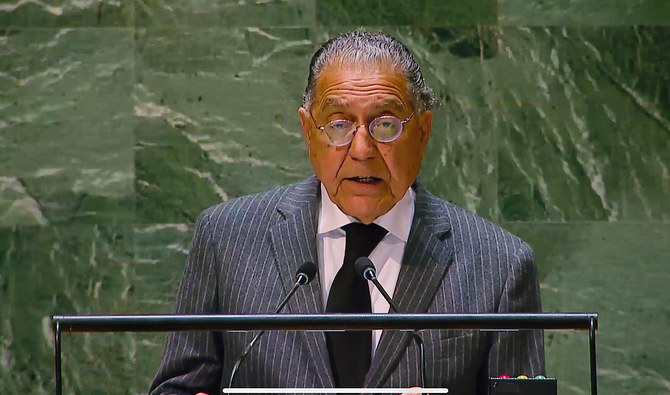
Pakistan’s Permanent Representative to the United Nations Ambassador Munir Akram speaks during a General Assembly at the United Nations in New York on May 1, 2024. (Pakistan Mission to UN/File)
Short Url
Updated 21 May 2024
Follow

Pakistan calls for ‘adequate’ Muslim representation amid debate on UNSC reforms

  • UNSC reform has been a contentious issue since intergovernmental negotiations first started in 2009
  • Ambassador Munir Akram says UNSC expansion should not be done hastily or without consensus

ISLAMABAD: Pakistan’s top diplomat at the United Nations on Tuesday reiterated the demand by the Organization of Islamic Cooperation that Muslim countries have ‘adequate representation’ in any future expanded Security Council.

UNSC reforms have been a contentious issue since Intergovernmental Negotiations (IGN) began in 2009, with little progress due to deep divisions among member states. The crux of the debate revolves around whether to add new permanent members, whether such members should possess veto power, and how to ensure fair regional representation.

The Group of Four comprising Brazil, Germany, India and Japan, seek permanent seats but are facing opposition from the Uniting for Consensus group, which includes Pakistan and argues against new permanent seats while calling for a new category of renewable memberships.

“Today at IGN meeting, I reiterated OIC’s demand that any reform of UN Security Council, which doesn’t ensure adequate representation of Muslim Ummah, will not be acceptable to the Islamic world,” Pakistan’s Permanent Representative to the United Nations Ambassador Munir Akram said in a social media post.

“This position is in line with an agreement on equitable representation of all groups,” he added.

According to the state-owned APP news agency, Akram said the issue of UNSC expansion had also come up for discussion at the recent Islamic Summit in Gambia which issued a communique, saying efforts to expand the 15-member body should not be subjected to artificial deadlines and should be made with consensus.

The UNSC currently has five permanent members — Britain, China, France, Russia and the United States — and 10 non-permanent members elected to serve for two years. 

The OIC is the second largest intergovernmental organization after the UN.


Pakistan stocks edge higher as export financing, industrial power tariffs are cut

Updated 8 sec ago
Follow

Pakistan stocks edge higher as export financing, industrial power tariffs are cut

  • KSE-100 index gained 1,607.26 points, or 0.88%, to close at 183,945.38
  • Rebound follows steep sell-off a day earlier amid regional geopolitical tensions

ISLAMABAD: Pakistan’s stock market rebounded on Friday, with the benchmark index gaining more than 1,600 points, as analysts pointed to cuts in export refinancing rates and lower electricity tariffs for industrial consumers as key drivers of the recovery.

The KSE-100 index rose 1,607.26 points, or 0.88%, to close at 183,945.38, up from 182,338.12 a day earlier, according to Pakistan Stock Exchange (PSX) data.

The uptick followed Prime Minister Shehbaz Sharif’s announcement of a Rs4.4 per unit cut in electricity tariffs for industrial consumers, alongside a reduction in the export refinance rate from 7.5% to 4.5%.

“Stocks staged an early recovery at the PSX on institutional buying in oversold scrips after the prime minister’s assurance to renegotiate the IMF deal, along with cuts in the export refinance rate to 4.5% and industrial power tariffs by Rs4.4 per unit,” Arif Habib Commodities Chief Executive Officer Ahsan Mehanti told Arab News.

He added that higher global crude oil prices and earnings-season speculation also acted as catalysts for bullish activity.

According to local media reports last week, Pakistan is seeking flexibility in IMF lending conditions for the 2026–27 budget and aims to renegotiate its agreement to complete the remaining $7 billion under the Extended Fund Facility (EFF) and a $1.4 billion Resilience and Sustainability Facility (RSF) by September 2027.

The rebound came a day after Pakistani stocks plunged 6,042.26 points on Thursday, a drop analysts attributed to heavy selling and heightened geopolitical tensions between Iran and the United States.

Those concerns intensified after US President Donald Trump warned Iran this week that “time is running out” to reach a deal on its nuclear program, amid a steady buildup of US military forces in the Gulf.