Iranians pay last respects to President Ebrahim Raisi

1 / 3
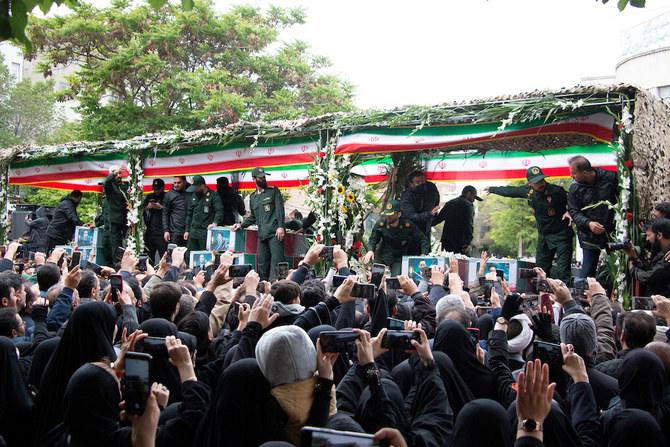
People attend a funeral ceremony for the late Iranian President Ebrahim Raisi in Tabriz, East Azerbaijan Province on May 21, 2024. (West Asia News Agency via Reuters)
2 / 3
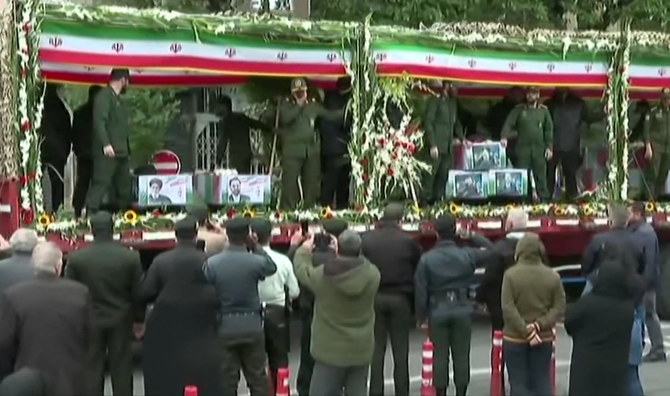
Above, the coffins of Iranian president Ebrahim Raisi and seven members of his entourage are loaded on a truck during a funerary procession in the northwestern city of Tabriz in this grab from a handout video footage. (Iran Press/AFP)
3 / 3
People gather to mourn Iranian president Ebrahim Raisi and seven members of his entourage during a funerary procession in the northwestern city of Tabriz in this grab taken from handout video footage on May 21, 2024. (Iran Press/AFP)
Short Url
Updated 21 May 2024
Follow

Iranians pay last respects to President Ebrahim Raisi

  • Mourners set off from a central square in the northwestern city of Tabriz
  • Supreme leader Ayatollah Ali Khamenei declares five days of national mourning

TEHRAN: Tens of thousands of Iranians gathered Tuesday to mourn president Ebrahim Raisi and seven members of his entourage who were killed in a helicopter crash on a fog-shrouded mountainside in the northwest.

Waving Iranian flags and portraits of the late president, mourners set off from a central square in the northwestern city of Tabriz, where Raisi was headed when his helicopter crashed on Sunday.

They walked behind a lorry carrying the coffins of Raisi and his seven aides.

Their helicopter lost communications while it was on its way back to Tabriz after Raisi attended the inauguration of a joint dam project on the Aras river, which forms part of the border with Azerbaijan, in a ceremony with his counterpart Ilham Aliyev.

A massive search and rescue operation was launched on Sunday when two other helicopters flying alongside Raisi’s lost contact with his aircraft in bad weather.

State television announced his death in a report early on Monday, saying “the servant of the Iranian nation, Ayatollah Ebrahim Raisi, has achieved the highest level of martyrdom,” showing pictures of him as a voice recited the Qur’an.

Killed alongside the Iranian president were Foreign Minister Hossein Amir-Abdollahian, provincial officials and members of his security team.

Iran’s armed forces chief of staff Mohammad Bagheri ordered an investigation into the cause of the crash as Iranians in cities nationwide gathered to mourn Raisi and his entourage.

Tens of thousands gathered in the capital’s Valiasr Square on Monday.

Supreme leader Ayatollah Ali Khamenei, who has ultimate authority in Iran, declared five days of national mourning and assigned vice president Mohammad Mokhber, 68, as caretaker president until a presidential election can be held.

State media later announced that the election would will be held on June 28.

Iran’s top nuclear negotiator Ali Bagheri, who served as deputy to Amir-Abdollahian, was named acting foreign minister.

From Tabriz, Raisi’s body will be flown to the Shiite clerical center of Qom on Tuesday before being moved to Tehran that evening.

Processions will be held in in the capital on Wednesday morning before Khamenei leads prayers at a farewell ceremony.

Raisi’s body will then be flown to his home city of Mashhad, in the northeast, where he will be buried on Thursday evening after funeral rites.

Raisi, 63, had been in office since 2021. The ultra-conservative’s time in office saw mass protests, a deepening economic crisis and unprecedented armed exchanges with arch-enemy Israel.

Raisi succeeded the moderate Hassan Rouhani, at a time when the economy was battered by US sanctions imposed over Iran’s nuclear activities.

Condolence messages flooded in from Iran’s allies around the region, including the Syrian government, Palestinian militant group Hamas and Lebanese militant group Hezbollah.

It was an unprecedented Hamas attack on Israel that sparked the devastating war in Gaza, now in its eighth month, and soaring tensions between Israel and the “resistance axis” led by Iran.

Israel’s killing of seven Revolutionary Guards in a drone strike on the Iranian consulate in Damascus on April 1 triggered Iran’s first ever direct attack on Israel, involving hundreds of missiles and drones.

In a speech hours before his death, Raisi underlined Iran’s support for the Palestinians, a centerpiece of its foreign policy since the 1979 Islamic revolution.

Palestinian flags were raised alongside Iranian flags at ceremonies held for the late president.


Gaza health officials say strikes kill 21 after Israel says shots wounded officer

Updated 4 sec ago
Follow

Gaza health officials say strikes kill 21 after Israel says shots wounded officer

GAZA CITY: Gazan health officials said Israeli air strikes on Wednesday killed 21 people in the Palestinian territory, with Israel’s military saying it struck after gunfire targeting its troops wounded an officer.
Despite a US-brokered truce entering its second phase last month, violence has continued in the Gaza Strip, with Israel and Hamas accusing each other of breaching the agreement.
The latest bloodshed came days after Israel partly reopened the Rafah crossing between Gaza and Egypt, the only exit for Gazans that does not pass through Israel.
The health ministry, which operates under Hamas authority, said that 21 people were killed in a series of strikes, with at least 38 others wounded, updating an earlier figure given by the territory’s civil defense agency.
Among the dead were three children, said the agency, which operates as a rescue force under the Hamas authority.
“We were sleeping when suddenly shells and gunfire rained down on us,” said Abu Mohammed Haboush, whose son was killed.
“Young children were martyred, my son and my nephew were among the dead. We lost many young men,” he said, adding that he and his family were living far away from the so-called “Yellow Line,” where Israeli forces are stationed.
AFP images showed mourners offering prayers in the compound of Al-Shifa hospital in Gaza City, where several bodies wrapped in white shrouds were laid out.
An AFP photograph showed a relative holding a body of a child wrapped in a shroud at the hospital as relatives gathered around him.
Shortage of medical aid
Three bodies were brought to Nasser Hospital after Israeli strikes hit homes and tents housing displaced Palestinians in the southern Khan Yunis area, the civil defense agency said.
Fourteen more bodies were taken to Al-Shifa Hospital, its director Mohamed Abu Salmiya said in a statement.
“We also received dozens of wounded. The situation is extremely difficult in the hospitals of the Gaza Strip due to the severe shortage of medicines and medical supplies,” Abu Salmiya said.
Israel scrutinizes all aid into besieged Gaza, a tiny coastal territory surrounded by fences, walls and the Mediterranean Sea.
The Israeli military said it had launched strikes after “terrorists opened fire on troops” Wednesday, seriously wounding an officer, adding that it considers the incident a violation of the ceasefire.
It said the troops came under attack near the “Yellow Line,” without specifying which side of the line the troops were on.
The ceasefire took effect after two years of war in Gaza, sparked by Hamas’s October 2023 attack on Israel.
Following what was reportedly US pressure, Israel allowed the opening of the Rafah crossing, but limited passage to patients and their travel companions.
Sick and wounded Gazans have begun crossing into Egypt to seek medical treatment since Monday.
On Tuesday, 45 people crossed into Egypt and 42 entered the territory, a source at the Palestinian Red Crescent Society told AFP.
Shortly after midnight Wednesday, those meant to enter during the day on Tuesday arrived in Gaza through Rafah in a large bus, an AFP journalist reported.
‘My homeland’
Relatives of those returning from Egypt screamed in joy, hugging and crying.
“I am so happy to be back with my husband, my children, my family, my loved ones, and of course, my homeland,” Fariza Barabakh, who returned that day, told AFP.
“It’s an indescribable feeling, thank God. What can I say? My two young children didn’t recognize me, but thank God. I hope it will be alright,” Yusef Abu Fahma, another returnee, told AFP.
Gaza’s health ministry says at least 556 people have been killed in Israeli strikes since the ceasefire took effect on October 10, while the Israeli military says four of its soldiers have been killed over the same period.
Saturday was among the deadliest days, with the civil defense agency reporting at least 32 people killed in Israeli attacks, which the military said were in response to a Hamas ceasefire violation.
Media restrictions and limited access in Gaza have prevented AFP from independently verifying casualty figures or freely covering the fighting.