Supporters of Hezbollah and Amal protest in Beirut against security plan

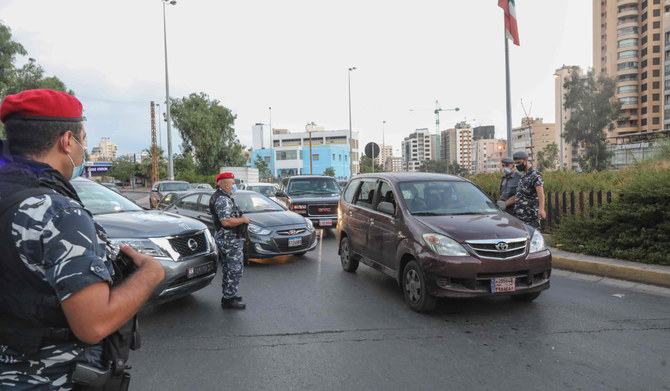
Members of the Lebanese security forces man a checkpoint on an avenue in the capital Beirut. (AFP file photo)
Short Url
Updated 19 May 2024
Follow

Supporters of Hezbollah and Amal protest in Beirut against security plan

  • Security Forces warn against attacks on their units and members
  • MP fears concerted campaign against interior minister

BEIRUT: Motorcycle owners in Beirut and the southern suburbs have protested against a security plan launched by the Ministry of Interior in the capital since Monday.

The protests reached their peak with gunfire being exchanged between the protesters and the internal security forces in the heart of the southern suburbs of Beirut.

The situation worsened on Sunday as protesters marched to the Ministry of Interior, claiming that the decision to confiscate unregistered motorcycles was being made randomly and arbitrarily while the vehicle registration office had been closed for years.

Thousands of young men and women have turned to using motorcycles as an alternative to cars since 2019 amid Lebanon’s economic crisis.

The shift has led to a rise in motorcycle thieves targeting people at the entrances of Beirut, particularly on the airport road and highways to the suburbs.

A Lebanese security source said that thieves often seek refuge in Palestinian refugee camps at the entrances of Beirut or in slums in the southern suburbs of Beirut, where illegal weapons are prevalent.

Social media activists shared videos of security forces confiscating motorcycles, while owners claimed the registration service was inaccessible, leading to a lack of registration.

For more than four years, tens of thousands of transactions have accumulated in the vehicle registration department without market licenses, car books, electronic stickers or license plates being issued.

This is due to the crisis of fluctuating exchange rates between the government and contractors — especially contracts in dollars.

In addition to this crisis, corruption investigations are being conducted.

The southern suburbs of Beirut, a stronghold for Hezbollah and the Amal Movement supporters, saw clashes between protesters and security forces on Saturday night.

The supporters held motorcycle rallies to oppose the security plan.

Protesters gathered around the Al-Marija Police Station to chant the message to Interior Minister Bassam Mawlawi that the situation was not under his control.

The Internal Security Forces said that the protesters fired in the air, and the police officers fired in the air to remove them from the site. There was no deaths or injuries among the protesters or the police, as claimed by some social media sites, according to authorities.

The security plan started on May 15, following a meeting of security service leaders 10 days before.

The meeting focused on Beirut’s security due to the increase in pickpocketing, theft, weapon threats and drug trafficking using motorcycles.

The security plan is based on strict measures aimed at maintaining security.

Traffic police units in Beirut and the southern suburbs conduct patrols day and night, with support from various units of the Internal Security Forces, such as the Fuhud forces, the judicial police and others.

Protesters have been blocking main roads with burning tires during afternoon rush hours for days.

Some affected roads include Sports City Road, Mazraa Corniche and the Mar Mikhael-Chiyah intersection.

A political observer expressed concern that “the protest in the heart of the southern suburb of Beirut against one of the state’s police stations may have been carried out with direct cover from Hezbollah, which rejects any disturbance to this environment. Hezbollah maintains a stable security grip in the southern suburb of Beirut while focusing on its war on the southern front against the Israeli army.”

One of the most prominent objections was a statement by the mayor of Ghobeiry, Maan Al-Khalil, who is close to Hezbollah.

The mayor protested against “the confiscation of motorcycles and vehicles belonging to the municipality and driven by municipal employees.”

Beirut MP Nabil Badr said that there was a campaign targeting the interior minister, who is committed to safeguarding the Lebanese people’s safety.

The MP said: “From the start of the security operation, we have urged a comprehensive effort in government agencies, particularly the Car and Motorcycle Registration Department, to help citizens resolve their breaches. The minister has acknowledged the issues and assured that the strict measures will be eased.”

Badr fears that “the campaign aims to create complete chaos in the streets of the capital and its suburbs among those affected by the imposition of security and state prestige. This is something we categorically reject.”

In a statement released on Sunday, the Internal Security Forces rejected “any attacks on their units and members, regardless of the excuses.”

They said that the security plan was requested to protect citizens on public roads from theft, robbery and reckless motorcycle riders, as well as their failure to wear helmets, which has led to an increase in traffic accident deaths.

The security plan aimed to protect people, they said, not to seek revenge or retaliate against them, and, according to authorities, has resulted in a significant decrease in crimes.


Iraq’s dreams of wheat independence dashed by water crisis 

Updated 16 December 2025
Follow

Iraq’s dreams of wheat independence dashed by water crisis 

  • Iraq ranks fifth globally for climate risk
  • Average temperatures in Iraq have risen nearly half a degree Celsius per decade since 2000

NAJAF: Iraqi wheat farmer Ma’an Al-Fatlawi has long depended on the nearby Euphrates River to feed his fields near the city of Najaf. But this year, those waters, which made the Fertile Crescent a cradle of ancient civilization 10,000 years ago, are drying up, and he sees few options.
“Drilling wells is not successful in our land, because the water is saline,” Al-Fatlawi said, as he stood by an irrigation canal near his parched fields awaiting the release of his allotted water supply.
A push by Iraq — historically among the Middle East’s biggest wheat importers — to guarantee food security by ensuring wheat production covers the country’s needs has led to three successive annual surpluses of the staple grain.
But those hard-won advances are now under threat as the driest year in modern history and record-low water levels in the Tigris and Euphrates rivers have reduced planting and could slash the harvest by up to 50 percent this season.
“Iraq is facing one of the most severe droughts that has been observed in decades,” the UN Food and Agriculture Organization’s Iraq representative Salah El Hajj Hassan told Reuters.

VULNERABLE TO NATURE AND NEIGHBOURS
The crisis is laying bare Iraq’s vulnerability.
A largely desert nation, Iraq ranks fifth globally for climate risk, according to the UN’s Global Environment Outlook. Average temperatures in Iraq have risen nearly half a degree Celsius per decade since 2000 and could climb by up to 5.6 C by the end of the century compared to the period before industrialization, according to the International Energy Agency. Rainfall is projected to decline.
But Iraq is also at the mercy of its neighbors for 70 percent of its water supply. And Turkiye and Iran have been using upstream dams to take a greater share of the region’s shared resource.
The FAO says the diminishing amount of water that has trickled down to Iraq is the biggest factor behind the current crisis, which has forced Baghdad to introduce rationing.
Iraq’s water reserves have plunged from 60 billion cubic meters in 2020 to less than 4 billion today, said El Hajj Hassan, who expects wheat production this season to drop by 30 percent to 50 percent.
“Rain-fed and irrigated agriculture are directly affected nationwide,” he said.

EFFORTS TO END IMPORT DEPENDENCE UNDER THREAT
To wean the country off its dependence on imports, Iraq’s government has in recent years paid for high-yield seeds and inputs, promoted modern irrigation and desert farming to expand cultivation, and subsidised grain purchases to offer farmers more than double global wheat prices.
It is a plan that, though expensive, has boosted strategic wheat reserves to over 6 million metric tons in some seasons, overwhelming Iraq’s silo capacity. The government, which purchased around 5.1 million tons of the 2025 harvest, said in September that those reserves could meet up to a year of demand.
Others, however, including Harry Istepanian — a water expert and founder of Iraq Climate Change Center — now expect imports to rise again, putting the country at greater risk of higher food prices with knock-on effects for trade and government budgets.
“Iraq’s water and food security crisis is no longer just an environmental problem; it has immediate economic and security spillovers,” Istepanian told Reuters.
A preliminary FAO forecast anticipates wheat import needs for the 2025/26 marketing year to increase to about 2.4 million tons.
Global wheat markets are currently oversupplied, offering cheaper options, but Iraq could once again face price volatility.
Iraq’s trade ministry did not respond to a request for comment on the likelihood of increased imports.
In response to the crisis, the ministry of agriculture capped river-irrigated wheat at 1 million dunams in the 2025/26 season — half last season’s level — and mandated modern irrigation techniques including drip and sprinkler systems to replace flood irrigation through open canals, which loses water through evaporation and seepage.
A dunam is a measurement of area roughly equivalent to a quarter acre.
The ministry is allocating 3.5 million dunams in desert areas using groundwater. That too is contingent on the use of modern irrigation.
“The plan was implemented in two phases,” said Mahdi Dhamad Al-Qaisi, an adviser to the agriculture minister. “Both require modern irrigation.”
Rice cultivation, meanwhile, which is far more water-intensive than wheat, was banned nationwide.

RURAL LIVELIHOODS AT RISK
One ton of wheat production in Iraq requires about 1,100 cubic meters of water, said Ammar Abdul-Khaliq, head of the Wells and Groundwater Authority in southern Iraq. Pivoting to more dependence on wells to replace river water is risky.
“If water extraction continues without scientific study, groundwater reserves will decline,” he said.
Basra aquifers, he said, have already fallen by three to five meters.
Groundwater irrigation systems are also expensive due to the required infrastructure like sprinklers and concrete basins. That presents a further economic challenge to rural Iraqis, who make up around 30 percent of the population.
Some 170,000 people have already been displaced in rural areas due to water scarcity, the FAO’s El Hajj Hassan said.
“This is not a matter of only food security,” he said. “It’s worse when we look at it from the perspective of livelihoods.”
At his farm in Najaf, Al-Fatlawi is now experiencing that first-hand, having cut his wheat acreage to a fifth of its normal level this season and laid off all but two of his 10 workers.
“We rely on river water,” he said.