



BEIRUT: Two people were killed in an Israeli strike on a car in southern Lebanon on Thursday afternoon. They were on their way to the funeral of a Hezbollah member when a drone targeted their vehicle on the Qana-to-Ramadiyeh road in Tyre.
Earlier in the day, Hezbollah said it launched “more than 60” Katyusha rockets toward Israeli military positions in the Israeli-annexed Golan Heights in retaliation for strikes on Wednesday that killed a member of the group.
It said it targeted an army base in Metula with S-5 missiles launched from a drone, and struck “the 210th Golan Division in Nafah, the Kilaa air defense base, and the Yoav artillery barracks with rockets.”
Hezbollah said it was using a new type of weapon — attack drones armed with missiles — and conducting several operations against Israeli military sites, including army outposts and a command center. The group also said its attacks had damaged surveillance equipment installed at the Ramyeh and Addir outposts.

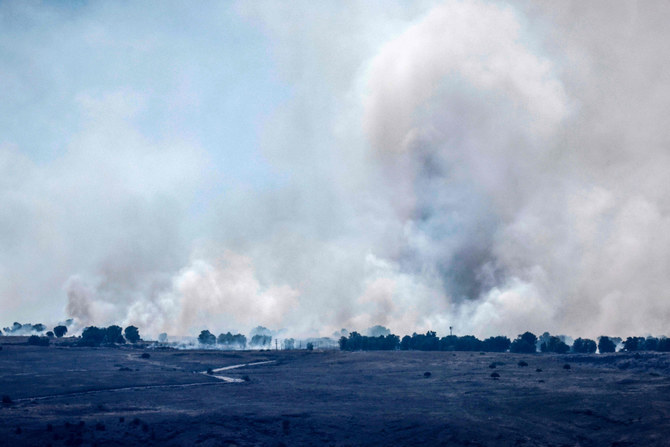
A picture taken from southern Lebanon shows smoke rising above the northern Israeli town of Metula following a Hezbollah strike from the Lebanese side on May 16, 2024. (AFP)
Israeli media said that an armor-piercing missile struck the Metula settlement, killing one person and seriously injuring two. Hezbollah also reportedly targeted the Zar’it barracks, including an equipment crane and newly deployed surveillance equipment, with guided weapons and artillery shells, and carried out a series of attacks on military outposts near the border, damaging surveillance equipment at Jal Al-Allam.
Sirens sounded repeatedly in several Israeli towns and cities, including Metula, Kiryat Shmona, Hurfeish and Peki’in, and in western Galilee and at Israeli military outposts in upper Galilee.
Israeli media reports described “the launching of dozens of rockets from Lebanon toward Meron and northern villages” in Israel, and the targeting of a military base at Mount Meron. Two missiles were fired from southern Lebanon toward Mattat in western Galilee, and 40 missiles targeted the Golan and the Galilee panhandle.
Hostilities between Hezbollah and the Israeli army have intensified over the past 48 hours along the southern Lebanese front, as both sides continue to cross red lines established over the past seven months and deploy ever-more advanced weapons.
Missiles fired by Hezbollah reached an area west of Tiberias, 50 kilometers from the border, while Israeli raids hit the village of Nabi Chit in Bekaa, 71 kilometers east of Beirut.
Hezbollah said its attacks on Thursday were in response to Israeli raids that targeted the Baalbek-Hermel region on Wednesday night and Thursday morning. Israeli warplanes carried out 10 raids on targets in the vicinity of Baalbek, and five raids on the outskirts of Nabi Chit. The attacks extended as far as a mountain range in eastern Lebanon between the villages of Brital and Khraibeh. Israeli airstrikes also targeted an evacuated Hezbollah training camp but no casualties were reported.

A picture taken from Kiryat Shmona in northern Israel shows an Israeli fighter jet firing a flare over southern Lebanon on May 16, 2024. (AFP)
Hezbollah had on Wednesday attacked the Ilaniya military base, west of Tiberias, with drones, targeting part of the Israeli Air Force’s comprehensive monitoring and detection systems.
Israeli Army Radio reported “the explosion of a Hezbollah drone at a security site in the Golani area” and said “technical teams were investigating the extent of the impact and damage to the site.”
This latest escalation of hostilities follows the assassination of a prominent Hezbollah field commander, Hussein Ibrahim Makki, and several other people in a drone attack on the Tyre road on Tuesday night.
The Israeli military had also targeted Lebanese border towns with dozens of missiles and airstrikes. In the Marjayoun plain, two shepherds were wounded by one of the attacks, which also struck Kfarkela, Aita Al-Shaab, Aitaroun, Mays Al-Jabal, Hula, Blida, Yarine, Ramyah, and the outskirts of Chihine and Wadi Zebqin. Some buildings in these towns have been razed as a result of such daily strikes.
Meanwhile, Moshe Davidovich, the head of the Mateh Asher Regional Council in Israel, said people evacuated from northern settlements are not expected to be able to return home until at least the end of the year.
In an interview with an Israeli radio station, he said the situation has reached “a stage of indifference” and criticized the Israeli government.
“There are no policies or plans in Gaza, or the abandoned security belt known as the Galilee, which is the front line,” he said.
“The government has lost its direction; it is absent in administration, the economy and security. Extending our evacuation period means we won’t be in our homes” until 2025, he added.


