Saudi Crown Prince’s visit to Pakistan will prove to be ‘game changer’ in bilateral ties — minister

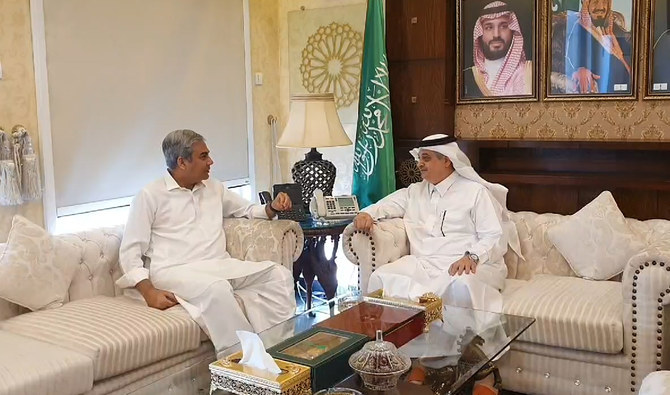
In this screengrab, taken from a handout video released by Pakistan’s Interior Ministry, Pakistan Interior Minister Mohsin Naqvi (left) meets Saudi Ambassador Nawaf bin Said Al-Malki at the Saudi Embassy in Islamabad on May 18, 2024. (Photo courtesy: MOI)
Short Url
Updated 18 May 2024
Follow

Saudi Crown Prince’s visit to Pakistan will prove to be ‘game changer’ in bilateral ties — minister

  • Pakistan’s deputy PM this month said the much-awaited visit was ‘on the cards,’ but neither side has confirmed any dates
  • The statement came amid Pakistan and Saudi Arabia’s efforts to increase bilateral trade and reach investment agreements

ISLAMABAD: Interior Minister Mohsin Naqvi said on Saturday that a proposed visit of Saudi Crown Prince Mohammed bin Salman to Pakistan would prove to be a “game changer” in bilateral ties between both countries, adding the entire Pakistani nation was awaiting the high-profile visit.
Naqvi said this during his visit to the Saudi embassy in Islamabad, where he met the Kingdom’s ambassador, Nawaf bin Saeed Al-Malki, according to the Pakistani interior ministry. The two figures discussed matters of mutual interest, including the Crown Prince’s visit, Pakistan-Saudi Arabia relations and bilateral cooperation in various fields.
Pakistan’s Deputy Prime Minister Ishaq Dar this month said a much-awaited visit of Saudi Arabia’s Crown Prince Mohammed bin Salman to Islamabad was “on the cards” and could materialize any time during May. But neither of the two sides has confirmed any dates.
“The historic brotherly friendship of Saudi Arabia and Pakistan is turning into a beneficial economic relationship,” Naqvi was quoted as saying by his ministry.
“The people of Pakistan are looking forward to the visit of the Crown Prince of Saudi Arabia. The visit of the Saudi Crown Prince will prove to be a game changer in relations between the two countries.”
Pakistan and Saudi Arabia have lately been working closely to increase bilateral trade and investment deals, with the Crown Prince last month reaffirming the Kingdom’s commitment to expedite an investment package of $5 billion.
A high-level Saudi business delegation, led by the Kingdom’s Assistant Minister of Investment Ibrahim Al-Mubarak, this month visited Pakistan to explore investment opportunities in various sectors, including mineral, energy, agriculture and petroleum.
“Saudi Arabia has supported Pakistan in every test,” Naqvi said. “The recent visit of Saudi Arabian investors to Pakistan was very successful.”
On the occasion, the Saudi ambassador said the Kingdom attached “great importance” to its relations with Pakistan, according to the Pakistani interior ministry.
Pakistan and Saudi Arabia enjoy strong trade, defense, and cultural ties. The Kingdom is home to over 2.7 million Pakistani expatriates and serves as a top source of remittances to the cash-strapped South Asian country.
Saudi Arabia has also often come to cash-strapped Pakistan’s aid by regularly providing it oil on deferred payment and offering direct financial support to help stabilize its economy and shore up its forex reserves.


Pakistan stocks close at record high over current account surplus, falling bond yields

Updated 9 sec ago
Follow

Pakistan stocks close at record high over current account surplus, falling bond yields

  • KSE-100 index gains 1,646.79 points or 0.97% to close at new high of 171,960.64 points
  • Pakistan’s central bank posted a current account surplus of $100 million in November

KARACHI: Pakistani stocks closed at an all-time high of 171,960.4 points on Thursday, with financial analysts attributing the surge to increasing investor confidence stemming from a current account surplus reported in November and a drop in government bond yields.

The benchmark KSE-100 index gained 1,646.79 points or 0.97% to close at an all-time high of 171,960.64 points on Thursday. The previous day, Pakistani stocks surged to 170,313.85 points at close of business. 

Ahsan Mehanti, chief executive officer at Arif Habib Commodities, said the optimistic mood at the stock exchange was fueled by the $100 million current account surplus reported by the central bank in November.

“Speculations ahead of year-end close and fall in government bond yields up to 70 basis points after the SBP (State Bank of Pakistan) policy easing played the catalyst role in bullish activity at PSX,” Mehanti told Arab News. 

The surplus was a welcome development for Islamabad as Pakistan’s central bank reported a $291 million deficit in October.

Topline Securities, a Pakistani brokerage firm, said in its daily market review that strong buying by local funds followed a drop in Pakistan Investment Bond (PIB) yields, which boosted investor confidence.

PIB yields are the returns on bonds or government-backed securities that pay fixed semi-annual interest, with rates influenced by market demand and SBP auctions.

“Strength in ENGRO (Engro Corporation), FFC (Fauji Fertilizer Company), UBL (United Bank Limited), LUCK (Lucky Cement) and BAHL (Bank AL Habib) underpinned positive momentum, collectively contributing 1,504 points to the index,” the brokerage firm wrote on X. 

“This upside was partly offset by declines in PIOC (Pakistan International Oil Company), DHPL (D.H. Corporation Limited) and MLCF (Millat Tractor Limited), which together subtracted 176 points.”

The sustained rise in equities comes amid improving liquidity conditions and continued investor participation, with market participants focusing on corporate earnings, sector-specific developments and broader macroeconomic signals.

Earlier on Monday, Pakistan’s central bank cut its key policy interest rate by 50 basis points to 10.5%, a move that surprised analysts and followed four consecutive policy meetings where rates were held unchanged.

The cut came despite an International Monetary Fund staff report earlier this month cautioning against premature monetary easing.

Inflation eased to 6.1% in November, remaining within the SBP’s target band, though analysts have warned that price pressures could resurface later in the fiscal year as base effects fade and food and transport costs remain volatile.