

FIFA orders legal review of Palestinian call to suspend Israel

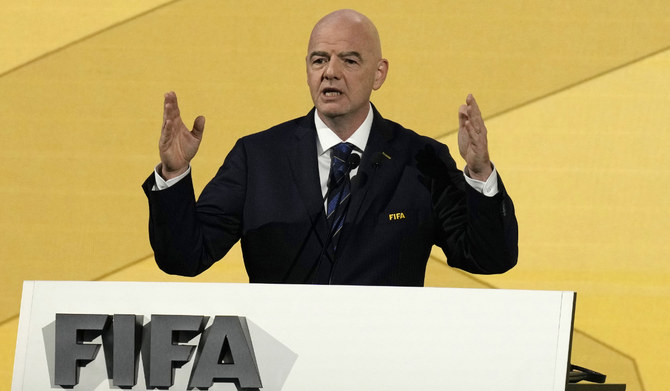
FIFA President Gianni Infantino delivers his speech at the FIFA Congress in Bangkok, Thailand, Friday, May 17, 2024. (AP)
Short Url
Updated 17 May 2024
Follow

FIFA orders legal review of Palestinian call to suspend Israel

  • Israel has killed more than 35,000 Palestinians, according to Gaza health officials. Israel says its strikes are targeted at militants

BANKOK: Soccer’s world body FIFA ordered an urgent legal evaluation on Friday of a proposal by the Palestinian Football Association to suspend Israel over the war in Gaza, promising to address it at an extraordinary meeting of its council in July.
FIFA President Gianni Infantino took the decision at an annual Congress in Bangkok, where the PFA president made an emotional plea to delegates to hold a vote to suspend Israel from all club and national competitions, accusing it of multiple breaches of FIFA statutes.
The Palestinian proposal accuses the Israel Football Association of complicity in violations of international law by the Israeli government, discrimination against Arab players, and inclusion in its league of clubs located in Palestinian territory. The IFA rejected that.
The request for sanctions against the IFA comes two years after FIFA’s decision to suspend Russia from international competitions over its invasion of Ukraine.

HIGHLIGHT

The request for sanctions against the IFA comes two years after FIFA’s decision to suspend Russia from international competitions over its invasion of Ukraine.

“FIFA cannot afford to remain indifferent to these violations or to the ongoing genocide in Palestine, just as it did not remain indifferent to numerous precedents,” PFA President Jibril Rajoub said.
“How much more must the Palestinian football family suffer for FIFA to act with the same urgency and severity as it did in other cases? Does FIFA consider some wars to be more important than others and some victims to be more significant?“
Since an Oct. 7 cross-border raid by militant group Hamas that Israel says killed more than 1,200 people, the Gaza offensive has left more than 35,000 Palestinians dead, according to Gaza health officials. Israel says its strikes are targeted at militants.
Rajoub said 193 Palestinian players had been killed, football infrastructure destroyed, its leagues suspended and its national team required to play World Cup qualifiers abroad.

‘Cynical, political and hostile’
The proposal was sent to FIFA in March and added to the Congress agenda with the support of the Algerian, Jordanian, Syrian and Yemeni federations.
The Asian Football Confederation gave its backing on Thursday for action against Israel.
IFA chief Shino Moshe Zuares said the proposal was based on motives and ambitions that “have nothing to do with the spirit of sports or the FIFA value of separating sports from politics.”
“Today, maybe more than ever, I believe that football must be a key element in healing the fractures and the wounds, helping us and everyone to recover,” he told the Congress.
“Yet, once again, we are facing a cynical, political, and hostile attempt by the PFA to harm Israeli football.
“I am holding myself back and will not speak about the true motives out of respect for this institution,” he said.
Infantino expressed extreme shock over the Oct. 7 attacks and the offensives in Gaza and said due to the “obvious sensitivity of the issue,” independent legal experts would be brought in urgently to analyze the Palestinian allegations.
Those findings would be referred to the FIFA Council, its main decision-making body outside of the Congress, to convene an extraordinary meeting in July and take appropriate decisions, he said.


T20 cricket set to dominate game’s landscape in 2026

Updated 10 sec ago
Follow

T20 cricket set to dominate game’s landscape in 2026

  • Inexorable rise of one of sport’s controlling forces

Following the end of the Ashes series in Australia, it has not taken long for cricket’s longest format — Test cricket — to be overwhelmed by the T20 format.

Apart from the 50-over Under-19s World Cup taking place in Namibia, it seems that, wherever one turns, there are only T20 tournaments.

Two explanations for this situation are the looming ICC Men’s and Women’s World Cups. The men’s event, to be jointly hosted by India and Sri Lanka, starts on Feb. 7, while the women’s tournament starts on June 12 in England.

The women’s event will comprise 12 teams, the largest number ever, of which eight have qualified already. The other four will emerge from 10 teams competing in a qualifying tournament in Nepal. This began on Jan. 18 and will end on Feb. 1. The teams have been divided into two groups of five and will play each other once. Group A comprises Bangladesh, Ireland, Namibia, Papua New Guinea and the US, with the Netherlands, Nepal, Scotland, Thailand and Zimbabwe in Group B. The top three teams will qualify for the Super Six stage in which the three teams from Group A will play the three teams from Group B. Points earned against the other two qualifying teams from each group are carried forward. The top four teams at the end of the Super Six will qualify for the World Cup in June.

The four highest-ranked teams in the competition are Ireland, Bangladesh, Scotland and Thailand. They are expected to progress to the Super Sixes but it remains to be seen if each of them will reach the main event in June. Thailand will probably face tough challenges against Ireland and Bangladesh in the Super Six stage. The Thai team are in good form, having triumphed in the ICC Women’s Emerging Nations Trophy and won double gold medals in the women’s cricket competitions in the SE Asia Games at the end of 2025. This form has continued into the tournament with victories over Nepal and Zimbabwe, but sterner tests lie ahead.

Players who are squad members of teams who have qualified for the World Cup are warming up in different ways. A number are currently involved in India’s Women’s Premier League, which is halfway into its schedule and will conclude on Feb. 5. In New Zealand, the Women’s Super Smash concludes on Jan. 31, while in South Africa the CSA Women’s Pro20 will resume on Feb. 8. There are upcoming bilateral tours by India to Australia in late February, Pakistan to South Africa in February, Zimbabwe to New Zealand in March, followed by South Africa. No doubt other matches will be arranged once the identity of the final four qualifying teams is known. Immediately prior to the World Cup, formal warm-up matches will take place at three venues in England and Wales.

The need for preparation is even more pressing for those involved in the men’s T20 World Cup, which comprises 20 teams. The Big Bash League in Australia allows four overseas players in each 18-man squad. In 2025/26, English players represent the bulk of non-Australian players, followed by players from Pakistan and New Zealand. The South African World Cup players are fully engaged in SA20, in which 19-man squads are allowed to contain seven overseas players, four of whom can be selected for a playing 11. English players are well represented. The Bangladesh Premier League will conclude on Jan. 23. Indian players with central contracts are not allowed to participate in franchise leagues outside India. Their World Cup players will feature in a T20 series against New Zealand that started on Jan. 21 in Nagpur. It followed an ODI series which was won by New Zealand. England start a three-match T20 series against Sri Lanka on Jan. 30, following three ODIs.

Outside of the leading countries, it can be difficult for players and teams to gain enough game-time preparation. Some of the UAE players participated in the DP World ILT20. Their next international action is a two-match series on Jan. 29 and 31 against Ireland in Dubai, where Afghanistan currently have a three-match T20 series against the West Indies, who then play a series against South Africa. Ireland will remain in Dubai where they will play three T20 matches against Italy, who are making their first appearance in a World Cup.

Australia will visit Pakistan and play three T20 matches. Teams such as the US, Canada, Oman, Nepal, Namibia and the Netherlands appear to have limited match preparation opportunities.

At least they do not face the uncertainties of Bangladesh. In early January, in a further example of the use of cricket as a political weapon, the Indian authorities excluded the Bangladeshi cricketer Mustafizur Rahman from the 2026 Indian Premier League, amid rising tensions between the two countries. Rahman had been bought at auction by the Kolkata Knight Riders franchise, which is owned by Shah Rukh Khan, the Indian actor and film producer, who was born into a Muslim family. Following this decision, the Bangladesh Cricket Board requested that the International Cricket Council move matches involving Bangladesh in the T20 World Cup out of India, citing the “safety and well-being of the players.”

Discussions ensued between the parties. Independent security assessments were commissioned by the ICC, along with comprehensive venue-level security plans and formal assurances from the host authorities. These were shared with the BCB. All assessments consistently concluded that “there is no credible or verifiable threat to the safety or security of the Bangladesh team in India.” On Jan. 17, the BCB suggested a swap of their matches with those of Ireland, whose group matches are to be played in Sri Lanka. The suggestion was rejected. At an emergency meeting of the ICC’s board on Jan. 21, 14 out of the 16 members voted against Bangladesh’s request. It is assumed that, apart from Bangladesh, the other vote in favour was from Pakistan.

It appears that the BCB’s attempt at a hardline stance has backfired. It must now either accept to play in India or withdraw from the competition, with significant loss of face either way. If it withdraws, a replacement team need to be introduced. The next-best-ranked T20I team are Scotland, who will have even less time to prepare than the other 19 teams.

Once again, a major international tournament has been disrupted by geopolitics. It is also the case that, once again, almost everyone has fallen in behind the combined power of the ICC and the Indian board. This stranglehold and the inexorable rise of T20 cricket are now undoubtedly the controlling forces shaping cricket’s future landscape.