

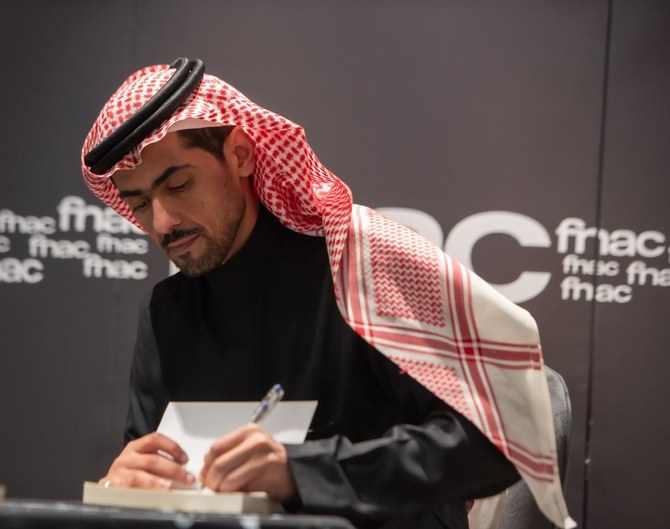


MAKKAH: Saudi author Osamah Al-Muslim’s appearance at the Rabat International Book Fair in Morocco has sparked huge interest from visitors at the event, which runs until May 19.
A book signing event by Al-Muslim drew large crowds, especially among young people and teenagers. The fair’s management was later forced to shorten the signing ceremony to alleviate overcrowding.
The 47-year-old writer, born in Al-Ahsa, spent his childhood in the US before returning to the Kingdom to complete his studies. He graduated from the Department of English Literature at King Faisal University.
“The Rabat International Book Fair is one of the most prestigious exhibitions, and I was pleased to visit it for the first time to meet my dear readers who came from all parts and cities of Morocco,” Al-Muslim told Arab News.
“The attendance was remarkable, but unfortunately, I was not able to meet most of them, which saddened me. However, there is now an intention, with the kind invitation of Moroccan Minister of Youth, Culture and Communication Mohamed Mehdi Bensaid, to hold a series of signing events in many major Moroccan cities to meet as many readers as possible,” he added.
Al-Muslim spoke about his origins as a writer, expressing how difficult it was to get a start in the industry. His first novel was rejected by more than 20 publishing houses, so Al-Muslim printed and self-published the title at his own expense.
“I marketed it myself through a small online store run by a young Saudi. The funny thing is that after the success of the first edition, all the publishing houses that had rejected the novel contacted me to collaborate with them,” he said.
Today, Al-Muslim has published 32 works, ranging from epic series to short stories. More than 15 editions have been translated into English, with work underway to translate the rest of Al-Muslim’s books.
“The first part of ‘Arabistan Orchards’ has been translated into Chinese, with more than 50,000 copies printed, and efforts are ongoing to translate the remaining parts,” he said.
“As for my cultural vision, I believe that old templates are no longer attractive to this generation. Relying on difficult and complex language, and showcasing linguistic and cognitive proficiency as a challenge to the reader is no longer appealing. Today’s readers need an interesting story, woven intelligently and in smooth language,” he added.
Al-Muslim “never paid attention to the critics” because he “knew their backgrounds, orientations and ideas.
“Had I listened to them, I would have stopped from the first day. They want everyone to adopt their views and not deviate from the methods they have set,” Al-Muslim said.
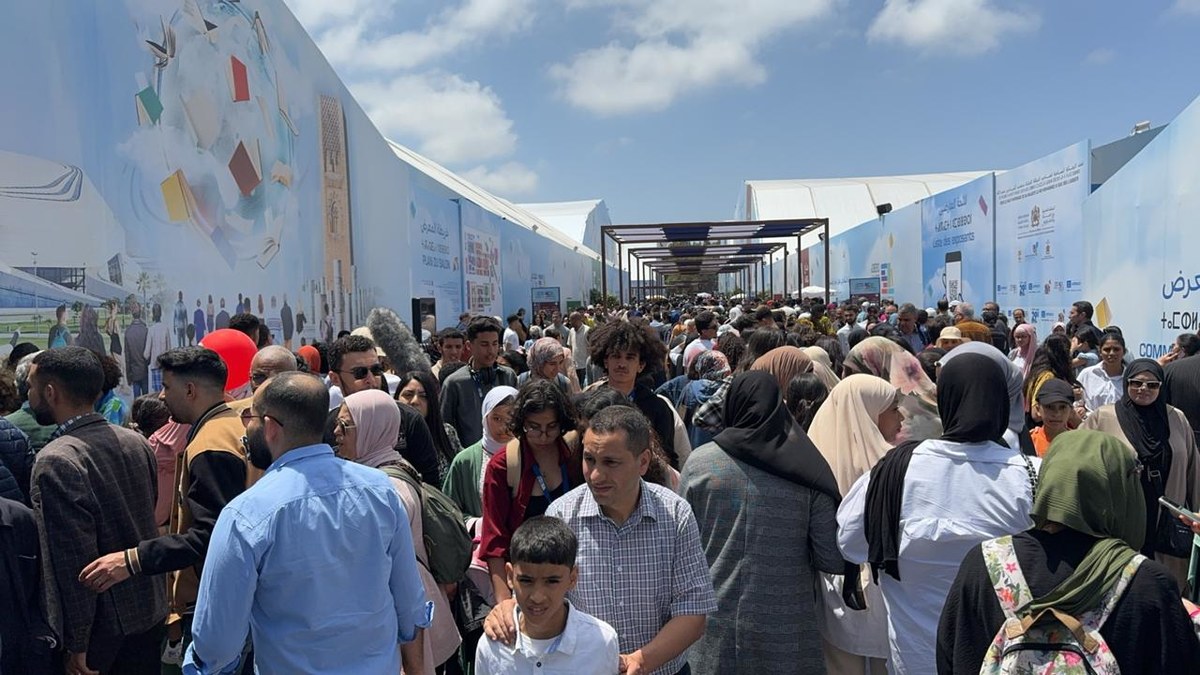
A book signing event by Al-Muslim drew large crowds, especially among young people and teenagers. (Supplied)
“The fantasy I present combines truth and imagination, relying on our Arab heritage and myths, especially those from Saudi Arabia, rather than global stories and legends that do not belong to us or resemble us. Therefore, readers become attached to this genre because it stems from their environment and is close to their thoughts, personalities and feelings.
“I present it in an easy and smooth language, but with philosophical and cognitive depth. This style is known as simple, yet it is enjoyed and understood by both young and old, and by all segments of society,” he added.
By breaking old, outdated literary molds, Al-Muslim hopes to keep up with the ideas, problems, wishes and aspirations of a new generation, saying he has “become close to them” and “understands them greatly.”
He added: “There is no doubt that the originality in my writing and my lack of imitation offers something new and unfamiliar, which has sparked excitement, enthusiasm, attachment and a desire to seek out new things among my readers.”
The author discussed plans for screen adaptation: “Yes, God willing, MBC Group has acquired the rights to almost all of my publications to turn them into dramatic series and films.
“Approximately 80 percent of the first part of the ‘Arabistan Orchards’ series has already been completed, with production costs considered the highest in Arab fantasy, exceeding $30 million.
“The beginning of work on the ‘Fear’ trilogy, the most famous book in my publications, has also been announced. Additionally, we are working on producing a movie based on one of my short novels, which the group will announce later.”


