Slovakia’s prime minister Robert Fico was gravely injured in an apparent assassination attempt that rocked the small country and the rest of Europe just weeks before an election.
Here’s a global look at other notable political assassinations and attempts during the 21st century:
— Sept. 1, 2022: Argentina’s then-Vice President Cristina Fernández is targeted by a man who reportedly aimed a handgun at point-blank range toward the politician in what government ministers characterize as an assassination attempt.
— July 8, 2022: Japanese former Prime Minister Shinzo Abe is assassinated by a gunman who opened fire on him as he delivered a campaign speech on a street in western Japan.
— Nov. 6, 2021: Iraqi Prime Minister Mustafa Al-Kadhimi survives an assassination attempt when two armed drones target his residence in Baghdad’s Green Zone area. While Al-Kadhimi is uninjured, seven of his security guards are injured in the attack.
— Oct. 15, 2021: British lawmaker David Amess is stabbed to death by a Daesh supporter while meeting with voters.
— July 7, 2021: Haitian President Jovenel Moïse is assassinated by gunmen in an overnight raid on his Port-au-Prince home. His widow, Martine, ex-prime minister Claude Joseph and the former chief of Haiti’s National Police, Léon Charles, among others, are indicted in his killing in February 2024.
— April 20, 2021: Chad President Idriss Deby Itno is killed while battling rebels in the north. Hours earlier he had been declared the winner of an election that would have given him another six years in power.
— Aug. 4, 2018: Drones armed with explosives detonate near Venezuelan President Nicolas Maduro in an apparent assassination attempt while he is delivering a speech to hundreds of soldiers being broadcast live on television. Six people are later arrested in connection with the attack.
— Dec. 19, 2016: Russia’s ambassador to Turkiye Andrei Karlov is shot dead by a Turkish policeman shouting condemnation of Russia’s military role in Syria, in front of a shocked gathering at a photo exhibit. The gunman was later killed in a shootout with police.
— July 15, 2016: A group of Turkish soldiers using tanks, warplanes and helicopters launch a plot to overthrow Turkiye’s president and government. The coup attempt fails. One year later, 40 people are sentenced to life in prison after being convicted on charges that include attempting to kill President Recep Tayyip Erdogan.
— June 16, 2016: British lawmaker Jo Cox is shot and stabbed to death by a far-right supporter in the English village of Birstall, part of her constituency.
— Feb. 6, 2013: Tunisian left-wing opposition leader Chokri Belaid is fatally shot outside his Tunis home. His killing — followed six months later by that of another left-wing leader, Mohammed Brahmi — plunged Tunisia into political chaos. Four people are sentenced to death and two others to life in prison in March 2024 for their roles in his death.
— Oct. 20, 2011: Longtime Libyan dictator Muammar Qaddafi is hunted and summarily killed by insurgents after being toppled in a NATO-backed uprising.
— Jan. 8, 2011: US Rep. Gabrielle Giffords survives an assassination attempt after being shot by a man in an Arizona grocery store parking lot while meeting with constituents. Giffords’ injuries are so significant that she has to re-learn how to walk and talk. The attack kills six other people and wounds 11 more.
— March 2, 2009: Guinea-Bissau President Joao Bernardo Vieira is killed by renegade soldiers in his palace, hours after a bomb blast killed his rival in the West African nation.
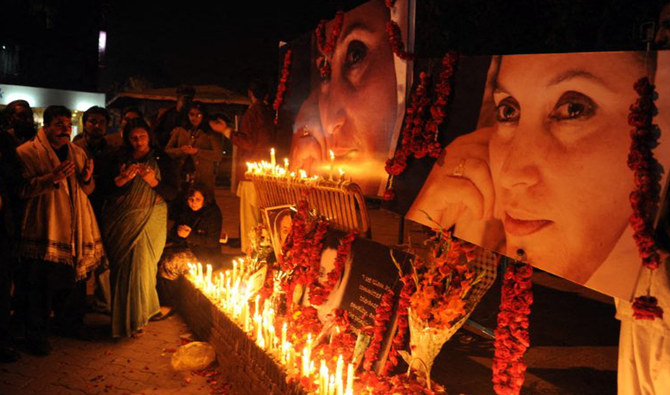
— December 27, 2007: Benazir Bhutto, the first female prime minister in a Muslim-majority country as well as Pakistan’s second nationally elected prime minister, is shot at and then fatally attacked by a suicide bomber at a political rally in Rawalpindi, Pakistan.
— Feb. 14, 2005: Lebanese Prime Minister Rafik Hariri is killed by a suicide truck bomb on a seaside boulevard in Beirut. Another 21 people die and 226 are wounded in the attack, which is seen by many in Lebanon as the work of neighboring Syria.
— March 12, 2003: Serbian Prime Minister Zoran Djindjic is shot dead in front of the Serbian government headquarters in Belgrade. He was a key leader of the revolt that toppled former President Slobodan Milosevic in October 2000. Twelve people were later convicted in connection with the killing, which was carried out to halt his pro-Western reforms, according to a Serbian court ruling.
— July 2, 2002: French President Jacques Chirac survives an assassination attempt by a far-right right supporter who shoots at him and misses during Bastille Day celebrations on Paris’ Champs-Elysees. Chirac is uninjured.
— May 6, 2002: Dutch politician Pim Fortuyn is gunned down in a northern Netherlands city, days before a general election in which he was a candidate, by an animal rights activist.
— June 1, 2001: Nepal’s King Birendra is killed when his son, Crown Prince Dipendra, opens fire on his family in the royal palace. The dead include Queen Aiswarya, a prince and five others. Officials said the shooting followed a dispute over the prince’s marriage.
— Jan. 18, 2001: Congo President Laurent Kabila is assassinated in the presidential palace in the capital, Kinshasa, by one of his bodyguards, who is killed minutes later by security forces.


![]()

A look at high-profile political assassinations and attempts this century
Short Url
https://arab.news/vy8wx
A look at high-profile political assassinations and attempts this century
- An apparent assassination attempt on Slovakia’s prime minister Robert Fico rocked the small country and the rest of Europe on Thursday
- In 2007, Pakistan lost its first female prime minister, Benazir Bhutto, in a gun and bomb attack at a rally in the garrison city of Rawalpindi
Latest updates


© 2026 SAUDI RESEARCH & PUBLISHING COMPANY, All Rights Reserved And subject to Terms of Use Agreement.