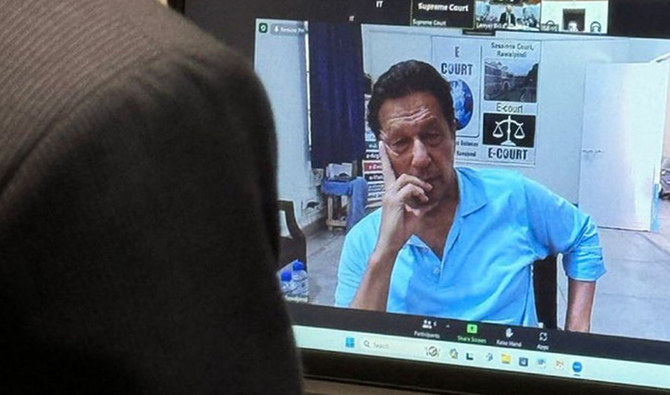

ISLAMABAD: Pakistan’s top court on Thursday adjourned proceedings of a case on amendments to the country’s accountability laws by the parliament, without allowing former Prime Minister Imran Khan to speak, who attended the hearing via video link from the central jail in Rawalpindi.
Khan, who is a petitioner in the case, appeared in the court through video link as per the Supreme Court’s orders. He attended the hearing for around two-and-a-half hours without any break, wearing a light blue colored shirt with two bottles of water beside him on the table. The court did not allow the hearing to be live-streamed as expected by thousands of Khan supporters. Some pictures of the former prime minister, however, were leaked on social media.
"Imran Khan should appear on the next hearing through the video link," the court said before adjourning the hearing indefinitely.
The five-member bench led by Chief Justice Qazi Faez Isa also raised questions as to why ordinances on accountability laws were promulgated during Khan’s government, and why bills were not presented in parliament.
“Ill intention cannot be attributed to parliament,” Justice Athar Minallah remarked, adding that it was the responsibility of politicians to strengthen parliament.
The chief justice, however, remarked:
“One person’s will is imposed on the nation through ordinances, doesn’t this stand against democracy?“
Khan, a 71-year-old cricketer-turned-politician who ruled Pakistan as PM from 2018-22, has been appearing in other cases since being jailed last August, but cameras are not permitted to cover the proceedings which are conducted inside the premises of the Adiala Jail where he is incarcerated.
The Supreme Court’s order to the government on Tuesday to ensure that Khan be produced via video link and granting his request to be allowed to represent himself instead of through a lawyer had raised widespread expectations among his millions of followers that they would be able to catch a glimpse of their leader after almost nine months.
“Chairman Imran Khan’s picture from Adiala Jail,” Khan’s PTI party said on X, posting a photo of their leader as he appeared in the case via video link.
“So far no live stream from SC,” the PTI said in a statement shared with reporters, adding that a court committee had voted for a live broadcast.
“Judicial process demands fairness and openness, transparency can only be ensured through public view of proceedings …Refusal to stream proceedings advances unfairness and non-transparency and must be condemned.”
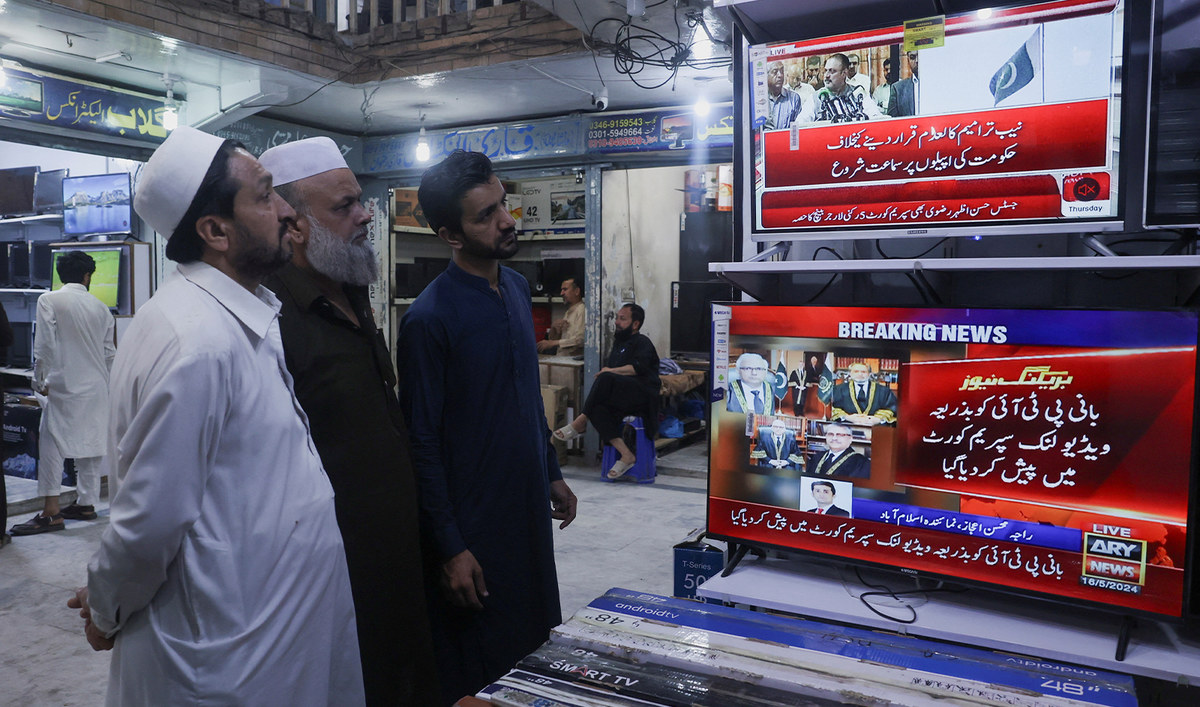
Men watch television screens as they wait to see the appearance of the jailed Pakistan's former Prime Minister Imran Khan, expected to be streamed live during a video proceeding of the Supreme Court of Pakistan, at a market in Peshawar, Pakistan on May 16, 2024. (REUTERS)
Khan’s two sisters and leaders of his Pakistan Tehreek-e-Insaf (PTI) party including Ali Muhammad Khan, Azam Swati, Shibli Faraz and others attended the hearing.
“Imran Khan is in jail just a few kilometers from here, so he should have been allowed to attend the hearing physically,” PTI lawmaker Ali Muhammad told reporters after the hearing concluded.
NAB AMENDMENTS
The last government of Prime Minister Shehbaz Sharif, who started his second term as PM in March, amended the National Accountability Bureau (NAB) Ordinance in May 2022, curtailing the powers of the country’s top anti-graft body, which is widely believed to have been used as a tool of political persecution by past governments and military rulers.
One of the amendments limited the NAB’s jurisdiction only to cases involving over Rs500 million, leading Khan and his party to argue that the changes were meant to close cases against leaders of Sharif’s ruling Pakistan Muslim League-Nawaz (PML-N) party, which involved larger amounts.
In June 2022, Khan challenged the amendments in the Supreme Court, claiming they would effectively “eliminate any white-collar crime committed by public office holders.” After reviewing the case, the top court reinstated the original provisions of the NAB law in September 2023, but the government has challenged the ruling.
Khan, who was ousted from the prime minister’s office in a parliamentary no-confidence vote in April 2022, has been fighting a slew of legal cases since, a frequent hazard for opposition figures in Pakistan.
A two-member Islamabad High Court bench granted him bail in a £190 million Al-Qadir land embezzlement case this week but he will have to stay in jail to serve time in two other cases, including one in which he is accused of revealing state secrets.
CASES AGAINST KHAN
Khan was first jailed after being handed a three-year prison sentence in August 2023 by the Election Commission for not declaring assets earned from selling gifts worth more than 140 million rupees ($501,000) in state possession and received during his premiership. In January, Khan and Bushra were handed 14-year jail terms following a separate investigation by NAB into the same charges involving state gifts.
An anti-graft court in Islamabad also handed Khan a 10-year jail term in January for revealing state secrets, a week before national elections on Feb. 8. Another ruling that his marriage to Bushra Bibi violated the country’s marriage law and a seven-year sentence each for both also came ahead of the polls.
Khan has also been indicted under Pakistan’s anti-terrorism law in connection with violence against the military that erupted following his brief arrest related to the Al-Qadir case on May 9. A section of Pakistan’s 1997 anti-terrorism act prescribes the death penalty as maximum punishment. Khan has denied the charges under the anti-terrorism law, saying he was in detention when the violence took place.
Khan’s convictions, which mean he is banned from holding public office, ruled him out of the February general elections. Arguably Pakistan’s most popular politician, Khan says all cases against him are politically motivated to keep him out of politics.