

What will be the repercussions of Biden’s new China tariffs?

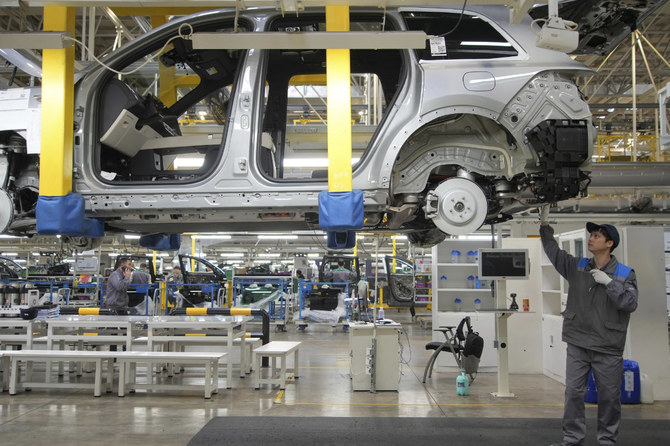
A worker assembles an SUV at a car plant of Li Auto, a major Chinese EV maker, in Changzhou in eastern China's Jiangsu province on March 27, 2024. The Biden administration has announced plans to slap new tariffs on Chinese electric vehicles, advanced batteries, solar cells, steel, aluminum and medical equipment. (Chinatopix Via AP, File)
Short Url
Updated 16 May 2024
Follow

What will be the repercussions of Biden’s new China tariffs?

  • Biden’s move “may accelerate pressure on the EU to adopt a similarly strong posture in its own China tariff review," say analysts
  • Beijing has warned it would “take resolute measures” to defend its interests

WASHINGTON: US President Joe Biden unveiled steep tariff hikes on Chinese green tech this week, hitting imports like electric vehicles, chips and solar cells — and adding stress to US-China ties.

But despite targeting $18 billion in imports across new and already targeted sectors, analysts do not expect a major economic impact, assuming Beijing does not retaliate significantly.
So what will be the repercussions of his moves?

Biden’s EV, semiconductor and battery tariffs “will not have a noticeable impact on US inflation or GDP,” said economist Ryan Sweet at Oxford Economics.
There were already levies on Chinese EVs, causing automakers to avoid the US market — though the new increase takes the tariff level from 25 percent to 100 percent.
“Last year, China exported around $400 million in battery EVs to the US while the European Union exported nearly $7.5 billion to the US,” Sweet said.
Oxford’s model assumes China does not retaliate significantly, given the current weaknesses seen in the world’s second largest economy, he said.
Tianlei Huang, research fellow at the Peterson Institute for International Economics, believes tariffs could hurt some Chinese companies’ sales and profitability.
But “the direct impact of those tariff hikes is actually quite limited,” he told a virtual event. “It’s more of a signal.”

More restrictive trade policies can cause low-carbon technologies to be less competitive against rivals like combustion engine vehicles, according to research from the Center for Strategic and International Studies (CSIS).
But research scenarios found that “rising trade frictions didn’t overcome the still-falling costs of clean energy,” said Joseph Majkut, director of the energy security and climate change program at the think tank.
US policies like the Inflation Reduction Act, which puts funding toward supporting the green transition, will still support the creation of domestic content too, he added.

China warns of retalization

Beijing has warned it would “take resolute measures” to defend its interests.
Policymakers could target industries in US swing states to impact Biden’s election chances, or opt for a symbolic retaliation, the Trivium China policy analysis group said in a newsletter.
China’s response, or lack thereof, will be telling in terms of how officials plan to address acts they deem as “economic suppression” moving forward, Trivium added.
“The challenge for the Chinese is, how do they do it in a way that doesn’t freak out foreign businesses?” said Bill Bishop, who publishes the Sinocism newsletter.
With Beijing previously announcing export controls on two rare metals essential for the manufacture of semiconductors, action on critical minerals remains possible, he said.
Beijing-based economist Mei Xinyu expects the response to be targeted, and analysts generally do not expect tit-for-tat actions.
China does not import American EVs while “Beijing and Shanghai have been very supportive of the one major US EV player, Tesla, in the China market,” said Paul Triolo, partner for China at Albright Stonebridge Group.

European tariffs
Biden’s move “may accelerate pressure on the EU to adopt a similarly strong posture in its own China tariff review, which is forthcoming,” said CSIS senior fellow Emily Benson.
The European Union launched an inquiry into Chinese electric car subsidies last year, fearing a threat to Europe’s auto industry. This could culminate in a tariff hike from the current 10 percent.
For now, the leaders of Germany and Sweden have expressed reservations about new European tariffs on Chinese EVs.
But if multiple major developed economies are on board with a tariff approach, China will likely be concerned from both an economic and propaganda standpoint, Bishop told AFP.
US tariffs may also “force Brussels’ hand” as it could divert trade to Europe, said Atlantic Council senior fellow Joseph Webster in an analysis.
“Brussels will have to act quickly, either to put its own tariffs in place or to accept a flood of Chinese-made products,” Webster added.

Analysts said the latest tariffs probably didn’t come as a surprise to China, given the signals from US officials ahead of the announcement.
But Bishop noted that the underlying problems between Washington and Beijing run deep — and that while both sides are talking again, their behaviors do not appear to have changed.
“These new actions just chip away at that very, very thin facade of stability,” he said.


Starmer’s chief of staff quits over former US ambassador's Epstein ties

Updated 11 sec ago
Follow

Starmer’s chief of staff quits over former US ambassador's Epstein ties

  • Morgan McSweeney said he took responsibility for advising UK's PM to appoint Peter Mandelson as Washington envoy
  • Epstein files suggest that Mandelson sent market-sensitive information to the convicted sex offender when he was part of UK government
LONDON: British Prime Minister Keir Starmer's chief of staff resigned Sunday over the furor surrounding the appointment of Peter Mandelson as the UK ambassador to the US despite his ties to Jeffrey Epstein.
Morgan McSweeney said he took responsibility for advising Starmer to appoint Mandelson, 72, to Britain’s most important diplomatic post in 2024.
“The decision to appoint Peter Mandelson was wrong. He has damaged our party, our country and trust in politics itself,” McSweeney said in a statement. “When asked, I advised the Prime Minister to make that appointment and I take full responsibility for that advice.”
Starmer is facing a political storm and questions about his judgment after newly published documents, part of a huge trove of Epstein files made public in the United States, suggested that Mandelson sent market-sensitive information to the convicted sex offender when he was the UK government’s business secretary during the 2008 financial crisis.
Starmer’s government has promised to release its own emails and other documentation related to Mandelson’s appointment, which it says will show that Mandelson misled officials.
The prime minister apologized this week for “having believed Mandelson’s lies.”
He acknowledged that when Mandelson was chosen for the top diplomat job in 2024, the vetting process had revealed that Mandelson’s friendship with Epstein continued after the latter’s 2008 conviction. But Starmer maintained that “none of us knew the depth of the darkness” of that relationship at the time.
A number of lawmakers said Starmer is ultimately responsible for the scandal.
“Keir Starmer has to take responsibility for his own terrible decisions,” said Kemi Badenoch, leader of the opposition Conservative Party.
Mandelson, a former Cabinet minister, ambassador and elder statesman of the governing Labour Party, has not been arrested or charged.
Metropolitan Police officers searched Mandelson’s London home and another property linked to him on Friday. Police said the investigation is complex and will require “a significant amount of further evidence gathering and analysis.”
The UK police investigation centers on potential misconduct in public office, and Mandelson is not accused of any sexual offenses.
Starmer had fired Mandelson in September from his ambassadorial job over earlier revelations about his Epstein ties. But critics say the emails recently published by the US Justice Department have brought serious concerns about Starmer’s judgment to the fore. They argue that he should have known better than to appoint Mandelson in the first place.
The new revelations include documents suggesting Mandelson shared sensitive government information with Epstein after the 2008 global financial crisis. They also include records of payments totaling $75,000 in 2003 and 2004 from Epstein to accounts linked to Mandelson or his husband Reinaldo Avila da Silva.
Aside from his association with Epstein, Mandelson previously had to resign twice from senior government posts because of scandals over money or ethics.
Starmer had faced growing pressure over the past week to fire McSweeney, who is regarded as a key adviser in Downing Street and seen as a close ally of Mandelson.
Starmer on Sunday credited McSweeney as a central figure in running Labour’s recent election campaign and the party’s 2004 landslide victory. His statement did not mention the Mandelson scandal.