India grants citizenship to first batch of immigrants from Pakistan, Afghanistan, Bangladesh

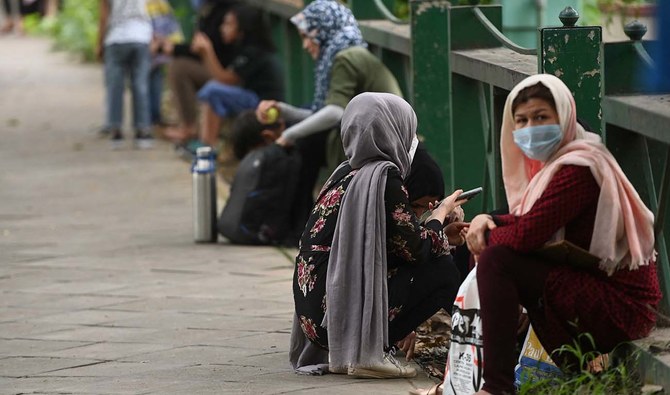
Afghan people wait outside the Australian embassy in New Delhi on August 19, 2021 after submitting documents to apply for a visa. (AFP/File)
Short Url
Updated 15 May 2024
Follow

India grants citizenship to first batch of immigrants from Pakistan, Afghanistan, Bangladesh

  • Citizenship Amendment Act grants citizenship to Hindus, Parsis, Sikhs, Buddhists, Jains and Christians who fled to India 
  • Controversial citizenship law has been criticized by rights activists as being discriminatory toward country’s Muslims 

NEW DELHI: India granted citizenship on Wednesday to a first batch of 14 people under a controversial law that has been criticized for discriminating against Muslims, midway through general elections in which religious divisions have taken center stage.
The Citizenship Amendment Act (CAA) grants citizenship to Hindus, Parsis, Sikhs, Buddhists, Jains, and Christians who fled to India from Muslim-majority Afghanistan, Bangladesh and Pakistan before Dec. 31, 2014 because of religious persecution.
Enacted in 2019, the law was not immediately implemented due to strong protests and sectarian violence in New Delhi and other places that resulted in the death of scores of people.
India implemented the act in March, weeks before the ongoing elections in which Prime Minister Narendra Modi and his Hindu nationalist Bharatiya Janata Party (BJP) are seeking a rare third consecutive term. Both deny CAA is anti-Muslim.
Four phases of the seven-phase election have concluded and votes will be counted on June 4.
On Wednesday, the recipients were administered the oath of allegiance and granted citizenship after their documents were verified, the home ministry said in a statement, without elaborating on their identities.
Hindu majority India has the world’s third-largest Muslim population with 200 million people. Rights and opposition groups have criticized Modi’s government and BJP saying they target the minority community and systematically discriminate against them to further the party’s core, Hindu revivalist ideology.
Modi and BJP deny the accusation and say they work for the welfare of all communities.
They have also said that the citizenship law only makes it easy for non-Muslim refugees to get a dignified life and is meant to grant citizenship, not take it away from anyone. Muslim refugees, they said, can apply under regular rules governing citizenship.
“This is like being reborn,” Harish Kumar, a Hindu refugee from Pakistan living in Delhi for over a decade, told news agency ANI after getting his citizenship on Wednesday. “If a person doesn’t have rights then what is the point, (now) we can go forward in education, jobs.”
India began voting on April 19 in the seven-phase election for which Modi launched his campaign by showcasing his economic record, governance and popularity. But he changed tack after the first phase to accuse the main opposition Congress party of being pro-Muslim and the issue has gained prominence since.
Analysts say this is likely aimed at firing up BJP’s Hindu nationalist base after a low turnout in the first phase sparked doubts that BJP and its allies could win the landslide that the party sought.


Pakistan explores underground gas storage to manage supply swings, price shocks

Updated 7 sec ago
Follow

Pakistan explores underground gas storage to manage supply swings, price shocks

  • Pakistan seeks consultants to assess feasibility of underground gas storage
  • Industry officials say storage could ease shortages, cut cargo cancelations

KARACHI: Pakistan is exploring the construction of underground gas storage facilities, a long-discussed energy infrastructure project that officials and industry experts say could help manage supply shortages and cushion the country against global price volatility during periods of geopolitical disruption.

The initiative has resurfaced after a state-run gas infrastructure company this month issued a tender seeking consultants to assess the market need and technical feasibility of underground gas storage, potentially marking the first concrete step toward a project that could cost more than $1 billion.

Pakistan’s energy ministry, through Inter State Gas Systems (Private) Limited (ISGS), posted the tender on the Public Procurement Regulatory Authority (PPRA) portal, inviting local and international firms to conduct a pre-feasibility study for the project.

Asif Inam, chairman of Sui Southern Gas Company (SSGC), welcomed the move, confirming that the idea had been envisioned decades earlier but never implemented.

“If they make it, it will be very helpful because we are forced to close the field in summer and sell LNG cargoes on the spot,” Inam, whose state-owned utility is responsible for gas transmission in Sindh and Balochistan, told Arab News.

He said the ability to store up to one billion cubic feet of gas would ease operational pressures during periods of excess supply and reduce the need to offload imported cargoes.

According to official data, Pakistan imports about $5 billion worth of liquefied natural gas (LNG) and petroleum gas annually, accounting for roughly 30 percent of the country’s total energy imports.

The energy ministry’s spokesperson, Zafar Abbas, did not answer queries about why Pakistan wanted to carry out the project. However, building such storage facilities can help the country avoid costly cargo cancelations.

In November last year, the country scrapped 21 LNG shipments under a long-term contract with Italy’s Eni after excess imports flooded its gas network, while also negotiating the deferment or resale of cargoes with Qatar.

“These storages can also be helpful in war-like situations,” the SSGC official said. “At least we should have storage for a month.”

The tender issued this month by ISGS seeks consultants to assess market demand, identify potential underground storage sites and evaluate their technical and commercial viability.

Inam said if these facilities were built at Port Qasim, then the LNG could be stored right after its arrival.

Energy analyst Muhammad Saad Ali said Pakistan had previously missed opportunities to build strategic reserves during the COVID-19 pandemic when global prices were low due to the absence of storage infrastructure.

“At that time, we did not have storage facilities and lost that opportunity,” said Ali, head of research at Karachi-based Lucky Investments Ltd.

Asked about the expected project cost, he said it could go up to $1 billion.

Ali noted that Pakistan currently has surplus gas, though he said it was a wise move since such storage facilities would provide insurance against future shocks.

“Right now, we have a surplus, so we don’t really need it that much,” he said. “But obviously, in the future, if there is a geopolitical crisis, wars, there can be an energy price shock in all these things.”