

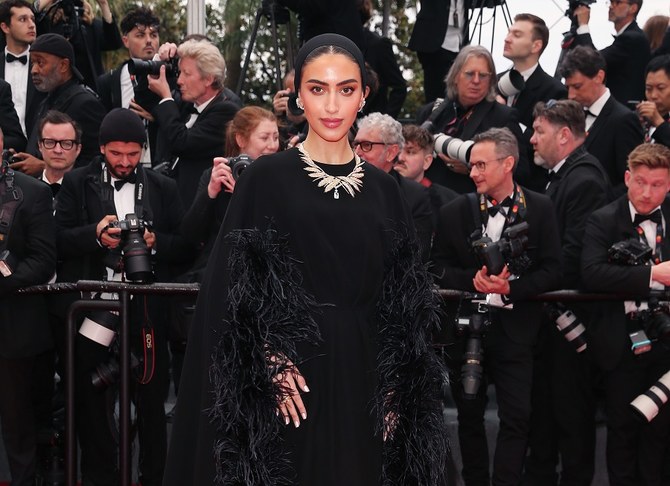
Arab stars, designers steal the spotlight in Cannes 

Saudi influencer Yara Alnamlah posed on the red carpet. (Getty Images)
Short Url
Updated 15 May 2024
Follow

Arab stars, designers steal the spotlight in Cannes 

DUBAI: As the curtain rose on the 77th edition of the Cannes Film Festival, Arab stars and designers once again stole the spotlight in the glamorous French Riviera setting.

The festival kicked off with the premiere of the film “The Second Act,” but not before Saudi influencer Yara Alnamlah hit the red carpet in a look by designer Rami Kadi. She sported jewels by Chaumet, including the Wheat necklace from Le Jardin de Chaumet High Jewellery collection.


Saudi influencer Yara Alnamlah posed on the red carpet. (Getty Images)

Shanina Shaik, the Australian-born model of Saudi, Pakistani, and Lithuanian descent, graced the opening night red carpet in a head-turning scarlet dress by Lebanese couturier Zuhair Murad. Her strapless gown, featuring a sweetheart neckline and a dramatic overskirt, was from the designer’s ready-to-wear Fall 2024 collection.

Shanina Shaik, the Australian-born model of Saudi, Pakistani, and Lithuanian descent, graced the opening night red carpet in a head-turning scarlet dress by Lebanese couturier Zuhair Murad. Her strapless gown, featuring a sweetheart neckline and a dramatic overskirt, was from the designer’s ready-to-wear Fall 2024 collection.

Shaik was not the only star on the red carpet championing an Arab designer. 

US German model and TV host Heidi Klum stunned on the red carpet in a bold red gown by Lebanese designer Saiid Kobeisy. The dress gathered at the waist, revealing one leg, with silk fabric draping around her. 

Meanwhile, US actress Jane Fonda donned a black jumpsuit adorned with crystal embroidery from Lebanese designer Elie Saab’s Fall 2019 collection. Completing her look, she opted for a leopard-print overcoat.

“The Second Act” is a French comedy starring Lea Seydoux, Vincent Lindon, Louis Garrel and Raphaël Quenard. They play squabbling actors filming a movie directed by artificial intelligence.

The festival’s first lengthy standing ovation, though, went to Streep, who was awarded an honorary Palme d’Or during Tuesday’s opening ceremony. After Juliette Binoche introduced her, Streep shook her head, fanned herself and danced while the crowd thunderously cheered.

“I’m just so grateful that you haven’t gotten sick of my face and you haven’t gotten off of the train,” said Streep, who soon thereafter declared Cannes officially open with Binoche.


Sheikha Al-Mayassa talks cultural patronage at Art Basel Qatar Conversations panel

Updated 04 February 2026
Follow

Sheikha Al-Mayassa talks cultural patronage at Art Basel Qatar Conversations panel

DOHA: Cultural leaders at the inaugural edition of Art Basel Qatar in Doha have discussed how patronage is reshaping art ecosystems, with Qatar’s own long-term cultural vision at the center.

The opening panel, “Leaders of Change: How is patronage shaping new art ecosystems?” brought together Sheikha Al-Mayassa bint Hamad bin Khalifa Al-Thani, chair of Qatar Museums, and Maja Hoffmann, founder and president of the Luma Foundation, in a discussion moderated by Hans Ulrich Obrist, artistic director of the Serpentine Galleries in London. The talk formed part of the Art Basel Conversations x Qatar Creates Talks program, coinciding with the debut of Art Basel Qatar which runs in Doha until Feb. 8.

Sheikha Al-Thani framed Qatar’s cultural project as a strategic, long-term endeavor anchored in national development. “Qatar has a national vision called 2030 where culture was one of the main pillars for socioeconomic development and human development,” she said. “We have always invested in culture as a means of human development.”

That vision, she explained, underpins the decision to welcome a major international fair like Art Basel to Doha after turning away many previous proposals.

“For the longest time, I can’t tell you how many art fairs came to us wanting to be here, and we never felt it was the right time,” she said. “However, this is an important year for us and we felt, with the surplus of talent and the growing gallery scene we had here, that it was time to bring industry to talent, because that’s how we will spur the economic diversification from hydrocarbon to a knowledge-based society.”

She was also keen to stress that Art Basel Qatar was not conceived as a conventional marketplace.

 “This is not your typical art fair … It’s a humane art fair where engagement is more important than transaction, discourse more important than division, and curiosity more important than conviction,” she added.

That ethos extends to the fair’s artistic leadership. Al-Thani described how the decision to have an artist — Wael Shawky — serve as artistic director emerged collaboratively with Art Basel’s team.

“He’s a global artist who’s now become a very local artist, very invested in our local art scene. And really, I think that’s the beauty of partnerships … There is a safe space for us to critique each other, support each other, and really brainstorm all the possibilities … and then come to a consensus of what would make sense for us,” she said.

Collecting art, she added, has long been embedded in Qatari society: “My grandmother is almost 100 years old. She was collecting in the 60s when Qatar was a very poor country. It’s in our DNA … always with this notion of investing in knowledge and human development.”

Today, that impulse translates into comprehensive, multi-disciplinary collections: “We are both collecting historical objects, contemporary objects, modern objects, architecture, archival material, anything that we feel is relevant to us and the evolution of this nation towards a knowledge-based economy.”

Looking ahead, Al-Thani outlined a new cultural triangle in Doha — the National Museum of Qatar, the Museum of Islamic Art and the forthcoming Art Mill Museum — as engines for both economic diversification and intellectual life.

 “That ecosystem will enhance the economic growth and diversification, but also the knowledge that’s available, because the diversity in the collections between these three institutions will no doubt inspire young people, amateurs, entrepreneurs to think outside the box and inform their next business,” she said.

The panel closed with a focus on the future of large-scale exhibitions with Rubaiya, Qatar’s new quadrennial, timed to coincide with the anniversary of the 2022 World Cup.

“Every four years in memory of the opening of the World Cup, we will open the quadrennial. This year, the theme is ‘Unruly Waters.’ At the center of the theme is Qatar’s trading route to the Silk Road,” explained Al-Thani.

“It’s important for us to trace our past and claim it and share it to the rest of the world, but also show the connectivity that Qatar had historically and the important role it has been playing in diplomacy.”