

Pakistan, China vow to accelerate key infrastructure projects amid discussions on next CPEC phase

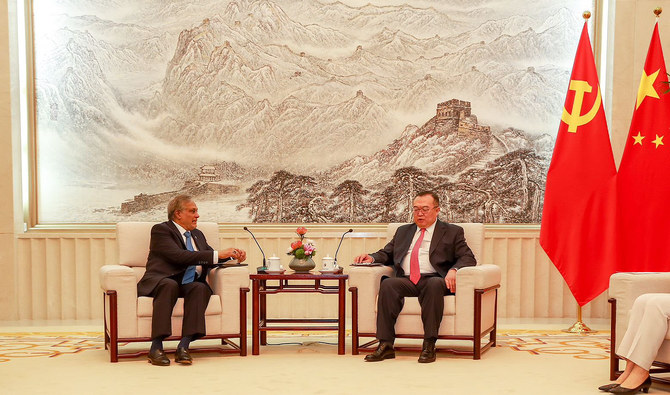
Pakistan's Deputy Prime Minister and Foreign Minister, Ishaq Dar (right), meets Minister for the International Department of the Communist Party of China (IDCPC), Liu Jianchao, in Beijing, China on May 14, 2024. (Foreign Office)
Short Url
Updated 14 May 2024
Follow

Pakistan, China vow to accelerate key infrastructure projects amid discussions on next CPEC phase

  • The two sides discussed the issue during Ishaq Dar’s meeting with a senior Chinese minister in Beijing
  • Both countries reaffirmed support to each other on issues of core concerns to their governments, people

ISLAMABAD: Pakistan and China have agreed to expedite work on key infrastructure development schemes as the two countries strive to proceed to the next phase of the multibillion-dollar economic corridor project launched in April 2015, the foreign office announced in a release issued in Islamabad on Tuesday.

Last week, Pakistan sent Federal Minister for Planning and Development Ahsan Iqbal to conduct a series of meetings in Beijing to set the tone for the second phase of the China-Pakistan Economic Corridor (CPEC).

Currently, the country’s newly appointed Deputy Prime Minister, Ishaq Dar, is visiting China, where he met with Liu Jianchao, Minister for the International Department of the Communist Party of China (IDCPC), to discuss various dimensions of CPEC.

“The two leaders reaffirmed the importance of the All-Weather Strategic Cooperative Partnership between Pakistan and China and to further reinforce mutually beneficial collaboration,” the foreign office said. “They also expressed joint determination to accelerate progress on all CPEC projects including ML-I [Main Line 1] upgradation, Gwadar Port and KKH [Karakoram Highway] realignment.”

The three projects are central to CPEC, with ML-I upgradation, a major railway project, involving the dualization of the existing railway track from Karachi to Peshawar. The development of Gwadar Port and KKH realignment are also vital to enhance trade and connectivity within and beyond the region.

Dar reaffirmed Pakistan’s support to China on its core issues. The Chinese minister also said that Beijing would always support Pakistan’s sovereignty, territorial integrity, and socioeconomic development.

The Pakistani deputy prime minister expressed over the killings of Chinese nationals in a suicide attack in Shangla earlier this year. He noted the Pakistani authorities had a firm resolve to counter extremist violence in all its forms and manifestations and bring perpetrators of the Shangla attack to justice.

Dar also invited the Chinese minister to visit Pakistan to co-chair the next meeting of the CPEC Joint Consultative Mechanism of Political Parties this year.


Pakistan says repaid over $13.06 billion domestic debt early in last 14 months

Updated 29 January 2026
Follow

Pakistan says repaid over $13.06 billion domestic debt early in last 14 months

  • Finance adviser says repayment shows “decisive shift” toward fiscal discipline, responsible economic management
  • Says Pakistan’s total public debt has declined from over $286.6 billion in June 2025 to $284.7 billion in November 2025

KARACHI: Pakistan has repaid Rs3,650 billion [$13.06 billion] in domestic debt before time during the last 14 months, Adviser to the Finance Minister Khurram Schehzad said on Thursday, adding that the achievement reflected a shift in the country’s approach toward fiscal discipline. 

Schehzad said Pakistan has been repaying its debt before maturity, owed to the market as well as the State Bank of Pakistan (SBP), since December 2024. He said the government had repaid the central bank Rs300 billion [$1.08 billion] in its latest repayment on Thursday. 

“This landmark achievement reflects a decisive shift toward fiscal discipline, credibility, and responsible economic management,” Schehzad wrote on social media platform X. 

Giving a breakdown of what he said was Pakistan’s “early debt retirement journey,” the finance official said Pakistan retired Rs1,000 billion [$3.576 billion] in December 2024, Rs500 billion [$1.78 billion] in June 2025, Rs1,160 billion [$4.150 billion] in August 2025, Rs200 billion [$715 million] in October 2025, Rs494 billion [$1.76 billion] in December 2025 and $1.08 billion in January 2026. 

He said with the latest debt repaid today, the July to January period of fiscal year 2026 alone recorded Rs2,150 billion [$7.69 billion] in early retirement, which was 44 percent higher than the debt retired in FY25.

He said of the total early repayments, the government has repaid 65 percent of the central bank’s debt, 30 percent of the treasury bills debt and five percent of the Pakistan Investment Bonds (PIBs) debt. 

The official said Pakistan’s total public debt has declined from over Rs 80.5 trillion [$286.6 billion] in June 2025 to Rs80 trillion [$284.7 billion] in November 2025. 

“Crucially, Pakistan’s debt-to-GDP ratio, around 74 percent in FY22, has declined to around 70 percent, reflecting a broader strengthening of fiscal fundamentals alongside disciplined debt management,” Schehzad wrote. 

Pakistan’s government has said the country’s fragile economy is on an upward trajectory. The South Asian country has been trying to navigate a tricky path to economic recovery under a $7 billion loan from the International Monetary Fund.