

In blow to ruling coalition, Pakistan’s electoral watchdog suspends 77 lawmakers elected on reserved seats

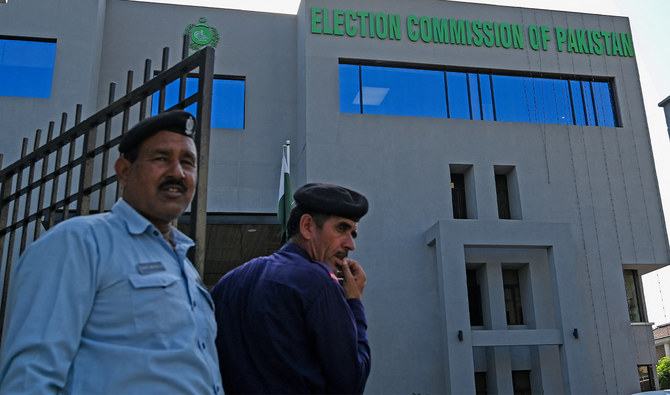
Security personnel stand guard at the headquarters of Election Commission of Pakistan in Islamabad on September 21, 2023. (AFP/File)
Short Url
Updated 14 May 2024
Follow

In blow to ruling coalition, Pakistan’s electoral watchdog suspends 77 lawmakers elected on reserved seats

  • Ruling follows top court overruling earlier verdict that party aligned with ex-PM Khan backed candidates not eligible for reserved seats 
  • Suspension of lawmakers means ruling coalition has lost two-thirds majority in National Assembly, which is required to amend constitution 

Pakistan’s election regulator has suspended 77 lawmakers elected on reserved seats, dealing a blow to the fragile ruling coalition led by Prime Minister Shehbaz Sharif which has lost the third-thirds parliamentary majority needed to make constitutional amendments. 

The Election Commission of Pakistan’s ruling comes a week after the Supreme Court overruled a verdict by the Peshawar High Court (PHC) that a party aligned with candidates backed by former premier Imran Khan was not eligible for reserved seats in the legislature. 

Khan’s Pakistan Tehreek-e-Insaf (PTI) party couldn’t contest the Feb. 8 elections under its traditional electoral symbol, a cricket bat, which it was denied on technical grounds, and subsequently struck an alliance with another party, the Sunni Ittehad Council (SIC), in a bid to secure reserved seats for women and minorities in parliament. Under Pakistan’s election rules, political parties are allotted reserved seats in proportion to the number of parliamentary seats they win in the election. This completes the National Assembly’s total strength of 336 seats. 

The Election Commission had ruled in March that the SIC was not eligible for reserved seats, a decision the alliance had appealed in the Peshawar High Court, which rejected the petition. The SIC then approached the Supreme Court to appeal the high court’s decision, which last week suspended the PHC’s ruling. 

“Pursuant to the order on 6th May, 2024 passed by the honorable Supreme Court of Pakistan, the notifications of the following returned candidates against under mentioned categories of reserved seats are hereby suspended till further orders,” the ECP’s notification read.

With the ECP’s notification, the strength in the National Assembly of PM Sharif’s ruling Pakistan Muslim League-Nawaz (PML-N) has reduced from 121 to 107 while that of its main coalition partner Pakistan Peoples Party (PPP) is down from 72 to 67. 

This means the ruling coalition has lost its two-thirds majority in the National Assembly, with its numerical strength decreasing to 209 from 228. In the 336-member National Assembly, the figure to attain two-thirds majority is 224, without which the government cannot enact reforms or amend laws.

Sharif formed a weak coalition with other parties after February general elections produced a hung parliament. The PML-N’s 79 and the PPP’s 54 seats together made a simple majority in parliament to form a government and they also roped in smaller parties in the coalition.

Candidates backed by Khan won the most seats, 93, but did not have the numbers to form a government. Khan and his party have rejected the results of the elections, alleging widespread rigging.

According to the breakdown of the 77 suspended lawmakers, 44 belong to Sharif’s PML-N party, 15 to the Pakistan Peoples Party (PPP), 13 to the Jamiat Ulama-e-Islam-Fazal (JUI-F), and one each to the Muttahida Qaumi Movement-Pakistan (MQM-P), Istehkam-e-Pakistan Party (IPP), Awami National Party (ANP), Pakistan Muslim League Quaid (PML-Q) and Pakistan Tehreek-e-Insaf Parliamentarians (PTI-P).

The 77 suspended lawmakers include 22 legislators elected on reserved seats in the National Assembly, 25 in the Khyber Pakhtunkhwa (KP) Assembly, 27 in the Punjab Assembly, and three in the Sindh Assembly. 


World Bank approves $400 million to expand water, sanitation services in Pakistan’s Punjab

Updated 4 sec ago
Follow

World Bank approves $400 million to expand water, sanitation services in Pakistan’s Punjab

  • Project aims to improve access for 4.5 million people and curb waterborne diseases
  • Program to prioritize women’s participation and climate-resilient urban infrastructure

ISLAMABAD: The World Bank this week approved $400 million for a new project to expand access to safe water, sanitation and hygiene services for around 4.5 million people in Pakistan’s most populous Punjab province, aiming to curb waterborne diseases and reduce long-term public health costs.

The project, known as the Punjab Inclusive Cities Program (PICP), is the second phase of the World Bank-supported Pakistan Urban Water, Sanitation and Hygiene Services Multiphase Programmatic Approach. It will focus on rehabilitating water supply networks, sewerage systems and wastewater treatment plants, while expanding stormwater drainage infrastructure across 16 secondary cities in Punjab.

Punjab faces persistent challenges in providing safe drinking water and adequate sanitation, with many urban households relying on contaminated sources. Weak infrastructure and limited hygiene services contribute to high rates of waterborne diseases such as diarrhea, typhoid and hepatitis, which disproportionately affect children and low-income communities.

“Reducing child stunting is essential for Pakistan’s future. Through the Punjab Inclusive Cities Program, we are investing in safe water, sanitation, and hygiene services to break the cycle of malnutrition and disease that holds back so many children from reaching their full potential,” the World Bank quoted its Country Director for Pakistan, Bolormaa Amgaabazar, as saying in a statement.

“In collaboration with the Punjab Government, the program represents a significant step forward in improving urban infrastructure and strengthening local institutions, thereby laying the foundation for healthier communities and a more prosperous Pakistan.”

Child stunting, a form of chronic malnutrition that leaves children too short for their age, is often linked to repeated infections, poor sanitation and unsafe drinking water, and remains a major public health concern in Pakistan.

Beyond water and sanitation, the project will also support solid waste management systems to improve sanitary waste disposal, extending services to an additional two million people in Punjab’s urban areas. The program will strengthen the capacity of local governments, including efforts to improve revenue generation and long-term service sustainability.

“The program complements infrastructure investments with capacity building and revenue generation, helping to ensure that service delivery is well sustained,” the statement quoted Amena Raja, Senior Urban Specialist at the World Bank, as saying.

“It will also help Punjab’s cities better withstand floods and droughts, ensuring urban development is both environmentally responsible and resilient to climate change.”

The program includes a gender-focused component, prioritizing the hiring of women in decision-making roles, establishing gender-compliant service desks and supporting skills development. It also aims to mobilize private capital to support water and sanitation services in Punjab’s secondary cities.

Pakistan has been a member of the World Bank since 1950 and has received more than $48 billion in assistance since. The Bank’s current portfolio in the country comprises 54 projects with total commitments of $15.7 billion, while its private-sector arm, the International Finance Corporation, has invested about $13 billion since 1956.

Earlier this year, Pakistan and the World Bank signed a first-of-its-kind agreement for a plan to focus $20 billion in lending to the cash-strapped nation over the coming decade on development issues like the impact of climate change as well as boosting private-sector growth.