

US doesn’t believe ‘genocide’ occurring in Gaza—White House

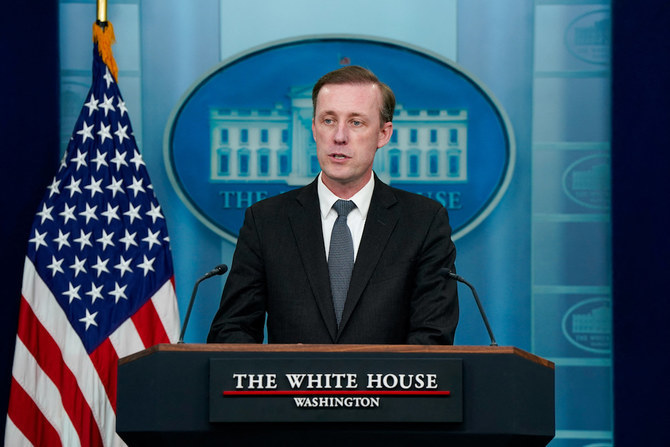
White House National Security Advisor Jake Sullivan speaks during a press briefing at the White House in Washington, U.S., on May 13, 2024. (REUTERS)
Short Url
Updated 14 May 2024
Follow

US doesn’t believe ‘genocide’ occurring in Gaza—White House

  • White House National Security Adviser Jake Sullivan insists responsibility for peace lies with Hamas
  • Comments come as ceasefire talks stall and Israel continues striking the southern city of Rafah

WASHINGTON DC: The United States does not believe that genocide is occurring in Gaza but Israel must do more to protect Palestinian civilians, President Joe Biden’s top national security official said Monday.

As ceasefire talks stall and Israel continued striking the southern city of Rafah, White House National Security Adviser Jake Sullivan insisted that the responsibility for peace lay with militant group Hamas.

“We believe Israel can and must do more to ensure the protection and wellbeing of innocent civilians. We do not believe what is happening in Gaza is a genocide,” Sullivan told a briefing.

The US was “using the internationally accepted term for genocide, which includes a focus on intent” to reach this assessment, Sullivan added.

Biden wanted to see Hamas defeated but realized that Palestinian civilians were in “hell,” Sullivan said.

Sullivan said he was coming to the White House podium to “take a step back” and set out the Biden administration’s position on the conflict, amid criticism from both ends of the US political spectrum.

Biden has come under fire from Republicans for halting some weapons shipments to press his demands that Israel hold off a Rafah offensive, while there have been protests at US universities against his support for Israel.

The US president believed any Rafah operation “has got to be connected to a strategic endgame that also answered the question, ‘what comes next?’” Sullivan added.

This would avoid Israel “getting mired in a counterinsurgency campaign that never ends, and ultimately saps Israel’s strength and vitality.”


UN says 3.3 million war-displaced Sudanese return home

Updated 5 sec ago
Follow

UN says 3.3 million war-displaced Sudanese return home

  • International Organization for Migration reports that three-quarters of those returning came from internal displacement sites
  • At its peak, the war has displaced around 14 million people both internally and across borders
KHARTOUM: More than three million Sudanese people displaced by nearly three years of war have returned home, the United Nations migration agency said on Monday, even as heavy fighting continues to tear through parts of the country.
Since April 2023, Sudan has been locked in a devastating war pitting the regular army against the paramilitary Rapid Support Forces (RSF).
The conflict has killed tens of thousands of people and created what the UN describes as the world’s largest displacement and hunger crisis. At its peak, the war had displaced around 14 million people both internally and across borders.
In a report released on Monday, the International Organization for Migration (IOM) said an estimated 3.3 million displaced Sudanese had made their way back home by November of last year.
The rise in returns follows a sweeping offensive launched by the Sudanese army in late 2024 to retake central regions seized earlier in the conflict by the RSF.
The campaign culminated in the recapture of Khartoum in March 2025, prompting many displaced families to try to go back.
According to the IOM, more than three-quarters of those returning came from internal displacement sites, while 17 percent traveled back from abroad.
Khartoum saw the largest number of returns — around 1.4 million people — followed by the central state of Al-Jazira, where roughly 1.1 million have gone back.
Earlier this month, the army-backed government announced plans to return to the capital after nearly three years of operating from the Red Sea city of Port Sudan in the country’s east.
Reconstruction work in Khartoum has been underway since the army retook the city.
Although Khartoum and several army-held cities in central and eastern Sudan have seen a relative lull in fighting, the RSF has continued to launch occasional drone strikes, particularly targeting infrastructure.
Elsewhere, violence remains intense.
In the country’s south, RSF forces have pushed deeper into the Kordofan region after seizing the army’s final stronghold in Darfur last October.
Reports of mass killings, rape, abductions and looting emerged after El-Fasher’s paramilitary takeover, and the International Criminal Court launched a formal investigation into “war crimes” by both sides.